
From Product Documentation to Search Traffic: How I Used AI to Turn Product Information into a Continuously Growing SEO Asset

When I first started running a SaaS product, I made a very typical mistake: I put all my marketing effort into the product pages, feature descriptions, and paid ads. The result? Apart from a few core product pages, the rest of the site was virtually empty. When search engine crawlers arrived, they found nothing to index, so naturally there was no traffic to give. The detailed product specifications, technical documentation, and use‑case scenarios were all tucked away in corners of the website, visible only to users who came in voluntarily.
I realized the problem wasn’t that the product information was insufficient, but that it hadn’t been ‘translated’ into a form that search engines and prospective users could discover on their own. Users don’t search for ‘how to configure step three of my product name’, but they might search for ‘how to automate handling customer feedback’, ‘how a SaaS tool integrates with CRM’, or ‘methods to improve team collaboration efficiency’. My product features happen to answer those questions, yet at the time I had no content to answer them.
Manual Conversion Attempts and Bottlenecks
Initially, I tried to do this ‘translation’ manually. I asked the marketing team to write related blog posts based on product feature points. For example, we have a ‘auto‑generate report’ feature, so we wrote an article titled ‘How to Reduce the Time Cost of Manual Reporting’. The logic was sound.
But soon a bottleneck emerged. The speed was too slow. From a feature point to identifying user search intent, researching keywords, writing an SEO‑structured article, optimizing meta data, and publishing, the whole process took on average two days per person. Our product has hundreds of feature points and use cases. At this pace, building a content library was a distant dream, let alone keeping up with changing search trends.
Another more subtle issue was the single‑sided perspective of the content. When humans write, authors unconsciously start from ‘what our product can do’, causing the article to become a disguised feature manual rather than a guide that truly solves the user’s independent problem. This affects the content’s appeal and ranking potential.
What I needed was a system that could continuously and in bulk convert the intrinsic information and value of the product into a content format that the external search world could understand and favor. This system also had to run on its own, because my team’s effort must stay focused on product development.
Introducing Automation: Not Just Content Generation, but a Traffic Pipeline
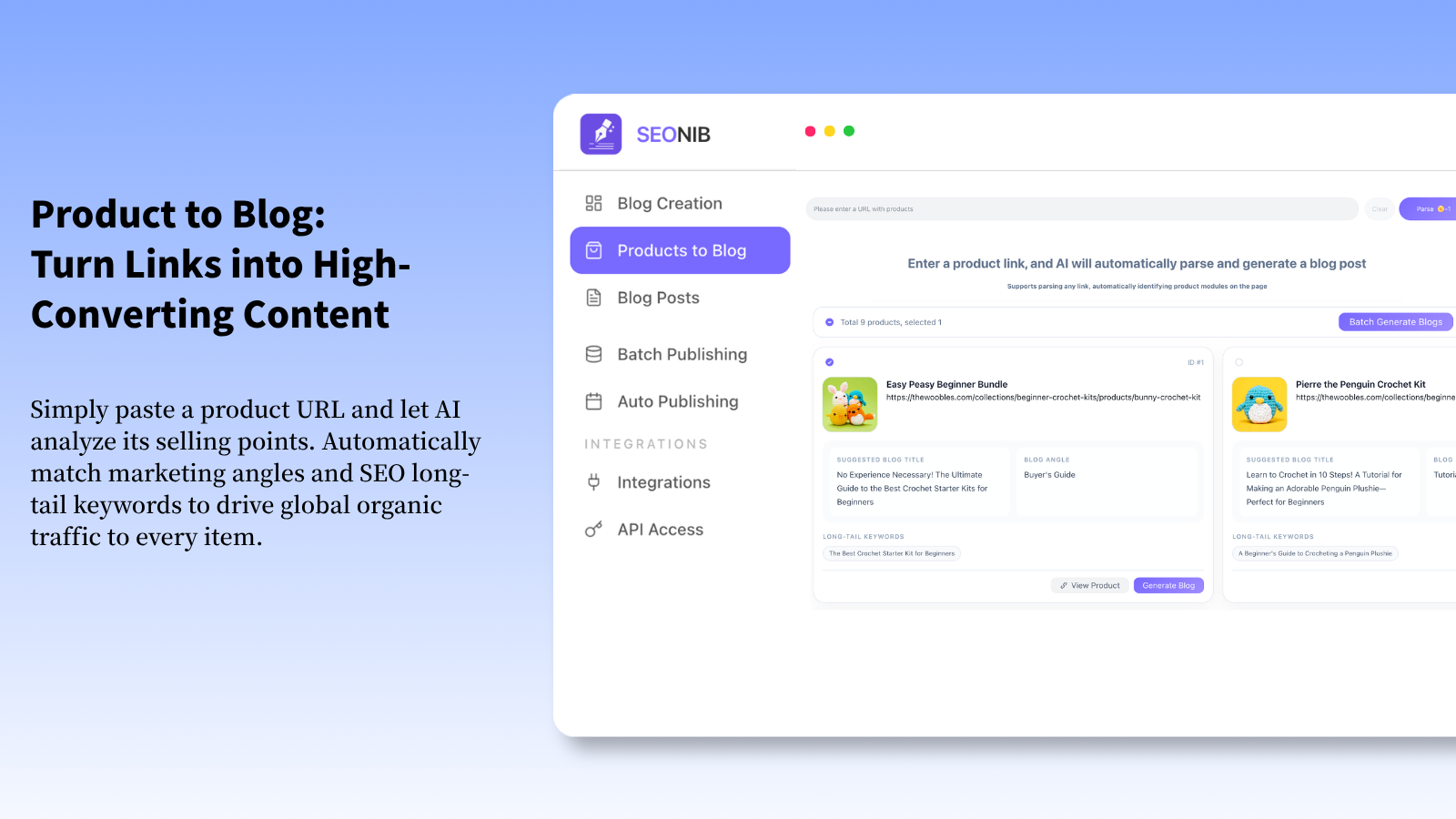
My turning point was to stop treating this as ‘content creation’ and instead see it as ‘information conversion and distribution’. The core input is my product information (features, advantages, use cases, technical details), and the core output is index pages that can attract traffic in search engines. In between, an efficient conversion engine is needed.
That’s when I discovered and started using SEONIB. What attracted me was straightforward: it promised not a better writing tool, but a complete SEO automation system. What I needed was a ‘system’.
My first setup was brutally simple. I compiled the descriptions of core product features, user case documents, and even common questions from customer support chats into a structured information source. I fed this information into SEONIB and let it, based on this data and real‑time search trends and question data (such as People Also Ask), automatically generate article topics.
This process immediately delivered two advantages I hadn’t realized before:
- Search‑driven topics. The system‑generated topics are no longer ‘write an article based on feature X’, but rather ‘users are searching for question Y, and our feature X can solve it’. The article’s starting point shifts from the product to the user’s search intent, which is the essence of SEO.
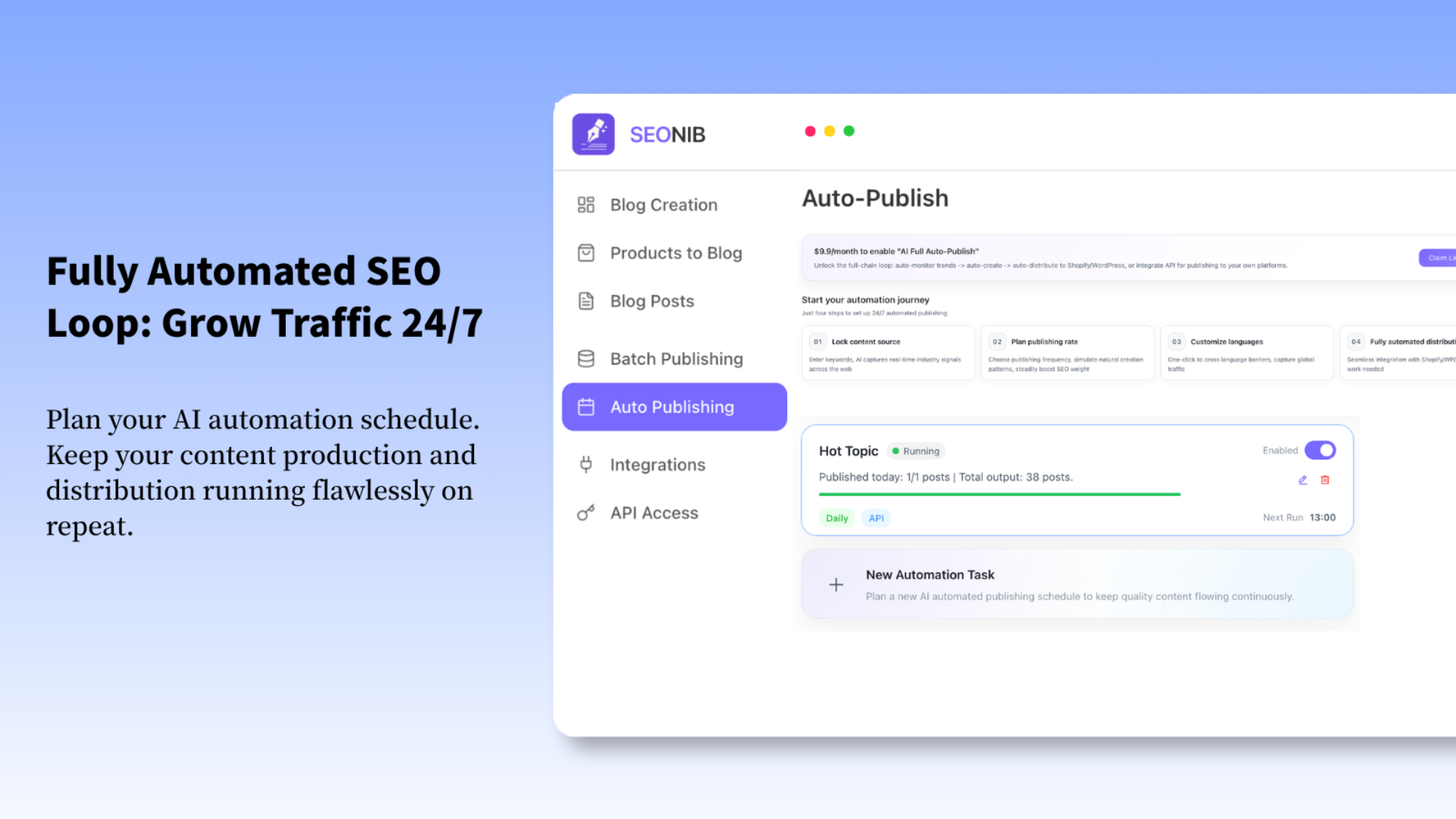
- Scalability feasibility. I can import dozens of information points at once, set a publishing frequency (e.g., one per day), and the system automatically carries out the full workflow from topic discovery to content generation to publishing. The growth rate of the content library changes from ‘linear’ to ‘exponential’.
Observations from ‘Publishing’ to ‘Index Growth’
After the articles were automatically published to the blog, I didn’t see an immediate surge of traffic. This is another area where expectations need to be adjusted. SEO traffic is not instant traffic; it’s the interest on an ‘index asset’.
I began focusing on more fundamental metrics: the growth curve of indexed page count. My site previously had maybe 20 pages indexed by Google (mostly core website pages). Within 30 days of launching this automation process, that number steadily climbed to over 200. This means search engines have built a richer content map of my site.
The initial traffic on these new pages may be modest, but they are ‘seeds’. Some pages happen to match long‑tail, specific search queries and receive early small traffic. More importantly, internal linking among these pages creates a content network, boosting the overall authority of the site and beginning to funnel related traffic to the core product pages.
SEONIB’s role in this process is a continuously operating conversion and distribution engine. It ensures that my product information—the ‘raw material’—is constantly processed into ‘finished products’ suitable for the search ecosystem and released on schedule. I no longer need to think each day about ‘what topic to write today’; the system, based on trends and my information pool, already handles that.
The Essence of Conversion Rate: Information Matching, Not Content Quantity
After some time, I started analyzing the conversions driven by this automated content. One key insight emerged: not all generated articles have high conversion rates. Some articles attract decent traffic but have low conversion; others have modest traffic yet generate high‑quality leads.
I found that the difference lies in the precision of matching content to the user’s search stage.
- Informational / Early Research Stage Content: e.g., ‘SaaS Tool Selection Guide’, ‘Benefits of Automated Marketing’. Such articles may attract large traffic, but readers are in a broad research phase, far from a concrete purchase decision, so direct conversion rates are naturally low. Yet they are crucial—they build brand awareness and capture a pool of potential users.
- Solution / Problem‑Solving Stage Content: e.g., ‘How to Fix Cross‑Platform Data Sync Errors’, ‘Specific Configuration Steps for Scenario XX’. These articles address more specific, urgent user problems. Traffic may be more precise and smaller, but the reader’s need is clear; if our product is the solution, the conversion path is very short.
The content generated by the automation system naturally covers both types. My role became optimizing this mix ratio. I can adjust the emphasis of the information sources, or lightly filter the system‑generated topics, to ensure there is enough ‘top‑of‑funnel’ content to broaden reach, as well as sufficient ‘bottom‑of‑funnel’ solution content to drive direct conversions.
FAQ
Q: Can the quality of automatically generated content match that of manually written content? Does it really rank well?
A: Purely from a literary or deep‑insight perspective, early outputs may not match top‑tier human content. But from an SEO standpoint—answering user queries, providing clear information, and having a structure that search engines understand—it is usually very effective. I’ve observed that for many medium‑to‑long‑tail keywords, automatically generated articles can achieve or even surpass the performance of manually written ones because their structure is standardized and optimized, tightly aligned with search intent. For large‑scale keyword coverage, it is an unparalleled tool.
Q: How much product information do I need to start this process?
A: You can start very small. I began with a detailed description of a core feature and three user cases, and the system could generate the first batch of topics from that. The key is that the information must be specific and detailed. Vague statements like ‘we are great’ won’t produce good content. Concrete details such as ‘we merge data via API in 2 seconds’ are the good raw material.
Q: Could this lead to duplicate or overly similar content?
A: The system has built‑in mechanisms to avoid generating highly duplicate content from the same information source. It combines different search angles and user question variants to create topics. In my experience, as long as your product information source is sufficiently multidimensional (features, scenarios, problems, advantages), the resulting content range will be broad. You can also set up multiple different information source combinations to increase diversity.
Q: After automatic publishing, do I still need to do any manual work?
A: Fully automatic operation is possible. However, I recommend retaining a lightweight manual task: periodically review content performance. See which topics bring good traffic/conversions and which are average. This helps you loop back to optimize your product information input source—identifying which feature points deserve deeper conversion focus and which user pain points to cover. It’s a closed‑loop optimization process.
Q: Is this applicable to e‑commerce products, or only to SaaS?
A: The principle is completely universal. Every e‑commerce product has abundant information: material, craftsmanship, usage scenarios, problems solved, style, pairing, etc.—all excellent ‘information sources’. Transforming them into content such as ‘how to choose a product made of XX material’, ‘styling guide for scenario XX’, or ‘home tool that solves problem XX’ can capture a large amount of informational search traffic beyond shopping queries, directing users to your product.
Share Article