Doing SEO in 2026, I realized I need to learn how to chat with AI
It’s a bit embarrassing to admit. At the end of last year I was telling my team, “AI search is just a hype, it won’t last more than two years.” Yet this spring I was sitting at my computer, watching in horror as a three‑month‑long article I had written was boiled down to three sentences in an AI answer—without even crediting me. That moment was a mixed bag of anger, curiosity, and a little amusement.
I work at a B2B SaaS company, heading the content direction—writing blogs, doing SEO, and trying to get our product to show up in search results. After more than six years, I thought I knew the game well. But 2026 feels like being an experienced player suddenly dropped into a new game—the map is familiar, but the rules have completely changed.
First, the simplest change: traffic no longer comes only from search‑result pages, but is “cited” from AI answers. The word “citation” is subtle; unlike a link, it doesn’t give a click, it merely mentions your existence within someone else’s answer. According to the WinWithSEO audit based on 3,200 queries, AI‑search citations now account for 17% of traffic in the B2B SaaS sector, up from just 4% a year ago. That figure gives me chills because for a small team like ours, once a chunk of the traffic pool is siphoned off through this indirect citation, the cost to recover it is high.
Waking Up to Find My Article “Translated” by AI
The first time I took this seriously was when I searched a product‑related keyword on Perplexity and saw an answer that cited one of our blogs. I was pleased, clicked through, and discovered the citation was to an article I wrote three years ago about API documentation optimization. That piece wasn’t bad, but it hadn’t been updated in three years, and its data were almost obsolete. AI treating it as an authoritative source left me feeling a bit hollow.
After that, I started to think seriously: how can I make my content appear professional in AI answers, rather than being an outdated relic dug up from three years ago?
I did two things. First, I added real author attribution to all my articles—not the anonymous “by staff” style, but my name, title, a Person schema, and a link to my LinkedIn. It may sound trivial, but WinWithSEO’s data are clear: pages with a named author and schema are 2.4 times more likely to be cited by AI than anonymous pages. If the author also has a Wikipedia entry, that multiplier jumps to 4.1. I don’t have a Wikipedia page, but I do have LinkedIn and Twitter, so I added those.
The second thing was to add “citable assertion paragraphs” to my articles. What is an assertion paragraph? It’s a single sentence that conveys a fact with concrete numbers, dates, or comparisons—e.g., “In Q3 2025 our API response time dropped by an average of 12 %.” AI loves to cite such statements. In contrast, boilerplate like “We strive to provide better service” gets ignored. I started to adjust my writing habit: for each paragraph, I ask myself, can this be extracted as a standalone quote? If not, I rewrite it.
The Rhythm of Content Updates Has Changed: Not More, but More Precise
Another headache is the cadence of updates. Traditional SEO logic was about volume—publishing three to five posts per week to capture some traffic. Now AI‑search citation favors “deep coverage” over “broad coverage.” In other words, a single, thorough article with original data is more valuable than ten shallow SEO pieces.
I ran an experiment: we turned a feature‑comparison page from a simple “Feature A vs Feature B” table into a long‑form article with scenario descriptions, real user test data, and a timeline. The result? That article was cited once in Google AI Overviews and twice in ChatGPT answers. Meanwhile, three regular SEO articles I wrote in the same period generated no noticeable traction.
This insight prompted me to reallocate effort. Instead of three posts per week, I shifted to one high‑quality long article plus two “quick‑write” grammatical pieces per week. In 2026, quality‑first is no longer a concept—it’s backed by hard data.
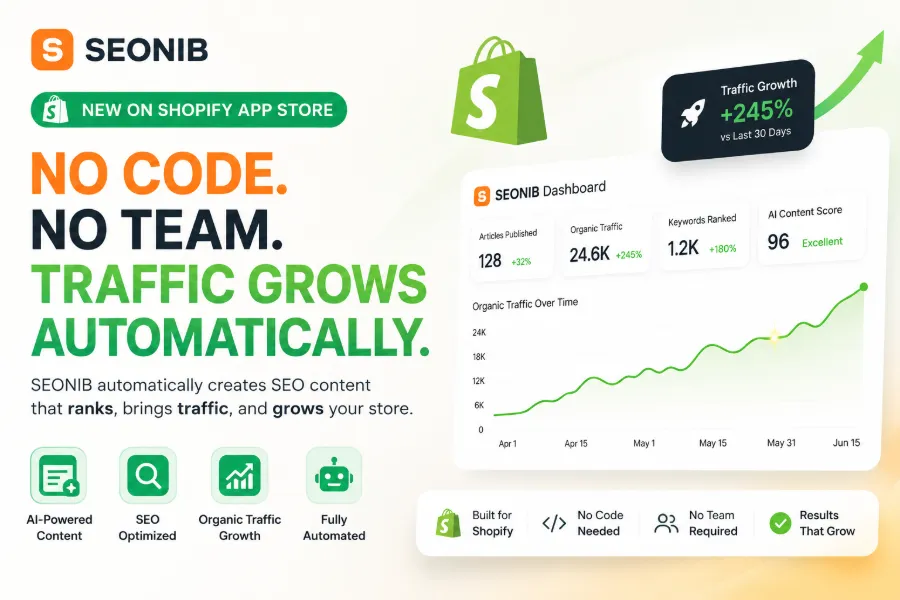
When it comes to content production, I must mention a practical dilemma: one person can’t produce that many deep pieces. That’s why I eventually turned to SEONIB for the “quick‑write” part. Its logic isn’t about spinning content; it generates structured, SEO‑optimized articles directly from keywords, trends, or even product links, then publishes them automatically across platforms. I mainly use it for data‑driven pieces—product changelogs, FAQ expansions, industry round‑ups. Those used to take a lot of my time; now I can allocate my energy to the deep, tonal pieces that need my personal touch.
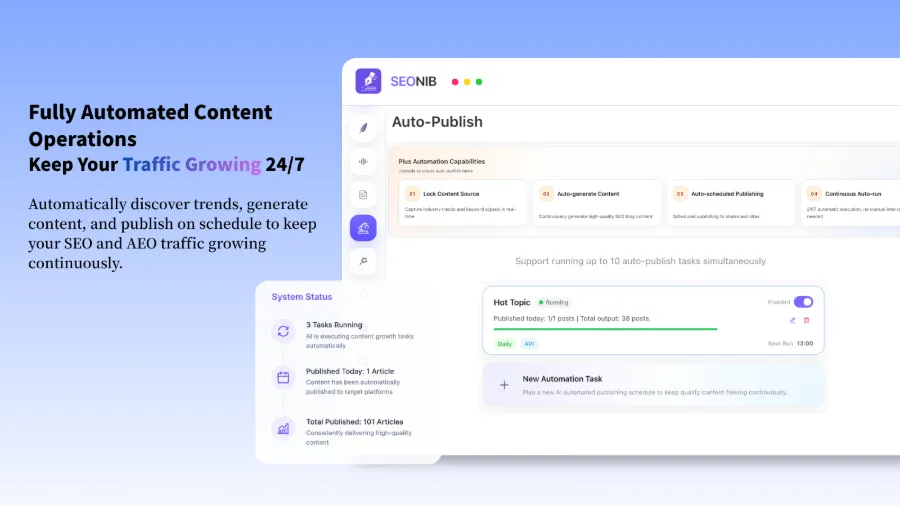
Its trend‑monitoring feature is also handy. It pushes a batch of topics to your queue each day, indicating search‑volume trends. I no longer have to scour forums or Google Trends daily to guess “what to write today.” Once this mechanical, routine work is delegated to a tool, I finally have time to ponder the more abstract question of “how my article appears in AI’s eyes.”
You Don’t Know Who Is Seeing Your Content
Honestly, the most unsettling aspect of the AI‑search era is that you have no idea in what context your content is presented to users. In traditional SEO you can at least see keyword rankings, click‑through rates, and dwell time. AI‑search citations, however, are a black box—you don’t know whether a whole paragraph was quoted or just a single sentence extracted and placed in a completely different context.
I experienced this firsthand. We had an article on “Pricing Strategies for SaaS Products” that included a paragraph stating “Premium pricing strategies may not suit small teams.” When I searched “SaaS pricing advice” on ChatGPT, the AI cited that sentence but placed it within a conclusion discussing “why premium pricing fails.” The context completely distorted our original meaning—we were saying “unsuitable for small teams but suitable for large customers,” yet AI only extracted the “unsuitable for small teams” part.
There’s no way to complain or fix this. The only solution is to make your article more “citation‑resistant”—in other words, each paragraph should stand alone logically. You can’t expect readers or AI to glance at your second paragraph and then refer back to the first. This mindset forced me to write shorter, denser, and more precise articles.
Don’t Put All Your Eggs in Google’s Basket
Another often‑overlooked point is that AI search is diverting users from different channels. ChatGPT gives the highest citation weight to brand content, Perplexity leans more on Reddit and forums, and Google AI Overviews favor large publisher pages. This means you can’t use a single content strategy to satisfy all AI engines.
I started doing something I never did before: spend twenty minutes each week searching our industry keywords on Perplexity and ChatGPT to see if my content was being cited. If I didn’t see any citations for three consecutive weeks, I’d go back and tweak the article’s title or opening paragraph. If it was cited but the context was off, I’d adjust that paragraph’s phrasing. This “manual audit” is rough, but it gives me a sense of control over the black box.
Later I simply performed a quarterly audit: list the top 50 commercial‑intent keywords in my category, then check each of the three AI engines to see who is citing whom. It sounds like a return to the most basic SEO practice, but the reality of 2026 is that algorithms and methodologies change, while manual review, iterative testing, and continuous iteration remain unchanged. The only shift is that the object of inspection moves from “search‑result page rankings” to “citation sources within AI answers.”
One Last Honest Point
If you ask me, “After all these adjustments, has traffic noticeably rebounded?” I’d answer honestly—not really. Our organic search traffic saw a clear dip in the second half of 2025, largely because AI Overviews gave many users answers directly on the results page, bypassing clicks. The changes I made this year have slowed the decline rather than reversed the trend. Ahrefs data shows that AI Overviews reduced the average click‑through rate of the top search result by 34.5 %, a structural industry shift that no single content team can overcome alone.
However, looking at other data, our brand search volume has slightly increased. In other words, while direct content exposure yields fewer clicks, users who see our name in an AI answer then search for our brand themselves. This signal tells me that brand building is more important than content volume in the AI‑search era. If your brand has a presence on several authoritative platforms, AI is more likely to cite you.
This line of thinking is simple: don’t just focus on “how to get AI to cite my content,” also consider “how to make users remember my name within AI’s context.” The former is technology; the latter is branding. Both are required.
Frequently Asked Questions (FAQ)
Q1: Which platforms should I prioritize for content to increase AI‑search citation probability?
The three most worthwhile platforms are Wikipedia (if permissible), Reddit (especially high‑quality sub‑forums), and your own blog (with named authors and structured data). WinWithSEO data show that these three sources account for 64 % of AI citations. Your own blog only contributes 11 %, meaning you also need a presence on authoritative forums and video platforms.
Q2: For a new site doing SEO in 2026, what should be prepared first?
Define author identity. Connect your real name, photo, LinkedIn, and Twitter, and mark them up with Person schema. This can be done in about a week, and its positive impact on AI citation probability lasts a long time. Next, add structured data (e.g., FAQ Schema, HowTo Schema) to your main pages—AI engines love that.
Q3: Do I need to write a separate set of content specifically for AI search?
At present, there’s no rush. Most AI engines cite the same sources as traditional SEO, so you can reuse the same material, just adjust the structure—add assertion paragraphs, reduce vague statements, ensure each paragraph can stand alone. Rewriting is less cost‑effective than revising.
Q4: Will AI search completely replace traditional search engines?
Not in the foreseeable few years. Google processes 14 billion searches per day, while ChatGPT handles only 37.5 million—a 373‑fold difference. Moreover, Google’s own AI Overviews now appear in about 38 % of commercial search queries, indicating that Google is embedding AI capabilities into traditional search rather than replacing it with a new AI‑only model. Think of them as parallel channels, not a replacement.
Share Article