2026 SEO Tool List: Truly Effective Solutions Screened from Practical Experience

If you’re still manually writing SEO articles, publishing them one by one, and then praying they get indexed in 2026, you’re likely falling behind. This isn’t alarmist; it’s the most direct realization from managing multiple content projects over the past two years. The methods of traffic acquisition have changed, search engine algorithms have changed, and even the logic of content production has changed. Yet, many of the “classic recommendations” in tool lists can no longer keep up with these shifts.
This article is not another generic “tool recommendation list.” It stems from real operational scenarios: from publishing 10 articles per day on a single site to batch content operations for multilingual matrices; from keyword research to trend capturing, and deep integration with e-commerce platforms. I will focus on why certain tools remain effective in 2026 while others gradually fade, and the specific problems, trade-offs, and unexpected results you encounter in practical application.
The Evolution of Tools: Migration of Traffic Acquisition Logic
Around the latter half of 2024, I began to notice a phenomenon: the traditional keyword ranking model started showing “fatigue” in certain vertical markets. It wasn’t that rankings dropped, but rather that even with stable rankings, the conversion path for traffic became longer. Users no longer simply search for a keyword, click the first result, and complete a conversion. They might interact directly with AI-generated summaries on the Search Engine Results Page (SERP), or be drawn away by multimodal content (like short video summaries + text links).
This means that relying solely on the single thread of “keyword research → write article → optimize → publish” is becoming less efficient. What you need is:
- Faster Response Speed: The ability to capture real-time trends (not just search trends, but also social topics and news hotspots) and quickly generate matching content.
- Broader Content Coverage: Not a quantitative堆砌 (duījiè - piling up), but covering all related search intents for a topic or need using various content formats (Q&A, tutorials, opinions, data).
- True Automation: Not just scheduled publishing, but end-to-end automation from discovery, generation, optimization, to publishing and monitoring, seamlessly integrated with your existing CMS, e-commerce backend, or collaboration platform.
Many established SEO tools were not designed with this “end-to-end automation” requirement in mind. They are often point solutions: one tool for keywords, one for content optimization, one for publishing. Integration costs are high, data flow is broken, and team collaboration efficiency is low. In 2026, this fragmentation will become the biggest bottleneck for scaled operations.
List Core: Categorization and Practical Reviews
I will categorize the tools, but this classification itself reflects my understanding of the evolution of the SEO workflow. It’s no longer divided by “technical functions” but by their role in the traffic acquisition chain.
1. Discovery and Insight Tools
The task of these tools is to tell you “what to write.” In 2026, this goes far beyond just keyword search volume data.
Traditional Keyword Tools (e.g., Ahrefs, SEMrush): They still have value, especially for analyzing competitor traffic structures and finding long-tail opportunities. However, note that the search volume data they provide reflects historical or cyclical demand more. They often have a delay in capturing nascent, real-time search demands driven by social platforms or news events. My approach is to use them for foundational infrastructure and strategic planning, but not rely on them for daily content topic selection.
Trend Capturing Tools: Some emerging platforms are starting to integrate data from Google Trends, Twitter topics, Reddit discussions, and even TikTok tags. The key here is data cleaning and intent attribution. A topic becomes popular, but what is the search intent behind it? Are users looking to buy a product, learn a tutorial, read news, or join a discussion? If a tool can help you complete this attribution step, its value increases significantly. Otherwise, you might end up with a lot of “hot topic” content that generates no traffic.
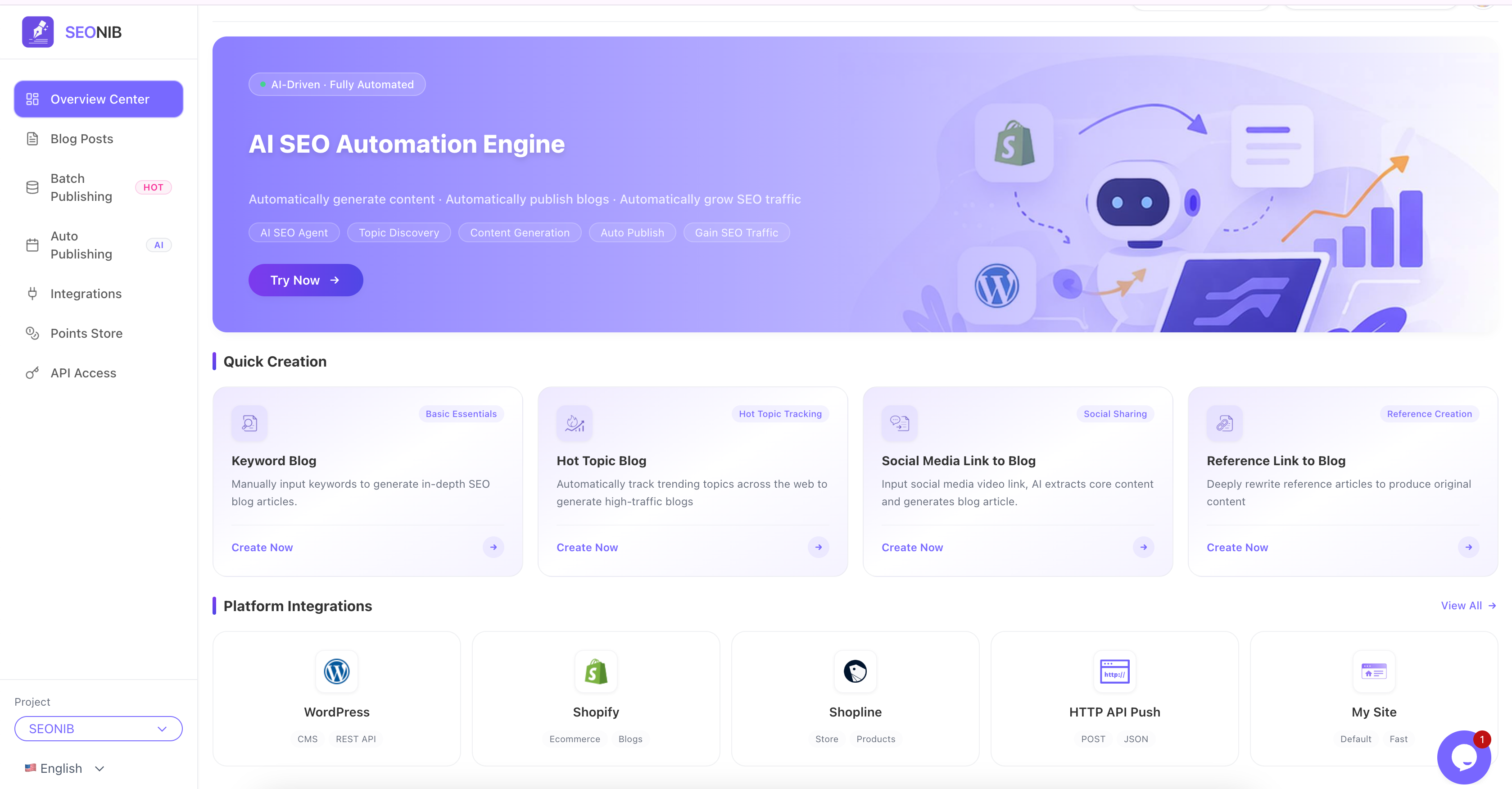
User Question Aggregation Tools: For example, utilizing “People Also Ask” (PAA) data. This is my preferred discovery method. It directly reflects users’ immediate and unmet intents during their search process. An efficient tool should be able to batch-fetch PAA data and identify problem patterns (how-to, why, what is, comparison, etc.) to guide you in generating content structures that directly answer these questions. I later delegated this part of the work to SEONIB for automation, as it can directly use PAA data as an input source to automatically generate structured Q&A articles, saving the effort of manual organization and ideation.
2. Content Generation and Optimization Tools
This is the area that has changed the most. AI writing has transformed from a “novelty” in 2023 to a “standard” in 2026. But problems have also arisen.
- General Large Model Interfaces (e.g., GPT-4, Claude): They are powerful, but for SEO content production, there are several practical pain points: cost control (for batch generation), style consistency (ensuring all articles align with brand tone), and SEO structural requirements (automatic insertion of H2/H3, keyword density control, meta description generation, etc.). You need extensive prompt engineering and post-generation manual checks, which are unrealistic for large-scale operations.
- Verticalized SEO Content AI: These tools are specifically optimized for SEO scenarios. They typically:
- Built-in SEO Structure Templates: Automatically generate articles including titles, introductions, subheadings, conclusions, and FAQ frameworks.
- Understand Search Intent: Based on the “keywords” or “questions” you input, they determine whether to generate tutorial-style, listicle-style, or comparison-style articles.
- Native Multilingual Support: Not simple translation, but content reconstruction based on search habits in the target language region.
- Deep Integration with Publishing Platforms: Generated content formats directly adapt to editors on platforms like WordPress, Webflow, and Shopify. When choosing such tools, focus on testing their performance in content originality and factual accuracy. Some tools, in pursuit of “optimization,” generate a large amount of semantically repetitive or factually vague sentences, which is detrimental to building website authority. SEONIB plays a clear role in these scenarios: it directly transforms signals obtained in the “discovery” phase (keywords, trends, PAA questions) into article drafts that comply with SEO best practices, and supports batch operations. This means my team no longer needs to first create a keyword list for a content plan, then assign writing tasks, and then optimize each one individually – this linear process is compressed into a concurrent task.
3. Publishing, Distribution, and Integration Tools
Content is written, how do you get it out? In 2026, the definition of “publishing” has also broadened.
- Traditional CMS Publishing: WordPress, Webflow, etc. The value of a tool lies in its ability to publish with one click or schedule batch publishing. Manually copy-pasting dozens of articles is unacceptable.
- Multi-Platform Synchronous Distribution: Content may need to be published simultaneously to the main site, a blog subdomain, a Medium column, or even synchronized as product descriptions to Shopify. Tools need to support multi-channel adaptation (automatic format adjustment) and permission management.
- Integration with Business Systems: This is a high-level requirement. For example, after generating product-related content (user guides, FAQs, comparison blogs) for an e-commerce platform, this content needs to be automatically linked to specific product pages, or even trigger updates to inventory or promotional information. This requires deep integration via APIs or Webhooks. The biggest pitfall here is “format loss.” An article beautifully formatted in a tool might have garbled styles after publishing to the CMS, or images might fail to upload correctly. Therefore, when selecting tools, you must practically test their publishing effect on your most frequently used platform. SEONIB provides direct publishing channels to multiple mainstream platforms, reducing the engineering time we spent on format conversion and API debugging in the early stages.
4. Monitoring, Analysis, and Iteration Tools
Content goes live, but the work isn’t over. In 2026, the focus of monitoring has shifted.
- Indexing Success Rate and Speed: Is the content quickly indexed by search engines? Can the tool monitor the indexing status of a large batch of content and identify “unindexed” content for investigation (which could be a technical issue or a quality issue)?
- Traffic Composition Analysis: Which specific articles are driving traffic? What were the initial “discovery signals” corresponding to these articles (was it a keyword, a trend topic, or a PAA question)? This helps you retroactively validate the effectiveness of your “discovery tools.”
- User Interaction Depth: Beyond click-through rates, how long do users stay on the page? Do they interact with elements within the page (like expanding FAQs, toggling tables)? This data can guide you in optimizing content structure design.
- Automated Iteration Signals: Ideally, tools should be able to automatically trigger suggestions for content updates or rewrites based on monitoring data (e.g., traffic decline for a certain article, new answers appearing for a question). Fully automated closed loops are still rare, but many tools have begun to offer “content health” scores and refresh prompts.
Specific Problems and Trade-offs Encountered in Practice
- Quality vs. Scale Trade-off: When you automate content generation, it’s easy to fall into a “quantity frenzy” initially. Publishing 100 articles a day, with a high indexing rate. But you’ll soon find that the average session duration for these articles is very low, and page engagement is almost zero. This means they are indexed but don’t truly satisfy users, failing to build loyalty or conversions. Our adjustment was to incorporate a “quality threshold” control into the automation process. For example, for AI-generated content, it’s required to include at least three citations or data points from authoritative sources; the article structure must include at least one list or table. This sacrifices some generation speed but improves content credibility.
- Multilingual Content Pitfalls: We deployed content automation in ten languages for one project. Initially, we thought it was just simple translation and localized keywords. It turned out that search intent varies greatly across different language regions. For instance, English users searching for “best laptop 2026” intend to compare before buying; while Japanese users searching for “2026年 最新ノートPC” are more interested in technology news. Directly applying the logic of English articles to generate other language versions yielded poor results. The solution was to configure independent “discovery signal” sources (localized trend tools and keyword databases) for each language and let the generation tool switch content type templates based on the language region.
- “Black Box” Risk After Tool Integration: When you hand over the entire process from discovery to publishing to an automation platform, your control over the intermediate steps weakens. For example, the platform automatically generates and publishes an article based on a social trend, but you might not see the content until it’s live and discover that one of its points contradicts your company’s public stance. Therefore, even when pursuing automation, approval nodes or content preview processes must be established. Completely black-box operation carries too high a risk for brand safety.
Outlook on the 2026 SEO Tool Ecosystem
Tools are evolving from “assistants” to “agents.” An ideal SEO Agent should be able to:
- Autonomously perceive the environment (search trends, competitive dynamics, website performance).
- Autonomously decide actions (what content to generate, in what format, when to publish).
- Autonomously execute tasks (completing the entire process from discovery to publishing).
- Autonomously evaluate results (analyzing traffic and engagement data, and adjusting subsequent strategies).
The tool combination we currently use is moving in this direction, but it’s not fully realized yet. The biggest obstacle is not technology, but trust – are we willing to entrust our brand’s content strategy and publishing rights to an autonomously operating AI agent? This requires building extreme transparency (traceability of the basis for every decision), controllability (allowing human intervention and correction at any time), and reliability (maintaining stable quality output in long-term operation) in tool design.
FAQ
Q: I currently mainly use manual writing and a few point tools. Is it necessary to switch to an end-to-end automation platform? A: It depends on your content scale and goals. If you’re just maintaining a personal blog or a small business website, producing a few articles per month, your current approach might be more flexible and cost-effective. However, if you need to operate at scale (e.g., generating auxiliary content for thousands of product pages for an e-commerce platform, or running a multilingual news blog), the efficiency gains and coverage advantages of end-to-end automation will be decisive. There’s a learning curve and integration work during the initial transition, but in the long run, it will free up significant human resources.
Q: Do search engines really like AI-generated content? Will it lead to ranking penalties? A: Based on observations as of 2026, search engines (especially Google) have become adept at evaluating content quality and usefulness, rather than solely focusing on the generation method. They penalize low-quality, valueless, or deceptive content, regardless of whether it’s manually written or AI-generated. Therefore, the key lies in how you use AI tools: have you provided clear instructions and high-quality input sources? Have you set up quality control mechanisms? Does the generated content truly solve user problems? If the answer is yes, AI content can absolutely achieve good rankings. In our own projects, AI-generated content that has undergone moderate optimization and editing shows no statistically significant difference in rankings and traffic performance compared to content written by experienced authors.
Q: After tools automate publishing, do I still need to manually manage technical SEO (like page speed, structured data)? A: Absolutely. Content automation tools typically only address content-level production and publishing. They cannot automatically optimize your website code, improve server response times, or correctly deploy complex Schema markup. Technical SEO remains an independent area that requires dedicated personnel (or specialized tools). Good content automation platforms should generate technical SEO-friendly content structures (e.g., clear heading hierarchies, reasonable image sizes and alt text), but they cannot replace the maintenance of your website’s overall technical health.
Q: With so many tools, how should I start choosing and testing? A: Don’t try to build the perfect suite all at once. Start with a core pain point. For example, if your biggest headache is “not knowing what to write,” first thoroughly test one or two discovery and insight tools. If your biggest bottleneck is “writing speed can’t keep up,” focus on trying content generation tools. Choose a tool that integrates smoothly with your primary publishing platform (e.g., WordPress). Test it on a small-scale project (e.g., a column or a product category) for one month, strictly monitoring content indexing rates, initial traffic, and user engagement data, before deciding whether to expand its use.
Q: Will the future development of SEO tools lead to the unemployment of SEO professionals? A: Tools (including AI) are changing the nature of SEO work, not eliminating it. Basic, repetitive tasks (like keyword organization, initial draft writing, batch publishing) will increasingly be automated. The value of professionals will shift upwards to more strategic and creative levels: defining content strategy and brand voice, designing quality control rules for automated processes, interpreting complex data and making business decisions, and managing the collaboration between AI tools and human teams. Future SEO roles will likely be closer to “Content Strategy Engineers” or “Traffic Acquisition System Architects.”
分享本文