Why MVP Cold Starts Often Fail

1. The Essence of a Cold Start – No Traffic, No Content, No Real Feedback
In the early stages of a startup, the MVP (Minimum Viable Product) is often seen as the only way to validate a business hypothesis. In theory, as long as the core functionality is built, users can experience it, data can be collected, and iterations can be made. In reality, without natural traffic, sufficient content, or genuine user feedback, even a technically sound product struggles to break through the “zero‑start” bottleneck.
1.1 The Chain Reaction of Traffic Deficiency
- Search engines don’t index it: New sites have no external links or content, so crawlers are unlikely to discover and index them quickly.
- Social channels are hard to reach: Without existing fans or communities, organic social media spread is virtually zero.
- Advertising costs are high: Acquiring the first users via paid ads often requires a budget of several thousand dollars, which is usually unaffordable for a startup.
1.2 Trust Crisis Caused by Content Scarcity
- Users expect complete information: Even if the core feature works, users who see a blank page or minimal description in search or social media will doubt the product’s reliability.
- Search engine quality assessment: Search algorithms favor pages with rich, well‑structured content; pages lacking content have almost no chance of appearing in results.
1.3 Absence of Real Feedback
- Insufficient data samples: Without enough visits, behavioral data (clicks, dwell time, conversions) lack statistical significance.
- Hypotheses are hard to validate: Founders end up making decisions based on intuition, lacking objective metrics to decide whether to iterate or abandon.
2. Key Elements of Low‑Cost Validation
When resources are extremely limited, founders must compress the “traffic, content, feedback” loop to the smallest possible cost. The following points are often overlooked in practice but determine success.
| Element | Low‑Cost Implementation | Key Risks |
|---|---|---|
| Traffic | Use long‑tail keywords and trending topics for organic search; post short value‑add posts in communities and forums | Over‑reliance on a single channel can cause traffic volatility |
| Content | Automate generation of structured articles, FAQs, case studies; use templates to build pages quickly | Poor‑quality content can be penalized by search engines |
| Feedback | Embed simple user survey forms, heatmaps, event‑tracking scripts | Incomplete data collection can mislead decisions |
3. SEONIB’s Site‑Building and Content‑Generation Capabilities
Among the three elements, SEONIB offers an almost “one‑click” solution. Its core advantages are:
- Fully automated site construction: No need to purchase a domain, server, or configure a CMS; the system generates publish‑ready pages within minutes.
- AI‑driven trend discovery: The platform continuously captures global search trends and automatically selects keywords and topics with traffic potential.
- Multilingual SEO optimization: Generated content is automatically translated and SEO‑structured, covering Chinese, English, Japanese, and other languages.
- Batch publishing and automatic indexing: Articles can be bulk‑published to WordPress, Webflow, Shopify, etc., and the system proactively submits sitemaps to improve crawlability.
SEONIB enables founders to move from “no content” to “search‑discoverable” with virtually zero technical barrier.
4. Real‑World Example: Validating a SaaS MVP with SEONIB
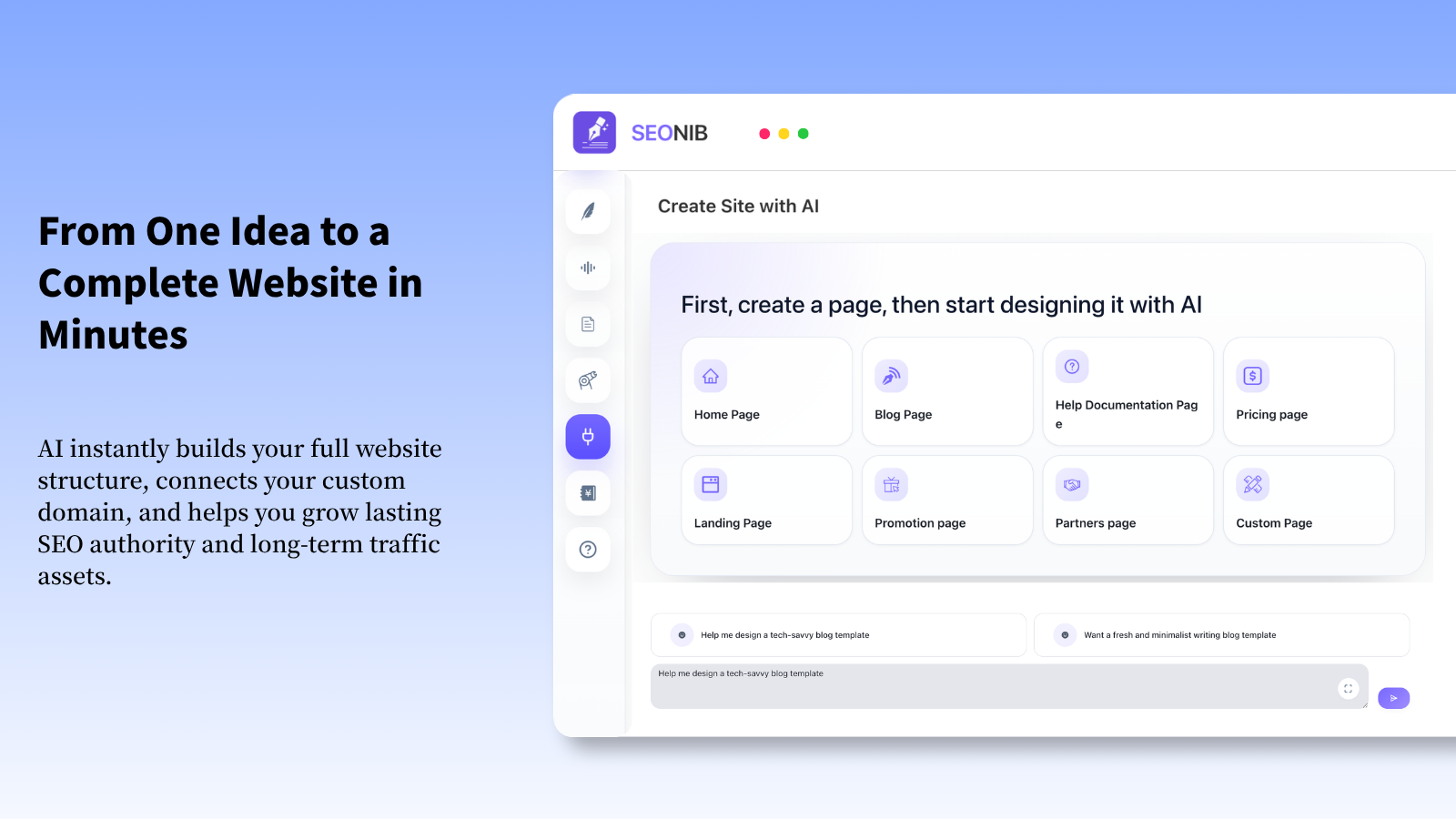
Below is a hypothetical niche SaaS tool example, showing how to complete low‑cost validation within two weeks.
4.1 Step 1: Rapid Site Construction
- Choose AI site builder; the system deploys the site in minutes, automatically filling generated articles into the appropriate blog sections.
- Use the platform’s “one‑click publish” to sync articles to my site, creating external links.
4.2 Step 2: Generate SEO Articles
- Input a keyword on the platform; it automatically creates a 1500‑2000‑word structured article with headings, paragraphs, images, and internal links.
- The article is automatically translated into English and Japanese, forming multilingual pages and expanding the potential traffic pool.
4.3 Step 3: Collect First‑Hand Feedback
- Site configuration → JS code injection: locate the JS code injection input field.
- Paste the full JS code provided by the third‑party platform into the field.
- Later, use the third‑party platform (e.g., Google Ads) to view user behavior analytics.
4.4 Step 4: Iterative Decision‑Making
- If total visits exceed 1,000 within a month, the market shows sufficient interest in the niche demand, and development can continue.
- If the data falls below the threshold, adjust keywords or reposition the product promptly to avoid over‑investing in technical implementation.
5. Common Pitfalls and Countermeasures
| Pitfall | Explanation | Countermeasure |
|---|---|---|
| Building only a single‑page MVP | A single page lacks content depth, making it hard for search engines to index. | Use SEONIB to generate multiple related SEO articles, creating a content network. |
| Blindly spending on ads | Budgets burn quickly with low conversion rates. | First acquire free traffic via organic search, validate demand, then consider paid channels. |
| Ignoring multilingual needs | Targeting only one language misses global traffic. | Leverage the platform’s automatic multilingual translation to cover major search markets. |
| Not monitoring data | Decisions are made based on gut feeling. | Use the platform’s real‑time analytics dashboard and set key metric thresholds. |
6. Conclusion: Turning “Cold Start” into “Hot Start”
MVP cold starts fail mainly because of the lack of traffic, content, and feedback. Relying solely on manually built sites, hand‑written articles, and waiting for users by luck yields almost zero success probability.
SEONIB automates site generation, trend discovery, content creation, and multilingual SEO, giving founders a searchable content library within minutes and naturally attracting the first visitors. Coupled with simple user surveys and behavior tracking, founders can validate market hypotheses at minimal cost and quickly decide whether to continue investing or pivot.
In resource‑constrained startup environments, the real competitive edge is no longer development speed but compressing the validation loop to its smallest size and collecting the most precise data. With SEONIB’s end‑to‑end automation, cold starts are no longer a “zero‑start dead end” but a “one‑click ignited starting line”.
FAQ
Q1: If my product is highly niche with very low keyword search volume, can I still use SEONIB?
A1: Niche markets often have higher conversion rates on long‑tail keywords. SEONIB can automatically uncover low‑competition long‑tail terms and generate targeted content, so even with modest overall search volume, you can achieve effective exposure among your target users.
Q2: How is the quality of generated articles ensured? Won’t search engines label them as low quality?
A2: The platform follows SEO best practices during generation (structured headings, appropriate keyword density, internal linking) and incorporates a semantic verification model. In practice, with a little human polishing, the content meets search engine quality standards.
Q3: I have no technical background—how do I manage the generated site?
A3: SEONIB provides a visual dashboard where all publishing and updating actions can be performed directly in the browser, without needing servers, domains, or code deployment.
Share Article