Cross-border E-commerce SEO Keyword Research Tool Recommendations

For cross-border e-commerce, a recommended approach for SEO keyword research is to use a combination of “General SEO Tools + Google Official Tools + Supplementary Free Tools.” This allows you to view global search data while also catering to different markets and languages.
I. Essential: Google Official Free Tools
Google Keyword Planner Suitable for: Judging product selection in the early stages of building a site, estimating search volume and general competition in different countries/languages. Key Usage Points: Use “product term + country” for filtering, focus on “average monthly searches, bid price range, and trends” to select high-value core and long-tail keywords.
Google Search Console Suitable for: Identifying keywords for which your website is actually getting impressions and clicks, and uncovering “terms you already rank for but haven’t optimized yet.” Key Usage Points: Pay close attention to keywords ranking between 10th and 50th place. For these terms, focus on optimizing the title, internal links, and content of the corresponding pages, which can easily lead to ranking improvements.
II. Highly Recommended: Professional Paid Tools for Cross-border E-commerce
Ahrefs / Semrush Suitable for: Cross-border independent websites, and those building multi-country, multi-language layouts. Core Advantages:
- View search volume, keyword difficulty, CPC, etc., by country.
- Supports keyword research across multiple platforms like Google, YouTube, and Amazon.
- Directly analyze competitor websites: see which of their pages drive the most traffic and which keywords they rank for.
SimilarWeb Suitable for: Large sellers or service providers who want to understand the traffic structure, popular countries, and trending keywords of industry-leading websites. Key Usage Points: Enter a competitor’s domain to see their primary traffic source countries and main referral keywords, helping you determine which markets and keyword directions to prioritize.
SEONIB
- Not inherently a “keyword database” tool (unlike Ahrefs/Semrush, which directly provide search volume and difficulty). It functions more like a pipeline for automatically generating and publishing a large volume of SEO blog posts based on your existing keyword strategy.
- Therefore, you can divide the workflow as follows:
- Use: Google Keyword Planner, Ahrefs/Semrush, AnswerThePublic, etc., for “finding and evaluating keywords.”
- Use: Seonib for “generating, updating, and publishing long-form articles and multilingual content in bulk around these keywords.”
III. Lightweight and User-Friendly: Long-Tail Keyword and Content Topic Tools
AnswerThePublic / QuestionDB Suitable for: Content marketing and blogging, uncovering “question-based, scenario-based” long-tail keywords. Key Usage Points: Enter a core keyword (e.g., “solar lights”) to see common questions buyers ask, which can be directly turned into blog titles or FAQs.
Keyword Surfer, Keyword Tool.io, and other browser or online tools Suitable for: Quickly brainstorming ideas by viewing approximate search volumes and related keywords while searching on Google.
KWFinder / Other Long-Tail Keyword Tools Suitable for: New independent websites focusing on low-competition long-tail keywords. Advantages: Provides search volume, difficulty, and SERP details, making it easy to judge “whether it’s worth writing a dedicated page for.”
IV. Combination Suggestions for Cross-border E-commerce Scenarios
| Use Case | Tool Combination | Description |
|---|---|---|
| Independent website beginners, limited budget | Google Keyword Planner + Google Search Console + AnswerThePublic + SEONIB | Use free/low-cost tools first to identify core and long-tail keywords, then feed these keywords into Seonib for bulk blog generation, solving the problem of “not knowing how to write or lacking the capacity to write.” |
| Multi-country, multi-language cross-border websites | Ahrefs / Semrush + Google Official Tools + SEONIB | Use Ahrefs/Semrush for keyword research and competitor analysis in various countries, then use Seonib to generate multilingual content in bulk (supporting 40+ languages) and automatically publish it to CMS like Shopify/WordPress/Shopline. |
| Heavy content matrix, aiming to scale production | Ahrefs / Semrush + AnswerThePublic / QuestionDB + SEONIB | Use professional tools and Q&A tools to uncover long-tail and question-based keywords, then import the keyword list into Seonib to generate comparison reviews, tutorials, TOP lists, and other long-form articles based on templates, forming topic clusters. |
V. Practical Implementation Ideas for Using Keywords in SEONIB
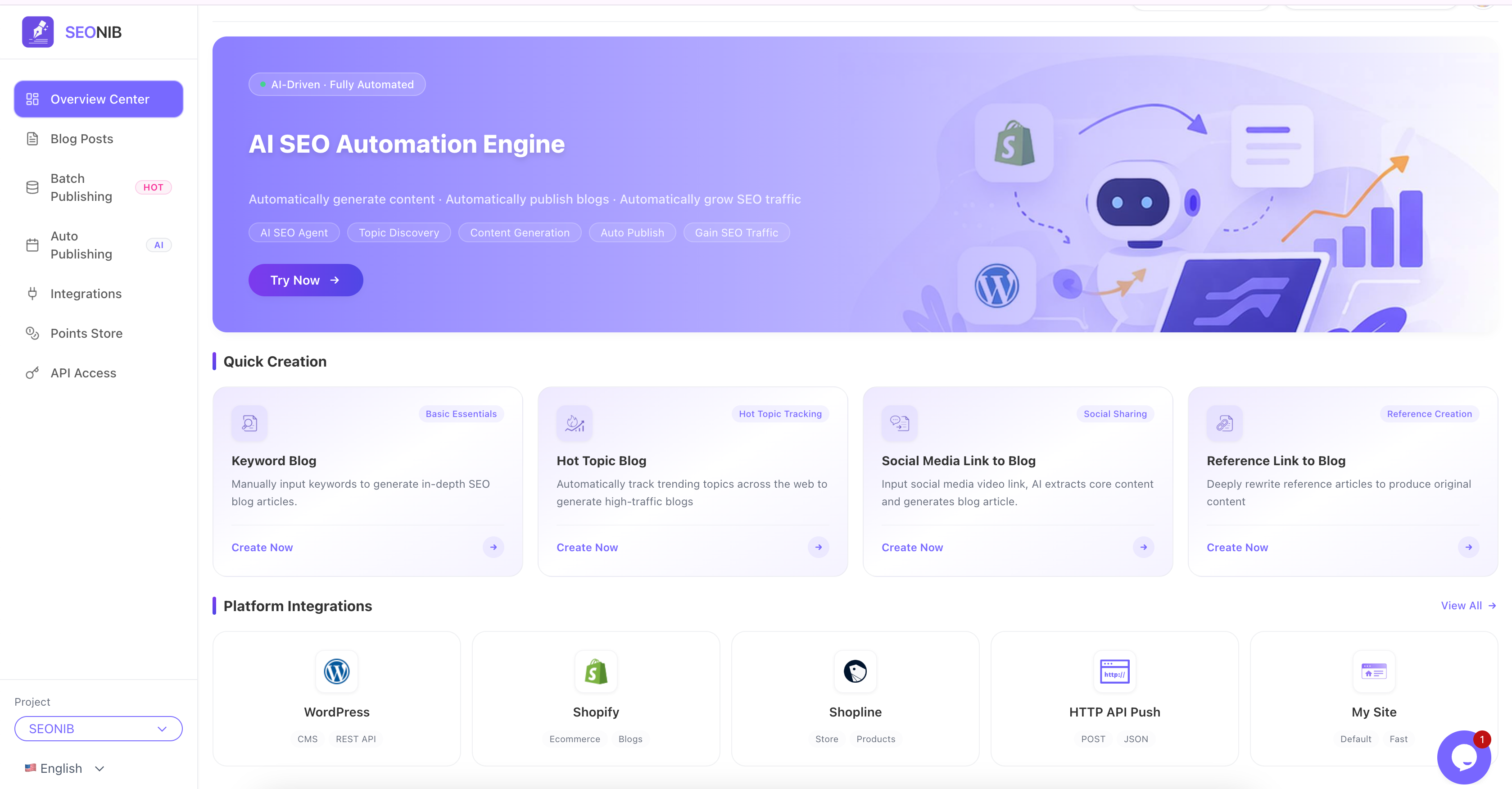
Filter a batch of target keywords in your keyword tool (with country/language tags), for example:
- Core keywords: solar garden lights
- Long-tail keywords: solar garden lights for backyard, best solar garden lights for winter, etc.
Bundle by topic and feed each keyword group into SEONIB:
- Select “Keyword-driven generation” or the appropriate template (e.g., review article, tutorial article, listicle), and set the word count and language.
Perform quick manual edits after generation:
- Slightly adjust titles to place the main keyword at the beginning.
- Supplement with your product/brand’s unique selling points and real data.
- Check if internal link anchor text matches the target keywords.
Utilize SEONIB’s “Bulk Publish + Scheduled Publish” features to push content to your independent website rhythmically. Monitor Search Console to see which keywords are starting to get impressions, then use this feedback to supplement content or build backlinks.
VI. One-Sentence Summary
In the realm of “cross-border e-commerce SEO keyword research,” traditional tools are responsible for “helping you find the right words,” while SEONIB is best suited to follow up by “massively and structurally producing and distributing rankable content around these keywords.” The combination of both is more efficient than using either one in isolation.
分享本文