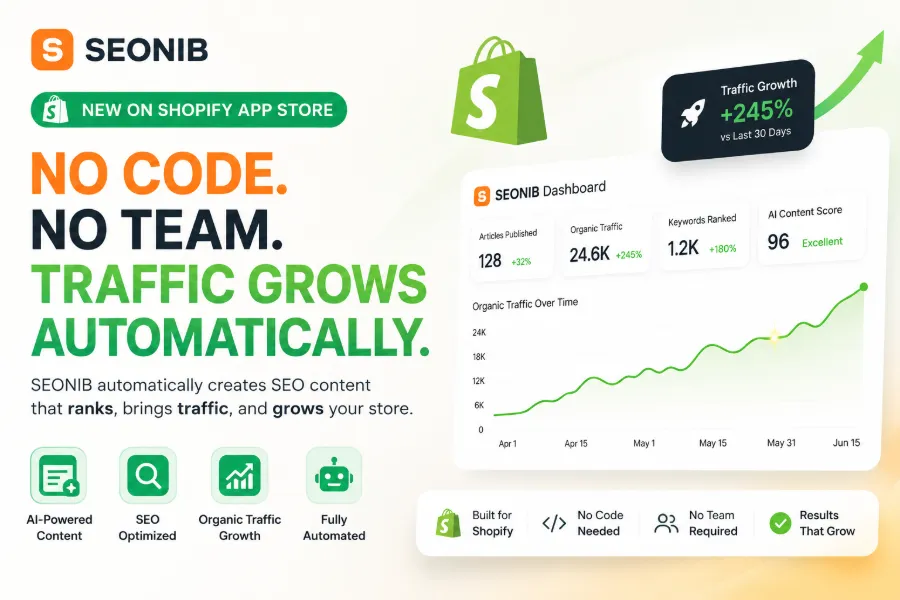
I Got Early Access to Alibaba's Latest AI Agent Platform and Discovered a Lazy Way to Do Content Marketing

I got early access to Alibaba International’s Axio Work purely by accident. One night I saw an obscure update announcement, filled out an application form, and three days later an email from alibaba.com landed in my inbox. I suspect the whole AI community has been focused on other things—what OpenAI just released, Claude’s price drop—while nobody noticed that this beast-sized platform had quietly launched.
First, the conclusion: Axio Work is not a model upgrade; it’s a full‑fledged agent platform. It’s more like Claude Desktop or Open Skywork’s logic: you can build different types of AI agents on it, connect various applications, and let those agents handle marketing, operations, even supply‑chain coordination for you. Alibaba International does over $100 billion in business each year, and the resources they pour into AI infrastructure are beyond what a small company can match. After I gave it a spin, I found an awkward truth—having just an agent platform doesn’t solve the granular tasks of content marketing.
Why No One Talks About Alibaba’s Quiet Launch of Axio Work?
I randomly tried a few of the more than 20 integrations: connecting Google Sheets, triggering Gmail replies, helping you find suppliers on Alibaba. Honestly, you can sense the ambition behind this thing. Previously, the Axio model was a linear update line—this time smarter, next time bigger. Axio Work jumps from a point to a plane. It’s no longer a single‑task model; it’s a workbench that can load various apps to run coordinated workflows.
The most striking part of the platform is its UI/UX design. You can drag and drop to build an agent workflow like building blocks: when an email meets a condition, it automatically launches a marketing agent to perform competitor analysis, then writes the results into Notion. This “connect everything” approach is genuinely exciting. When I saw the list of over 20 integrations, my first thought was: can I still sleep in the mornings?
However, when I calmed down and looked at my actual needs, I noticed a subtle issue: this suite is designed for “custom complex workflows,” whereas content marketing is essentially a “repetitive standard process”—today’s trending topics, yesterday’s blog, tomorrow’s article—all require fixed templates and delivery logic. The agent platform provides a generic base, but it doesn’t encapsulate the fine‑grained editing, publishing, and SEO synchronization steps.
The Real Pain Point of Content Automation—Why Just an Agent Platform Isn’t Enough
I spent an entire day building a content pipeline on Axio Work: detect topics → trigger generation → push to WordPress. The result? Midway through writing, I realized a step for filling an SEO field was missing; the agent workflow didn’t have that module pre‑configured. I had to manually add a webhook to call an external service. After getting it running and testing, I found images wouldn’t upload automatically and the article formatting was messed up. I gave up.
This is the classic gap between a “generic foundation” and a “specialized tool.” The real bottleneck in content marketing isn’t generating a piece of text; it’s the daily tasks of finding topics, manually pasting into a CMS, adding images and SEO descriptions one by one, logging into each platform to publish, and relying on willpower to maintain frequency—those specific actions consume the most effort.
The tool I use most now is SEONIB, which wraps the entire content pipeline. It doesn’t just help you write an article; it handles trend discovery, content generation, scheduling, and multi‑platform synchronization—all four steps automatically within a single system. I compared the numbers: building a pipeline yourself on Axio Work takes three to four hours from configuration to execution in the best case; with SEONIB, you just fill in the source and set the frequency, and the next day the blog is already published automatically.

Many people think the core of content automation is AI writing, but the real bottleneck lies in publishing and synchronization. You’ll find that even after ChatGPT generates a decent article, you still need to copy‑paste it into a CMS, manually set title tags and meta descriptions, and adjust formatting in Shopify’s backend or the WordPress editor. The repetitive nature of these steps can be exhausting. If you want to see real‑world performance of such automation tools, check out the AI SEO Automation Tools 2026 Review. Also, the differences between general AI writing tools and dedicated content automation platforms are outlined in my article What Is SEONIB? – How It Differs From Ordinary AI Writing Tools.
When I Switched from Axio Work to SEONIB, I Found the Content Pipeline Still the Best
I admit I originally signed up for SEONIB with the mindset “another AI writing toy.” Drop a product link (e.g., an AliExpress product page) into it, and within minutes it actually generates a fairly complete, SEO‑structured buying guide—title, H2 sections, internal link suggestions, FAQ module, all included.
If you don’t have a website yet, it can automatically build one for you in ten minutes—enter a desired domain, choose the platform (Shopify, WordPress, WooCommerce, Shopline all supported), then set the content source. It will then automatically push topics and articles at the configured frequency. I set it to push 24 new topics daily, and in the first week I got a dozen extra pages. For new sites, the biggest headache is indexing; its automated publishing strategy can actually speed up crawler discovery through continuous output. If you’ve just built a site, this article What to Do When a New Site Indexes Slowly? might help.
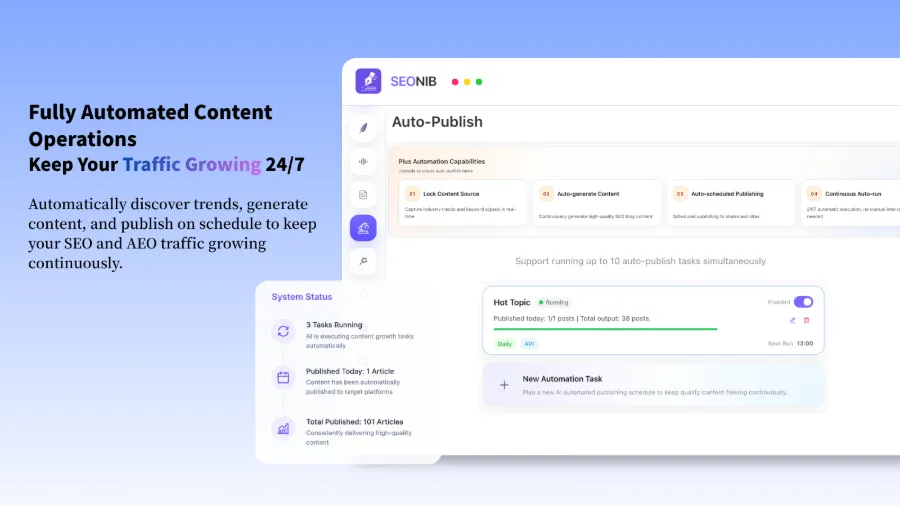
The biggest difference between Axio Work and SEONIB is actually the design philosophy: the former lets you define the workflow yourself, the latter packages the entire “content marketing” scenario. I don’t need to drag and drop an agent workflow—I need four buttons: “Discover Trends → Generate → Schedule → Sync.” SEONIB turns those four buttons into a loop. According to its product description, content sources can be keywords, trending topics, product links, social media posts (Twitter/YouTube/TikTok/Instagram), or other reference links. Once you set the source, it automatically tracks industry trends and pushes topics—24 new topics daily, supporting 40 languages. After generation, it automatically schedules publishing at the configured frequency and syncs to Shopify, WordPress, Shopline, WooCommerce, and other platforms. These details are covered in the tutorial Turning Social Media Links into Blog Guides, which provides more concrete instructions. Also, if you want to turn a product link into a SEO‑optimized blog that attracts organic traffic, this article Convert a Product Link into a Sustainable Organic‑Traffic SEO Blog with One Click is worth reading.
SEONIB isn’t trying to replace agent platforms like Axio Work—they operate on completely different levels. Axio Work suits scenarios where you need to customize complex workflows, such as “when a supplier updates prices on a certain day, automatically trigger a procurement negotiation agent.” Content marketing, frankly, for most people isn’t complex enough to require building your own workflow. Filling a ready‑made pipeline with content sources, setting the frequency, and letting it run automatically is the most efficient solution.
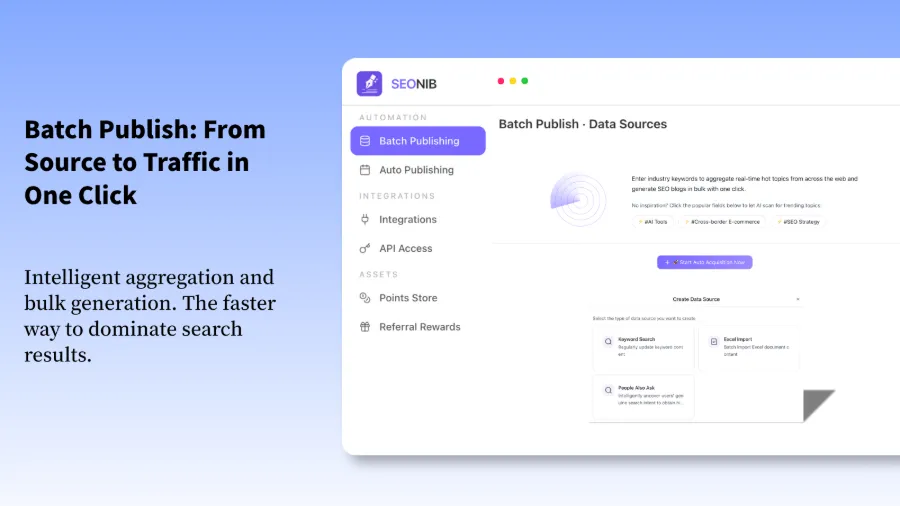
If you’re stuck at “want to keep producing content but can’t” or “don’t know how to sync generated content across all platforms,” check out SEONIB’s Help Documentation, which clearly explains the configuration for each step.
FAQ
Which is More Practical: Axio Work or SEONIB?
It depends on what you want to do. If you need to customize complex business processes—like automatically monitoring competitor price changes and triggering a procurement negotiation—Axio Work is more suitable. If your need is to continuously produce blogs, acquire organic traffic, and sync across multiple e‑commerce platforms, SEONIB’s higher level of packaging makes it quicker to get started.
Can AI‑Generated Content Really Get Organic Traffic?
It’s not a matter of whether it can, but how you publish and optimize it. If the generated page lacks proper SEO structure, isn’t updated regularly, or has no internal linking strategy, even great content will struggle to attract traffic. SEONIB embeds SEO fields, images, and internal linking rules into the generation process, so its published content is already relatively complete.
Which Platforms Does SEONIB Support for Synchronization?
Shopify, WordPress, WooCommerce, Shopline, Webflow, Contentful, and Ghost are all supported. One publishing action automatically pushes to multiple platforms without needing to log into each backend separately.
Share Article