SaaS Era Blogging Automation: From Efficiency Tools to Growth Engines
From Manual Publishing to Automated Pipelines
The SaaS operational landscape in 2026 is difficult to describe simply as “fiercely competitive.” It’s more akin to a sustained battle for efficiency and scale. Content marketing, especially the production and distribution of blog content, remains a core method for acquiring organic traffic and building brand awareness. However, the paradox lies in the market’s ever-increasing demand for content quality, while team energy and budgets are increasingly strained. Over the past few years, we’ve tried various solutions: outsourcing teams, content crowdsourcing platforms, and even building small in-house editorial teams. The results were often inconsistent quality, runaway costs, or lengthy publishing processes that couldn’t keep pace with trending topics.
The most troublesome part for me was often not content creation itself, but publishing. A meticulously prepared blog post, emerging from a Word document or collaboration tool, needed to go through formatting adjustments, image uploads, category selection, SEO field completion, final publishing, and potential subsequent revisions. If multi-platform distribution was involved (e.g., corporate website blog, product documentation site, third-party technical communities), this process would be repeated multiple times. These “last mile” tasks consumed a significant amount of time that could have been dedicated to strategic thinking or content optimization. We began to realize that the bottleneck in content production had shifted from “can’t write” to “can’t publish” or “can’t publish in time.”
Integrated Automation: More Than Just Saving Time
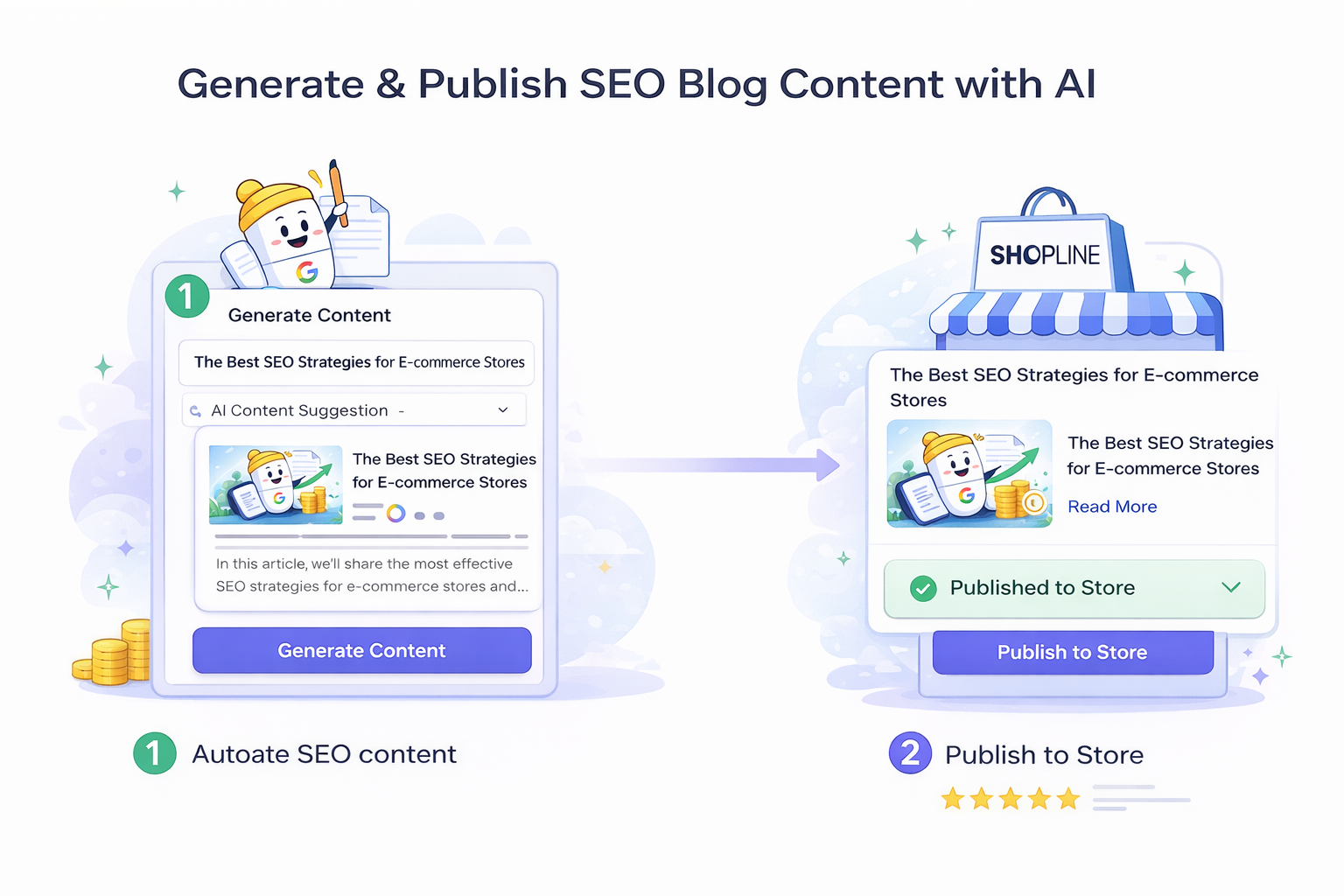
When we initially considered introducing automation tools, our goal was simple: save manpower and free editors from repetitive copy-pasting. But after actual implementation, we found its value extended far beyond that. Taking our recent project of integrating the SHOPLINE store with SEONIB as an example, the changes brought about by the entire process were multi-dimensional.
Firstly, there’s process certainty. In the past, the publishing path for a trending article relied on the collaboration of multiple people: the editor would finish, hand it over to operations for configuration, and operations might even need technical support to handle certain CMS settings. Any delay or communication error in any step would affect the final go-live time. Now, by finding the Shopline module in SEONIB’s backend “Integration Management,” completing authorization and blog category configuration, the entire publishing chain becomes a controllable pipeline. Editors or operations personnel only need to complete content generation or review on the SEONIB side, click publish, and the content will accurately appear on the SHOPLINE store’s blog page according to the preset format and category. This certainty eliminates ambiguity in collaboration.
Secondly, there’s the possibility of scaling. Once the publishing process is automated, we truly have the capability to experiment with a “content matrix” strategy. In the past, maintaining multiple categories or topic series was a chore because each series required manual management of the publishing rhythm. Now, we can create different automation tasks in SEONIB, targeting different signal sources (such as specific keyword trends, competitor dynamics, vertical community hotspots), allowing AI Agents to continuously monitor and automatically generate content that aligns with different category positioning, publishing it to the corresponding blog collections in SHOPLINE. This means we can simultaneously operate multiple content lines like “Product Updates,” “Industry Insights,” and “Customer Cases” without linearly increasing headcount.
Configuration and Considerations in Practice
According to SEONIB’s help documentation, the steps to connect SHOPLINE with SEONIB are clear: prepare your store account, find Shopline in Integration Management, enter your store URL, complete official authorization, and finally select a specific blog collection as the publishing target. The selection of this “blog collection” is a practical point worth considering.
SHOPLINE’s blog functionality typically allows merchants to create multiple collections, such as “News,” “Tutorials,” or “Stories.” When configuring, you need to specify one from the dropdown menu. Our experience is that you shouldn’t choose randomly, but rather in conjunction with your content strategy. If you plan to primarily use automation tools to generate news flashes and trend analysis content, then the “News” collection is appropriate. If you want to generate more in-depth, solution-oriented tutorials, you might need to create a dedicated “Guides” collection and point the configuration to it. This choice determines the organizational structure and user perception of automated content on the store’s frontend.
Another point that is easily overlooked is verification. The documentation mentions that after successful publishing, you should check the article status in the SHOPLINE backend (“Online Store” -> “Blog”) to see if it’s “Published” and verify that the category is correct. We recommend incorporating this verification step into the initial process testing. Automation tools eliminate manual operations, but this doesn’t mean we can completely abandon checks. Spending a few minutes initially to confirm the publishing effect of a few articles (format, images, categories) can ensure the long-term reliability of the entire pipeline. After that, you can confidently rely on automation.
From Automated Publishing to Automated Growth
Once the publishing环节 is stable, our attention naturally shifts back to the source of content production. The essence of SEONIB’s “automatic publishing” module is “set once, manage all.” You can configure signal sources, and then the system monitors viral topics 24⁄7. This means content production is also integrated into the automated pipeline.
However, this brings new operational challenges: how to configure these signal sources? We no longer need to think about “what to write today,” but rather need to think more strategically about “what trends should we monitor.” This effectively elevates the role of content operators from executors to strategy designers. We need to define which keyword domains are our core battlegrounds, which competitor dynamics are worth tracking, and which social media or forum discussions might give rise to early hotspots. These decisions determine the quality and relevance of the automated content flow.
For example, when setting up automation tasks for an outdoor gear SHOPLINE store, the monitored signal sources include: popular Reddit topics for specific outdoor activities (like hiking, camping), new articles from major competitor blogs, and search trends for related gear categories on Google Trends. The AI Agent generates in-depth reviews or pain point solutions based on these signals, and then automatically pushes them to the store’s blog on a preset schedule. The result is that the store’s blog can respond to trending market topics almost in real-time, maintaining extremely high timeliness and relevance, which was completely unachievable with manual creation and publishing in the past.
Quality Control in the Age of Automation
While efficiency improves, the paradigm of quality control must also change. We no longer proofread every article word-for-word before publishing; instead, we have established new quality control mechanisms:
- Source Signal Filtering: Strictly define and filter the monitored signal sources to ensure the input information is high-quality and relevant.
- Generation Template and Rule Optimization: Continuously optimize content generation templates within the automation tool.