2026: How can newcomers leverage social media video links to launch your SaaS blog?
For teams or individuals just entering the SaaS space, content creation is often the first daunting obstacle. You need professional, in-depth industry insights, while also considering search engine optimization and maintaining a certain frequency of updates. Today, in 2026, a content source that many newcomers overlook but is extremely effective in practice is video content on social media platforms.
Many newcomers have a misconception: blogs require entirely original, lengthy articles. But in reality, especially in the early stages, deeply expanding existing, popular social media video content into text is a lower-risk, faster strategy to get started. This isn’t simple transcription; it’s “content reinvestment”—transforming the core ideas, conversations, and trends from videos into long-form, structured articles that search engines can crawl and users can find through search.
Why starting with social media videos is a pragmatic choice?
A video that gains significant engagement on TikTok or YouTube has already undergone initial market validation. It indicates that the topic, pain point, or solution has resonated with a specific audience. However, video content has two inherent shortcomings: first, its information density is usually low and it relies on linear viewing; second, its “discoverability” in traditional search engines is far inferior to text.
This is where the opportunity lies. By expanding a 5-minute Instagram Reels video into a 1500-word blog post, you are essentially doing two things: first, providing a systematic framework for the flashes of inspiration in the video; second, creating a new, indexable entry point for search engines. In our practice, we’ve found that blog posts converted from popular videos often see stable growth in long-tail search traffic 2-3 months after publication, becoming a continuous source of leads.
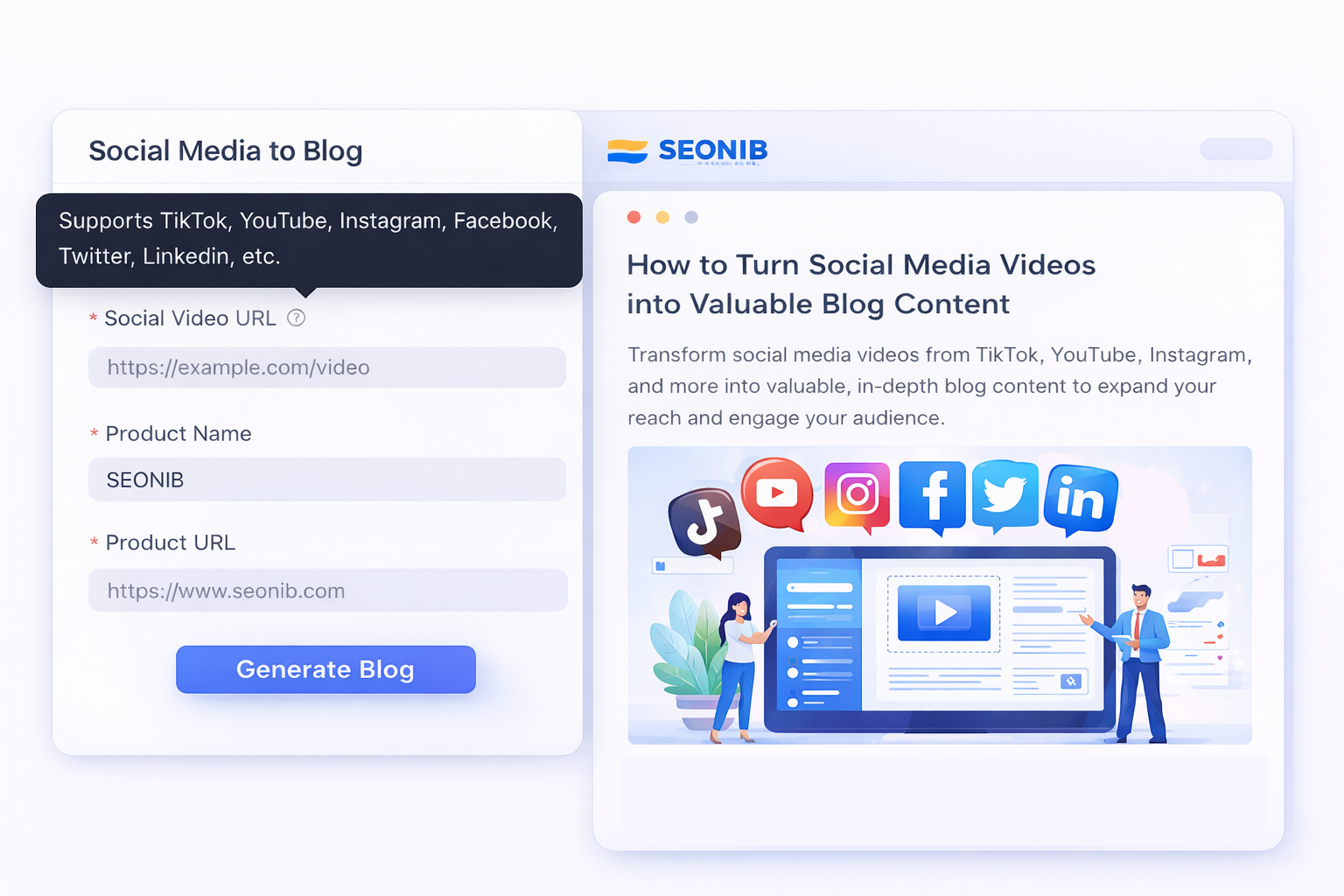
The ideal is grand, but the manual conversion process is fraught with pitfalls.
Initially, we tried to complete this process manually: team members watched videos, took notes, and then reorganized the language to write articles. This process exposed several pitfalls that newcomers easily fall into:
- Loss of perspective: In videos, especially conversational ones, core arguments are often interspersed with examples and interactions. Manual note-taking can easily miss key logical chains, leading to insufficient depth in the article.
- Efficiency bottleneck: From watching and digesting to writing, even for skilled writers, processing one article takes hours. This is fatal for a content matrix that requires scaled output.
- Style disconnect: The tone of a video might be light and lively, but a blog may require more professionalism and rigor. Balancing and transitioning these requires repeated deliberation and consumes significant energy.
- Lack of SEO foundation: Newcomers often get absorbed in the content itself when writing, forgetting to implement basic SEO elements like keywords and meta descriptions, causing their articles to disappear like stones in the sea after publication.
We were in a situation where we had accumulated over a dozen good video materials, but our content production pipeline was completely blocked. This continued until we systematically attempted to tool this process.
Introducing an automated pipeline: “One click away” from link to draft
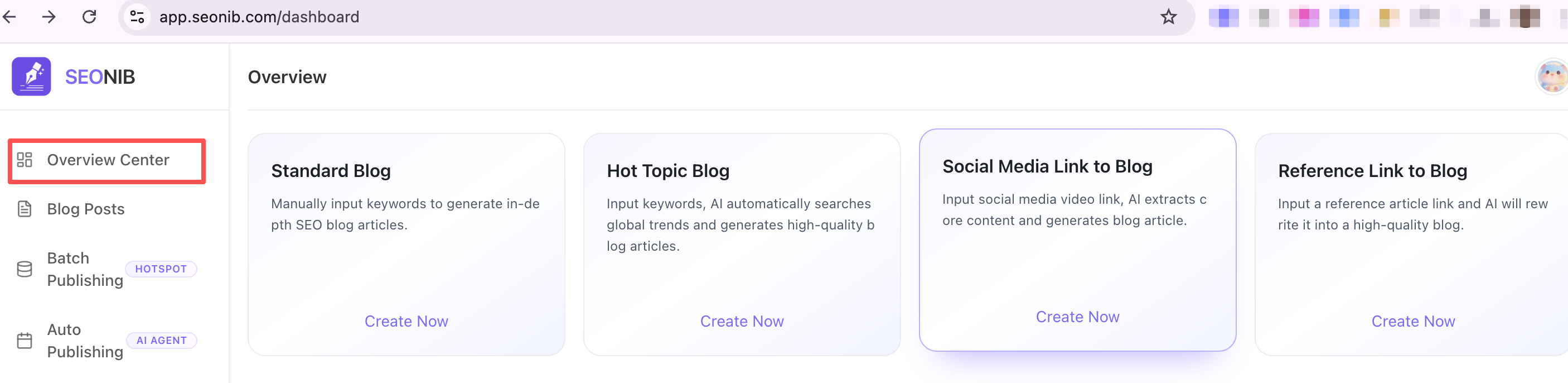
Our turning point was embedding the “Social Media Link to Blog” feature of SEONIB into our workflow. The simplicity of this operation initially made us doubt its output quality—simply pasting a YouTube video link and clicking generate.
But the first result changed our minds. The system didn’t perform mechanical voice-to-text transcription; instead, it accurately identified the video’s chapter structure, extracted three core arguments, and elaborated on them in coherent paragraphs. It even generated subheadings for each argument, along with meta descriptions and SEO title suggestions. What surprised us most was that it retained some of the vivid metaphors used by the speaker in the video and naturally integrated them into the written language.
This solved a fundamental problem: it compressed the most time-consuming “from scratch to first draft” process into a few minutes. What we received wasn’t a perfect final draft, but a “high-quality semi-finished product” with a clear structure, complete core arguments, and an established SEO framework. The editor’s focus shifted from “creation” to “optimization and refinement.”
Editing and optimization in practice: making articles truly “come alive”
The draft generated by SEONIB is our starting point, not the end. The subsequent editing phase is crucial for determining the final quality of the article. We’ve developed several fixed optimization actions:
- Deepening insights and examples: AI can extract insights, but examples might not be localized or in-depth enough. Based on the arguments in the draft, we supplement with customer cases from our own SaaS business or more specific data to increase the article’s uniqueness and credibility.
- Tone calibration: Through the platform’s “Advanced Options,” we can preset tones like “professional,” “neutral,” or “friendly.” However, after generation, we still read through the entire text to ensure it aligns with our brand voice. Sometimes, we rephrase overly technical sentences to be more accessible.
- Strong binding of visual materials: SEONIB’s “Smart Image Generation” feature is very useful. However, we find that the best accompanying visuals are still screenshots from the video itself or key infographics. We manually insert the most impactful screenshots from the video and note in the article, “As we discussed in the video…”, achieving cross-platform content traffic.
- Globalization testing: We once used the multilingual feature to generate Spanish and Japanese versions of an English video blog about “SaaS onboarding best practices” with a single click. After publishing to the respective regional blogs, we observed a significant increase in page dwell time in non-English markets. This is a very low-cost experimental method for newcomers to test overseas market interests.
Unexpected gains and boundaries that still require vigilance
After running this workflow for several months, we’ve achieved some unexpected results:
- Natural emergence of keywords: Since the videos themselves discuss trending topics, the generated blog posts often naturally include some long-tail keywords that we hadn’t actively planned for, bringing in unexpected search traffic.
- Improved content consistency: Our video content and blog content maintain high consistency in core arguments, which strengthens the brand’s professional image. Customers receive coherent information regardless of which channel they interact with us through.
However, automation is not a panacea. We still adhere to several principles:
- Absolute fact-checking: AI may misinterpret a data point or citation in the video. All data, dates, and product names in generated content must be manually verified.
- No publishing “empty shell” articles: If the AI-generated draft is of poor quality (which occasionally happens, especially when video content is very scattered or relies heavily on visual humor), we choose to abandon the material rather than force the publication of a low-quality article.
- Irreplaceable human strategy: Deciding which video to convert, when to publish, and for which audience to localize the language are strategic decisions that still rely on human judgment. Tools liberate our productivity but do not replace our thinking.
For SaaS creators just starting in 2026, the biggest challenge is not the lack of tools, but finding a starting point among numerous tools that allows for rapid launch and the formation of a positive feedback loop. Transforming dynamic video assets on social media into static, searchable blog assets, and using automated pipelines like SEONIB to bridge the critical step from inspiration to draft, might be an underestimated but extremely effective starting point. It cannot replace all your content creation, but it can ensure that you don’t exhaust yourself at the starting line of the content marathon.
FAQ
Q1: Are all types of social media videos suitable for conversion into blog posts? Not necessarily. In practice, tutorial videos, in-depth opinion sharing, and industry analysis videos convert best because their information structure is clear and their arguments are well-defined. Purely entertainment-focused Vlogs that rely heavily on background music or rapid editing often lack substantial content when converted into articles, requiring significant effort to rewrite and offering low cost-effectiveness.
Q2: Will articles generated this way be flagged by search engines as duplicate or low-quality content? This is a common concern. The key is “transformation” rather than “copying.” An excellent tool (like SEONIB) performs content restructuring and expansion, producing entirely new textual expressions, structures, and SEO elements. As long as the generated article provides equal or greater value than the video and has undergone human optimization, search engines will typically treat it as independent, high-quality content. We have not experienced any negative repercussions from this to date.
Q3: For multilingual blogs, should I generate in my native language first and then translate, or generate directly in the target language? We have tried both methods. Generating directly in the target language (if the tool supports it) usually yields better results, as the AI can better understand the target language’s expression habits during generation. Generating in the native language first and then machine translating can lead to stiff sentence structures. It is recommended to use the tool’s “target language” option to directly generate a draft, and then have it polished by a native speaker or professional tool.