2026 Independent Website Content Operations: A Leap from Tool Integration to Automated Pipelines
As 2026 dawns, the competitive landscape in the SaaS sector has quietly shifted. For independent websites operating globally, content is no longer mere “filler” but the core engine driving growth. While teams might have previously spent hours on keyword research, content writing, formatting, and publishing, today’s leaders have compressed these actions into minutes, running 24⁄7. This transformation signifies not just an increase in efficiency, but a fundamental restructuring of operational paradigms.
Many practitioners have faced a common dilemma: a fragmented content production process. Trend discovery relies on social media or third-party tools, content creation depends on writers or general AI, and publishing requires manual backend operations. Each transition between these stages means time loss and potential human error. When this fragmented process encounters the global market, which demands scalability, multilingualism, and real-time responsiveness, bottlenecks become particularly pronounced.
The Depth of Integration Determines the Height of Automation
A profound realization is that true automation begins with seamless integration. If tools only engage in shallow data exchange via APIs, then so-called “automated workflows” are often fragile and require extensive maintenance. Automation only becomes reliable and scalable when tools can deeply understand and operate the native functions of target platforms.
Take WordPress, the most common independent website architecture, as an example. It remains the absolute mainstream for the global market, especially for self-built sites and small to medium-sized enterprise official websites. However, the complexity of its operation has not diminished. Whether it’s the self-hosted (WordPress.org) or officially hosted (WordPress.com) version, content publishing involves permission verification, format adaptation, media uploads, and status management. In the past, achieving automatic publishing often required relying on development resources to customize plugins or write complex scripts, posing a high barrier for non-technical operators.
The situation is different now. Some professional AI content automation platforms, such as SEONIB, have made deep WordPress integration a standard feature. This integration is not a simple “publishing interface” but covers the entire process from App Password authentication and REST API writes to media library synchronization. This means operators don’t need to worry about technical details; they simply complete a one-time configuration, similar to authorizing a regular app, to securely delegate the blog update permissions for their entire WordPress site to an AI agent team.
Specifically, for self-hosted WordPress, users only need to generate a dedicated App Password in the backend and enter the site address, username, and this password on SEONIB’s integration page to complete the connection. For officially hosted WordPress.com sites, as long as their plan supports plugin installation (usually Business plan or above), API write permissions can be enabled and connected through a similar process. This out-of-the-box deep integration eliminates technical barriers, ensuring a completely smooth “last mile” from content generation to going live.
✨ For specific guidance, please refer to the SEONIB official integration tutorial: https://seonib.com/help/5
A Full-Link Closed Loop from Hotspot Capture to Publishing
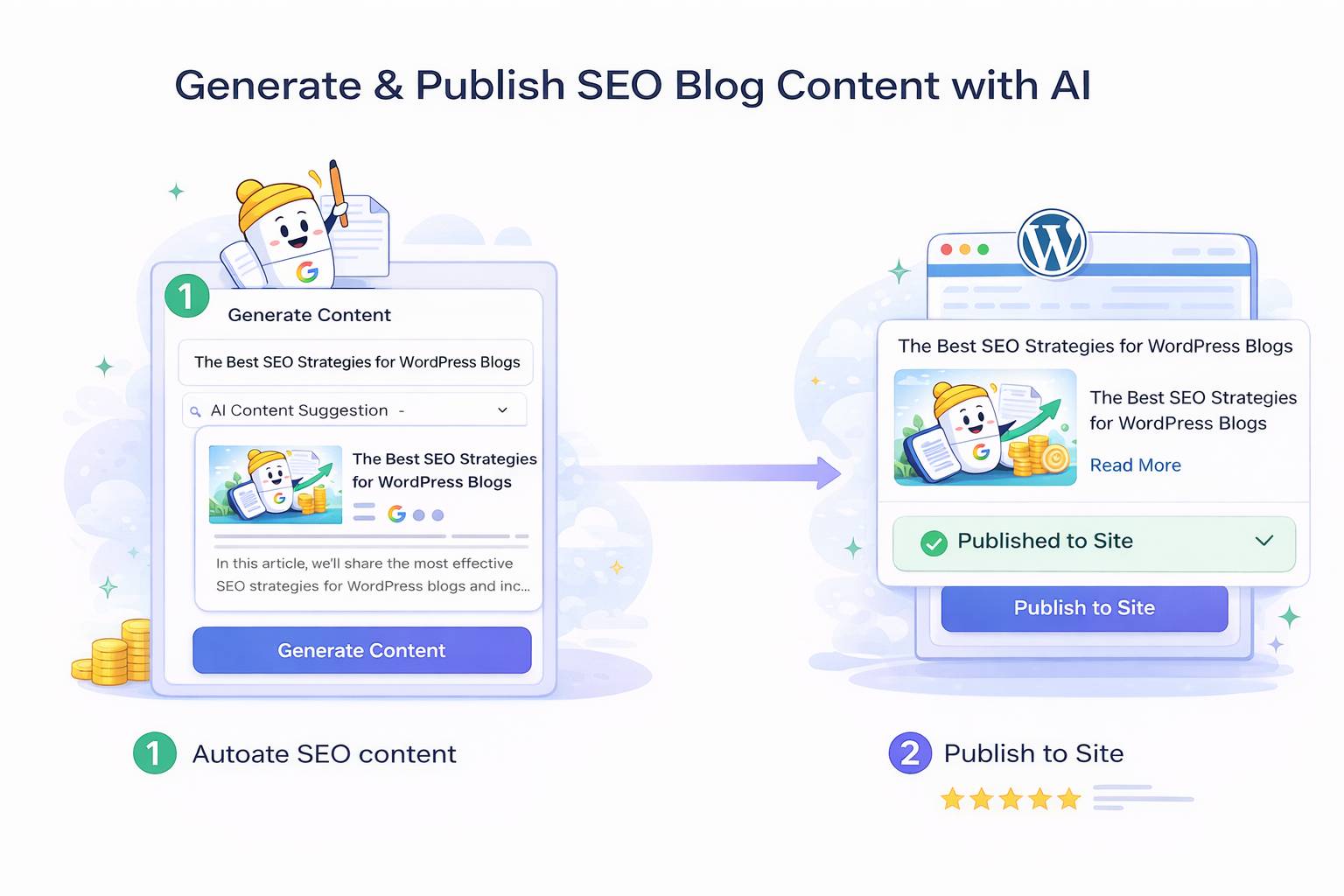
Integration is just the foundation; the real value lies in the automated pipelines that integration enables. By 2026, excellent content operation tools will have evolved into a complete “Perception-Decision-Execution” system.
First is real-time trend capture. The system can monitor industry hotspots, social media trends, competitor dynamics, and even analyze YouTube video content 24⁄7, transforming them into creatable source material. This is equivalent to equipping the operation team with a tireless market radar.
Second is AI generation and optimization. Based on captured trends or specified keywords, AI can automatically generate SEO-optimized blog posts with complete structures, including titles, body text, image suggestions, and meta descriptions. More importantly, this process supports batch operations. Imagine generating dozens of pieces of content from different angles and in different languages for a new product line or market; what used to take weeks might now take a single click.
Finally, and most disruptively: intelligent scheduling and automatic publishing. Generated content no longer piles up in drafts waiting for manual processing. The system can automatically publish content to integrated WordPress sites based on preset strategies—for example, at optimal active times in the target market, at a specific frequency. Images will be automatically uploaded to the media library, and the status will be automatically updated to “Published,” with no human intervention required. This achieves an end-to-end closed loop from “discovering hotspots” to “automatically writing blog posts” to “automatically publishing to WordPress.”
This full-link capability transforms content operations from a high-intensity creative labor into a configurable, monitorable, and scalable systematic engineering. The team’s role thus shifts from content “producers” and “movers” to content strategy “architects” and “analysts,” focusing on defining direction, evaluating results, and optimizing processes.
Rethinking Cost Structure and Operational Elasticity
When evaluating any SaaS tool, long-term cost controllability and operational elasticity are crucial decision factors. The traditional subscription model, which charges a fixed monthly fee regardless of usage frequency, is often uneconomical for businesses with fluctuating content demands. This is particularly true for globally operating teams that may need to produce content in concentrated bursts to penetrate markets in certain quarters, while maintaining steady updates at other times.
A more flexible model is gaining favor: permanent credit validity. In this model, purchased credits do not expire monthly but can be used flexibly according to one’s content rhythm. During peak marketing seasons or when entering new markets, a large number of credits can be used for batch content generation and publishing. During stable periods, the pace can be slowed down, and purchased credits will quietly remain in the account, waiting for the next use. This model gives operators true autonomy, making the cost of the tool more directly linked to business value (content output), and fundamentally preventing resource waste.
The Core of Future Content Operations
Looking ahead, content competition for independent websites and all online businesses will increasingly focus on two dimensions: speed and system.
Speed refers to the response time to market signals. Whoever can capture trends first and transform them into high-quality, search engine-friendly content will gain the advantage in traffic and mindshare. This relies on the extreme compression of the “perception-creation-publishing” cycle by automated pipelines.
System refers to the scalability and consistency of content production. Whether targeting ten markets or a hundred, whether publishing one article per day or a hundred, the system can reliably and consistently output content that aligns with brand tone and SEO standards. This relies on deep, reliable platform integration and intelligent process scheduling.
For operators in the global market, building such an agile yet robust content automation pipeline is no longer an “icing on the cake” option but the “infrastructure” for participating in future competition. Its value lies not only in freeing up human resources but also in enabling content, the core growth engine, to operate continuously with unprecedented efficiency and scale.
FAQ
Q: Is it safe to connect a WordPress site to an automation tool? A: Yes, it is safe. Reputable automation platforms (like SEONIB) use WordPress’s officially recommended App Passwords for authentication. These passwords are generated specifically for a particular application, differ from your main login password, and can be revoked at any time in the backend, providing granular security control.
Q: Will automatically published articles include images? Will the formatting be messed up? A: Yes. Advanced AI content automation systems will match high-quality illustrations based on the content theme when generating articles and synchronize them to your WordPress media library with one click. Publishing will follow the formatting and styles defined by your website theme, ensuring that the front-end display is consistent with manually published articles.
Q: Are these automation tools suitable for businesses with fluctuating content needs? A: They are very suitable, especially platforms that adopt the “permanent credit validity” model. This model allows you to store credits and use them for large-scale content production and publishing during peak demand periods (e.g., product launch seasons, shopping festivals), and use them as needed during normal times, achieving a perfect match between costs and business rhythm, and possessing extremely high operational elasticity.
Q: Can I automate publishing to platforms other than WordPress? A: Yes. Professional content automation pipelines typically support deep integration with mainstream e-commerce and content platforms, such as Shopify, Shopline, etc. This allows you to synchronize and distribute content to multiple online channels through a central hub, achieving cross-platform content matrix management.
Q: How is the SEO quality of automatically generated content guaranteed? A: The system optimizes SEO automatically from multiple dimensions: including title and structure optimization based on keyword research, internal linking suggestions, image ALT tag generation, and meta description writing. Some tools also provide real-time SEO scoring, allowing you to grasp the basic search friendliness of the content before publishing. Of course, the final strategic direction and core keywords still need to be controlled by the operator.