2026: The Paradigm Shift in Independent Site Content Operations: From Manual Updates to AI Agent Full Hosting
It’s that time of year again, the annual peak season preparation period. While reviewing last year’s traffic data with the team, a clear conclusion emerged: over 30% of the stable inquiry traffic to our self-operated SHOPLINE independent site did not come from traditional advertising or social media, but from in-depth articles in the blog section, written around product pain points and industry trends. This finding was not surprising; content is traffic, a consensus in the cross-border e-commerce circle.
But the problems followed. Maintaining a high-quality, frequently updated blog is costly. We’ve tried building content teams and outsourcing, but either the costs were unbearable, or content quality and industry expertise couldn’t be balanced, let alone keeping up with global trends in real-time. With traffic dividends peaking, content has become a necessity, yet also a heavy operational burden.
Until we introduced the concept of “automation” into content production. This is not just about using a few writing tools, but about building a complete automated pipeline from hot topic discovery, content creation, to distribution. Our practical approach might offer some reference.
The Efficiency Bottleneck in Content Production and the Breakthrough Point of Automation
In the early days, our blog operations were a typical handicraft workshop model: operations colleagues discover a hot topic or common user question -> collect information -> draft an article -> optimize SEO -> manually publish to the SHOPLINE backend. An article from conception to launch took an average of 1-2 working days. This resulted in our content update frequency hovering around 1-2 articles per week, completely unable to achieve economies of scale, let alone seize fleeting traffic opportunities.
We realized that this process had to be broken down and automated. There are three core aspects:
- Information Input: How to continuously and automatically acquire valuable content creation themes?
- Content Generation: How to efficiently and high-quality transform these themes into SEO-friendly articles?
- Publishing and Deployment: How to ensure articles appear automatically and error-free in the correct location on the website?
There are various point solutions on the market, but the friction costs generated by data flowing between different tools, and the segments requiring manual intervention, make “full automation” a perpetual myth. What we need is a solution that can connect the entire process from “signal” to “page.”
Building an Unattended Content Growth Engine: Taking SHOPLINE + SEONIB as an Example
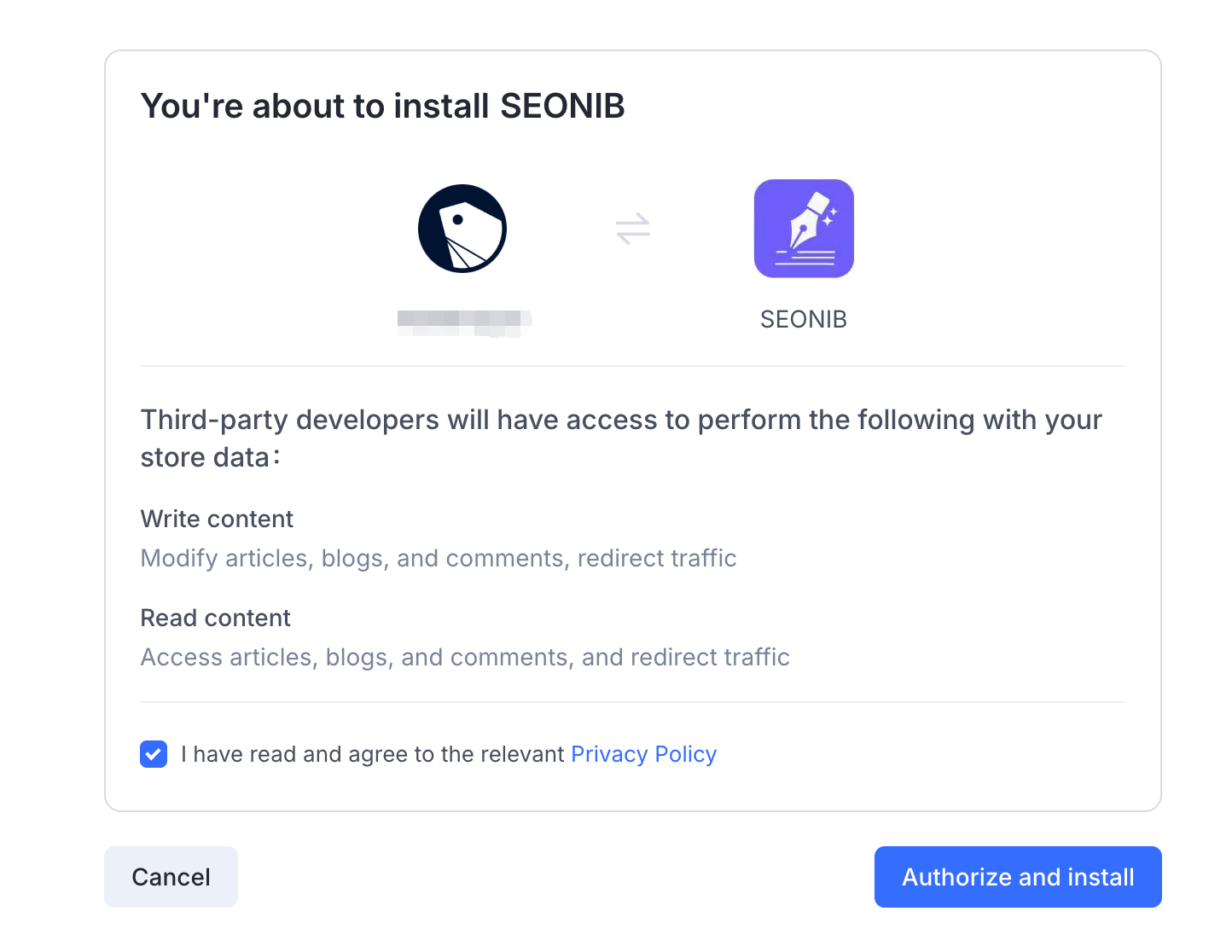
Our turning point was connecting our SHOPLINE store with SEONIB. The process itself is extremely simple. In the SEONIB backend, under “Integration Management,” find the Shopline module, authorize, and select the blog collection to publish to (e.g., the “News” category built into SHOPLINE). It takes no more than a few minutes. But this simple connection builds the “last mile” of the automation pipeline.
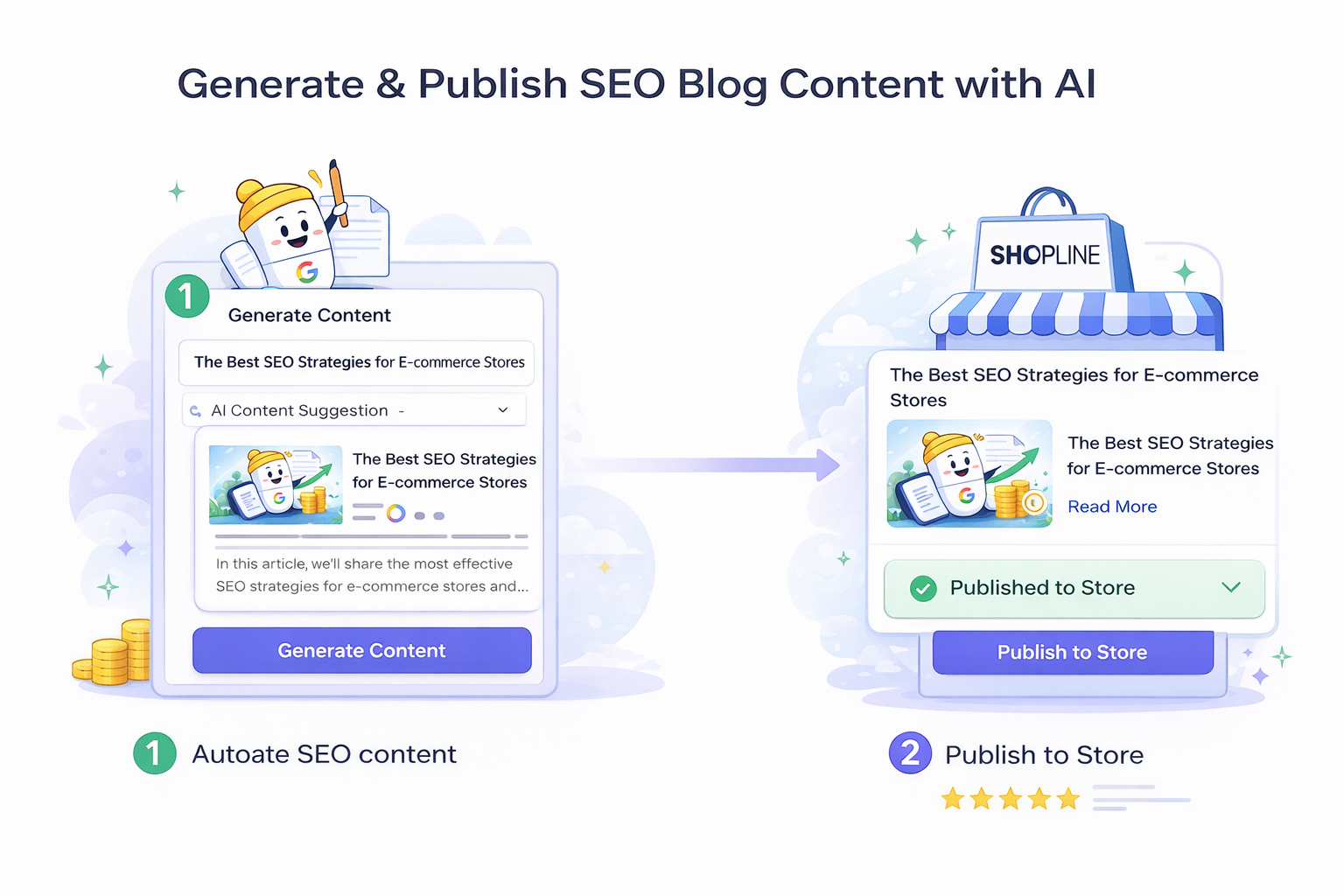
After the connection is complete, the entire workflow becomes this: In SEONIB’s “Automatic Publishing” module, we set up the “signal sources” to monitor – this could be our product’s core keywords, competitor dynamics, or even a link to a popular YouTube video. Then, the AI Agent begins working 24⁄7.
It automatically monitors the dynamics of these signal sources. Once it captures a hot topic or subject worth creating content about, it automatically initiates the content generation process. The generated articles are not simple information dumps, but will combine our store’s product characteristics to produce content with in-depth reviews or pain point solutions. The most crucial step is that these articles will be automatically and scheduled pushed to the designated blog category of the SHOPLINE store according to our preset publishing rhythm, with the status directly showing “Published.”
This means the entire process, from monitoring, creation, to publishing, achieves true unattended operation. Our team’s role shifts from content producers to strategy makers and quality auditors (of course, SEONIB also supports manual review before publishing). We can focus our energy on planning content matrices, analyzing traffic data, and optimizing conversion paths.
The Transformation of Operational Perspective Brought by Automation
When the foundational work of content production is taken over by an automated pipeline, the focus of operations undergoes a fundamental shift.
Firstly, scalability. We no longer agonize over “what to write this week” and “who will write it.” Through SEONIB’s batch generation feature, we can plan and generate dozens of articles at once based on a core theme or a series of keywords, and let the AI agent publish them automatically according to the plan. This enables us to quickly build a content matrix covering long-tail keywords, something unimaginable in the manual era.
Secondly, optimization of cost structure. This involves two levels. One is the significant reduction in direct labor and time costs. The second is that when choosing tools, we highly value SEONIB’s permanent credit validity model. Unlike common SaaS monthly subscription models, it allows us to flexibly adjust content output rhythm according to sales seasons. During peak seasons, we can increase content investment; during off-peak seasons, we can accumulate credits without paying for idle monthly quotas. This pay-as-you-go, resource-unwasted model is highly cost-effective for independent site sellers pursuing refined operations.
Finally, data-driven iteration. Automation frees up manpower, allowing us to focus more on results analysis. We regularly check the traffic performance, dwell time, and conversion rates of different automated content series in the SHOPLINE backend and Google Analytics. This data is fed back into SEONIB’s signal source settings, optimizing the direction of AI monitoring and creation, forming a growth loop of “strategy - automated execution - data analysis - strategy optimization.”
Future Outlook: Deep Integration of AI Agents and Independent Site Operations
Integration with SHOPLINE and automated publishing is just the beginning. In my opinion, future independent site content operations, and even broader marketing operations, will be collaboratively completed by multiple professional AI agents. One responsible for monitoring trends and generating content, another for managing social media distribution, and a third possibly specializing in analyzing competitor dynamics and adjusting advertising strategies.
Automation pipelines like SEONIB play the role of the “central nervous system” and “execution arm.” They translate our business strategies (what content is needed) into specific, automatically executable instructions, and ensure the results (published articles) are accurately landed on our digital assets (independent sites).
This process no longer requires developer intervention, nor does it require operations personnel to repeatedly switch between platforms and copy-paste. It makes content, a segment that once relied most on creativity and manpower, predictable, scalable, and continuously optimizable. For independent site operators in 2026 and beyond, building such automated capabilities may no longer be an “optimization choice,” but a “survival necessity.”
FAQ
Q: After connecting SEONIB, will the AI automatically published content affect the manually published blogs in my SHOPLINE store? A: Not at all. Content published by SEONIB will enter the specific “blog collection” (e.g., News) you specified during configuration. Your original blog articles and category structure will remain unchanged, and the two will not interfere with each other. You can view and manage all articles uniformly in the same blog management interface in the SHOPLINE backend.
Q: How is the quality of automatically generated content guaranteed? Will it sound mechanical? A: This depends on how you set up the “signal sources” and generation instructions. Our experience is that providing more specific and scenario-based instructions (e.g., “solve YY pain points around XX product”) will result in more targeted and in-depth AI-generated content. SEONIB’s generation logic includes SEO optimization and in-depth analysis of source content, not simple compilation. We recommend quickly reviewing a few articles after initial generation and fine-tuning the instructions based on the results. You will soon achieve stable and usable quality.
Q: What exactly does “permanent credit validity” mean? What are its advantages compared to traditional subscription models? A: Traditional SaaS typically involves monthly or annual payments, granting a fixed usage quota (e.g., 100 articles per month), which expires. SEONIB’s credit system means that the credits you purchase are permanently valid and do not expire monthly. This offers great flexibility: during peak traffic seasons (e.g., Black Friday, Christmas), you can use credits to publish content intensively to capture traffic; during off-peak seasons, you can reduce publishing and save credits for future use, without paying for unused periods, achieving true cost control and pay-as-you-go investment.