How My SaaS Content Production Pipeline Broke and Was Rebuilt in 2026
I run a SaaS product targeting the global market. A few years ago, our content strategy was stuck in a simple loop of “keyword-article-publish.” Our team of two or three content writers churned out a dozen blog posts a month, manually published to WordPress. Everything seemed stable until we decided to scale.
The problems didn’t appear suddenly; they crept in like a frog in slowly boiling water. As we tried to double our blog output to cover more niche markets and languages, the entire process began to crack. Writers were overwhelmed, translation quality was inconsistent, publishing times were chaotic, and most critically, our content well ran dry – we were constantly rehashing the same core keywords and couldn’t capture rapidly changing industry trends. Traffic growth stagnated, and the top of our conversion funnel remained stubbornly narrow.
I realized we didn’t need more people; we needed a completely new system adapted to the 2026 content ecosystem. This system had to address several core pain points: diversity of content sources, scalability of production, and seamless integration with global distribution channels. After a period of struggle and trial-and-error, my workflow ultimately restructured around one tool: SEONIB.
From Single Keywords to Multi-Source Input: Breaking the Creative Bottleneck
The initial breakdown began with “not knowing what to write.” Traditional SEO writing relied on keyword lists, but in the SaaS domain, especially in tech-driven fields, hot topics and trends often emerge on social media, in industry reports, or in deep dives by competitors, rather than waiting for you to search for keywords.
I remember one instance where a significant industry update sparked extensive discussion on Twitter and LinkedIn. It took us three days to organize a response article, by which time the traffic had already been captured by more agile competitors. This “time lag” is fatal in competition.
SEONIB’s first shock to me was how it broadened the concept of “input.” It’s not just a keyword generator. You can paste a YouTube video link, and the AI will analyze its content and transform it into a well-structured SEO blog post. This is crucial for converting video traffic into long-tail search traffic. Similarly, you can input a URL of a competitor’s excellent article and perform a deep rewrite and restructuring, providing a much higher starting point than simple keyword expansion.
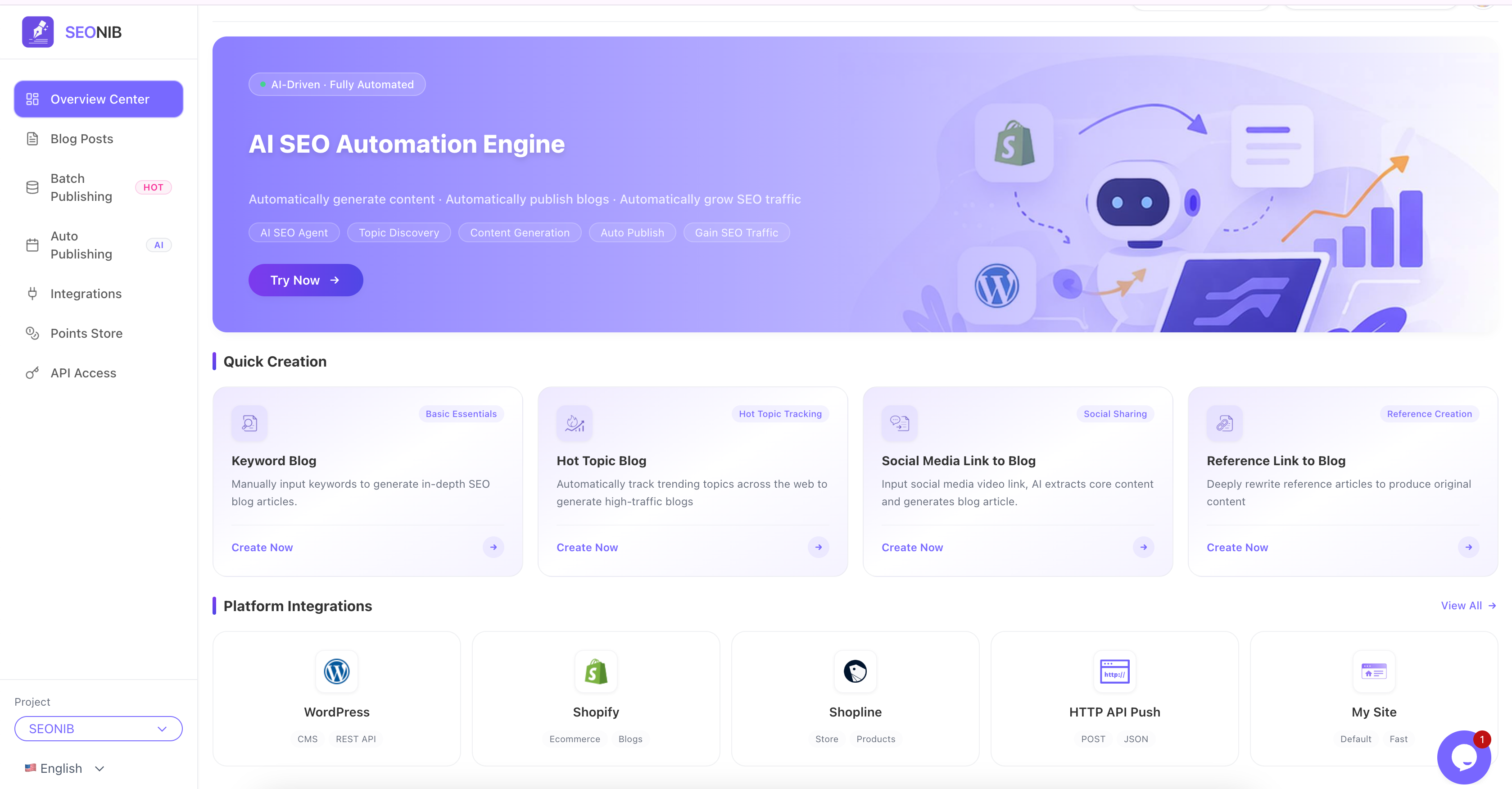
Even more impactful is its “Industry Hot Topics Blog” mode. You input a few broad industry terms, click to get the latest trends, and the AI pulls real-time hot topics. This is equivalent to equipping the content team with a 24⁄7 industry radar. We no longer passively wait for inspiration; we can actively intercept traffic. This shift from “keyword-driven” to “timeliness-driven” is a critical step in modernizing content strategy.
Scaling and Automation: From “Handicraft Workshop” to “Content Pipeline”
Having solved “what to write,” the next question was “how to write so much.” Manual writing, translation, typesetting, and publishing – each step was a time bottleneck. When we planned to expand content into ten languages and establish a publishing rhythm of dozens of articles per week, the manual process was completely unfeasible.
We tried some automation tools, but they often got stuck in two areas: first, the quality of bulk-generated content was inconsistent, like cheap products from an assembly line; second, integration with CMS was not deep enough, requiring significant manual adjustments after publishing.
SEONIB’s “bulk generation + automatic publishing pipeline” design directly targets these two pain points. You can configure a task – for example, generate five language versions for each of ten hot topics – and then batch generate with one click. This isn’t just a quantitative increase. I found that because its core is a unified AI model, the consistency in style and quality of bulk-generated articles far exceeds the results from different writers working independently. This is crucial for establishing a unified brand voice.
Even more critical is the publishing stage. It natively supports mainstream CMS like Shopify, WordPress, and Shopline. Connect once, and subsequent articles can be published automatically, even supporting scheduled publishing. This means I can set up a content matrix that automatically publishes articles in different languages at different times throughout the week, without manual oversight. This completely liberates us from the role of “content producer” and “publishing operator,” allowing us to focus more on strategy and optimization.
Editor Details: The Overlooked Yet Crucial Experience
When evaluating any tool, I always focus on the seemingly small details that severely impact the daily experience. Several designs in SEONIB’s editor make me feel it was truly polished from user operations.
Smart Image Pairing System: Finding images for technical blogs used to be very time-consuming. Either we used generic stock photos or created our own charts. Its AI-generated image feature allows you to input descriptive text to create original illustrations. Even more importantly, the “favorite” function allows you to save a suitable diagram, adding it to a favorites tag that can be reused in all subsequent articles. This builds a growing library of brand-exclusive visual assets.
Secure Cloud Drafts: Content creation often spans devices and time. Its “save draft” feature synchronizes progress to the cloud at any time. I’ve had several instances where inspiration struck on a plane or in a coffee shop, and I could continue editing unfinished articles from my computer on my phone or tablet, with seamless transitions. For distributed teams or frequent travelers, this isn’t a nice-to-have; it’s a lifesaver.
SEO and Translation Synchronization: This is another ingenious detail. After writing an article, clicking the SEO tab can automatically generate meta titles and descriptions. When you translate an article into multiple languages, these SEO elements are also translated. This means you get not only multilingual article bodies but also multilingual metadata, providing a complete one-stop solution for global SEO. When doing this manually, we often forget to translate meta descriptions, leading to significantly reduced search performance for non-English versions.
Pre-Publish Check and Non-Mandatory: A Wise Balance
SEONIB has a “pre-publish check” window before publishing, showing the completion progress of elements like title, SEO, body text, and cover image. However, it’s marked as “non-mandatory” – you can still click “continue publishing” even if translations are incomplete or SEO elements are missing.
I like this design. It provides a quality control reference but doesn’t lock you in with mandatory rules. In real operations, sometimes you need to publish an article quickly to capture a hot topic, and you might not have time to perfect all the details. The tool reminds you but returns the final control to the operator. This “assistive rather than dominant” philosophy is more suitable for professional scenarios requiring flexibility.
The Rebuilt Pipeline and Continuous Observation
After introducing SEONIB, our content pipeline looks like this:
- Content Source Input: Daily mixed use of keywords, capturing industry hot topics, analyzing competitor URLs, and converting social media content.
- Batch Generation: Set up batch tasks once a week to generate multilingual versions of core topics.
- Editing and Enhancement: Make final adjustments in the editor, using AI tools to optimize images and SEO.
- Automatic Publishing: Configure scheduled publishing plans and sync to WordPress and Shopify with one click, requiring no manual intervention throughout the process.
Traffic and lead numbers saw a significant increase within three months, especially from non-English markets and short-term traffic captured through hot topics. However, I remain observant: are completely automatically generated content still limited in emotional resonance and extremely in-depth technical analysis? I believe the answer is yes. Therefore, we retain the “handwritten blog” mode for content requiring extreme depth or unique brand narratives, while utilizing all AI enhancement tools in the editor for assistance.
The tool liberates our productivity, but the brain for strategy and creativity still needs to be operated by us.
FAQ
Q: Can the quality of content generated from multiple sources truly remain consistent? Will some generation modes produce better articles? A: In my experience, the core quality depends on the quality of the input source. If you input a well-structured, information-rich YouTube video or webpage, the generated article will have a good foundation. Articles generated from the “Industry Hot Topics” mode, due to the timeliness and discussion surrounding the topics themselves, often gain initial traffic more easily. The key is that you need to review and fine-tune the generated results; you can’t let it run completely unsupervised. However, overall consistency is higher than with different human writers.
Q: Is automatic publishing with CMS truly reliable? Will there be formatting errors? A: We connected to WordPress and Shopify, and it has been very reliable so far. The formatting of published articles (title, body, image layout) is consistent with the preview in the SEONIB editor. It seems to handle the template differences of various CMS well. Of course, after the initial connection, I recommend publishing one or two test articles first to check the display effect on your specific website theme.
Q: Will this automated pipeline lead to content that is too “industrialized” and loses brand personality? A: This is a question that requires balance. Automation solves scale and efficiency, but brand personality needs to be injected through other means. We use SEONIB’s “handwritten blog” mode to create core brand stories and in-depth thought leadership content. At the same time, in bulk-generated articles, we consistently incorporate brand-specific narrative frameworks and case study references. The tool provides the skeleton; you need to fill in the flesh yourself.