2026, The Automation Inflection Point for SaaS Content Operations: From Tool Integration to API-Driven Workflows
In the SaaS content operations landscape of 2026, a clear trend is emerging: practitioners are shifting their focus from “what tools to use” to “how to build automated workflows.” In the early days, teams might have been enthusiastic about trying various standalone AI writing, SEO optimization, and publishing tools, only to quickly discover that data silos and manual operation bottlenecks between tools made scaled content production still a struggle. The real leap in efficiency occurs when these tools are connected into an automated pipeline that requires no human intervention. In this context, open and flexible API integration capabilities have become the core metric for evaluating whether a content automation platform possesses “future-proofing.”
From Manual Publishing to Real-Time Synchronization: A Paradigm Shift in Content Distribution
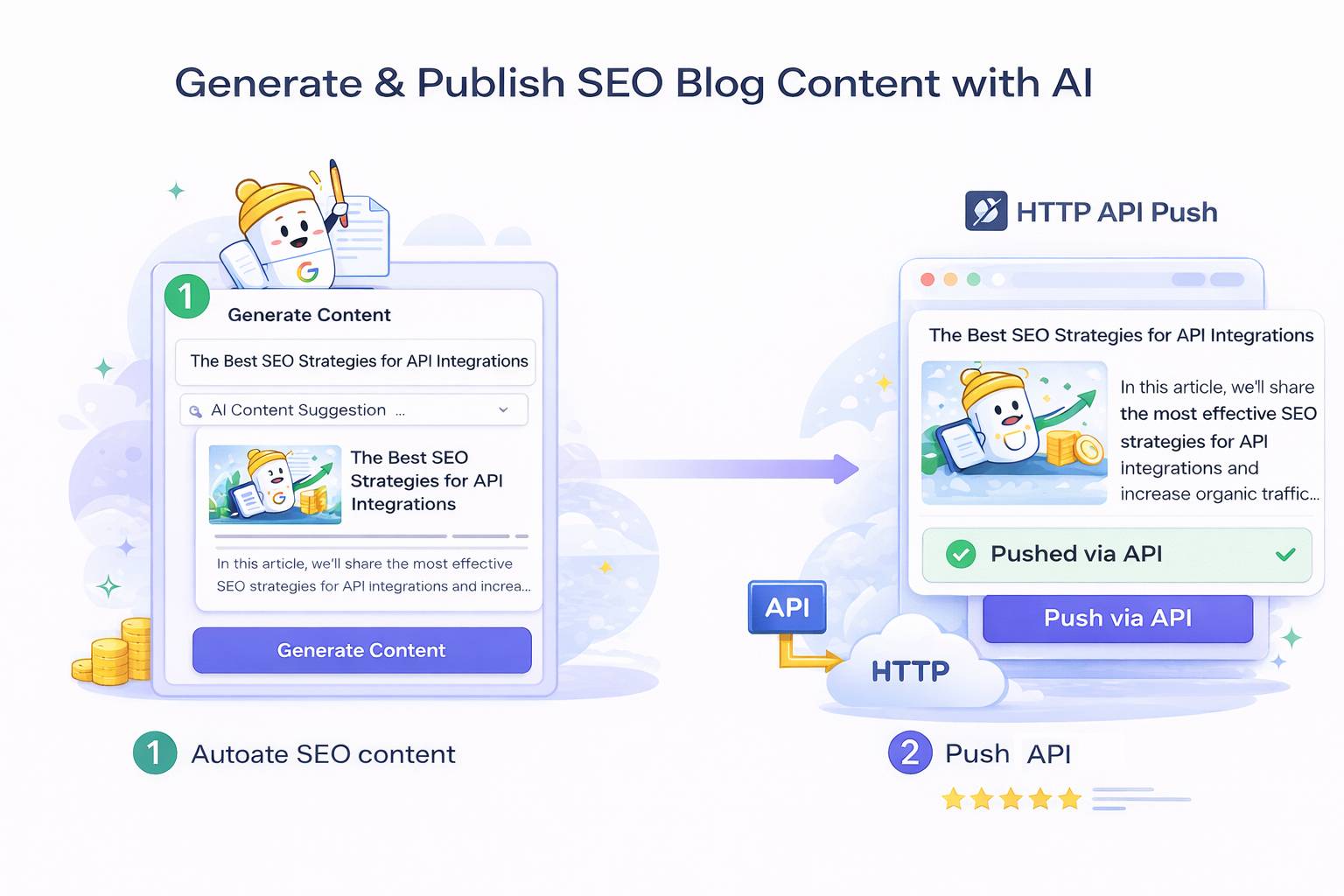
In the past, the endpoint of content generation was often exporting files or manual copy-pasting. For teams with independent websites, application backends, or complex data mid-platforms, this meant an extra, error-prone manual step. Even if content generation was automated, the disconnect in the distribution phase would drag down overall efficiency.
Many teams began seeking solutions: could content be automatically synchronized to my own systems the moment it’s generated? This is precisely where the value of HTTP API Push (Webhook) functionality lies. Taking SEONIB as an example, after its AI agent completes a blog post, it immediately pushes a structured JSON data packet to the user’s pre-set server address, including complete information such as title, body HTML, keywords, summary, and image links. This means that a user’s order system, customer portal, or internal knowledge base can access the latest content with almost no delay and trigger subsequent automated processes, such as customer email notifications, in-app message updates, or data warehousing for analysis.
This “push” model transforms the content platform from a passive data source into an active workflow trigger, a crucial link in achieving a fully automated content pipeline. Its configuration is also relatively simple, primarily involving filling in the receiving interface’s HTTPS URL and a signature key for verifying the legitimacy of requests on the “Integration Management” page in the backend.
Proactive Fetching and Deep Integration: Empowering Businesses with Complete Flexibility
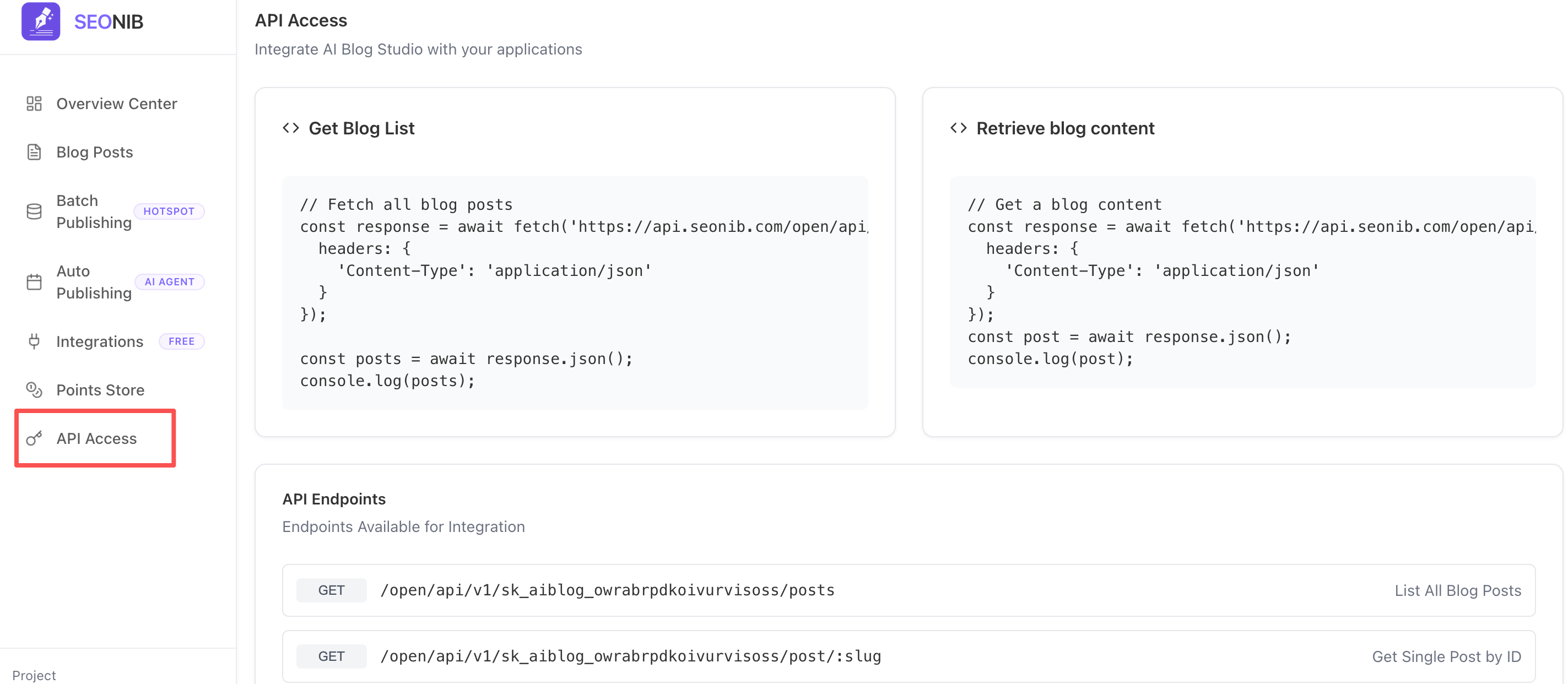
Complementing the push mode is the capability for API proactive access. This is particularly important for teams that require deeper control over integration logic or wish to pull content according to their own business rhythms. For instance, a content mid-platform might need to batch-fetch articles periodically for secondary processing, or a mobile application might want to pull the latest blog content only when its users open a specific section.
SEONIB’s standard API (with the root address https://api.seonib.com/open/api/v1/) supports this proactive fetching mode. Developers can authenticate using an API Key and use core interfaces like GET /posts to retrieve a list of articles, or GET /post/:slug to fetch complete content, including the body, AI-generated images, and SEO metadata, based on the article ID or slug. It’s important to emphasize that this method of proactively fetching content via API is completely free, requiring no paid subscription, offering developers and startup teams significant integration freedom and cost control.
These two API modes—passive push and proactive pull—form a complete content export matrix. Teams can choose the most suitable method, or even combine them, based on their technical architecture and business processes, thereby seamlessly weaving automated content flows into their broader business automation blueprints.
Beyond Tool Comparisons: Building Sustainable Operations Centered on “Perpetually Valid Credits”
When selecting an automation platform, operational cost models are as crucial as the features themselves. In 2026, a more favored model is one where resources are prepaid and perpetually valid, a stark contrast to many SaaS software offerings that mandate monthly subscriptions with resources resetting monthly.
Taking SEONIB as an example, its “perpetually valid credits” strategy offers significant long-term value to content operations teams. The generation credits purchased by users do not expire and have no monthly reset limitations. This allows teams to plan flexibly according to their content marketing rhythm: they can increase investment during peak promotion seasons to rapidly expand their content library, and accumulate resources during off-peak seasons without worrying about waste. This model returns control to the operators, supporting non-linear business growth rather than locking teams into fixed monthly output pressures.
When we consider powerful API integration capabilities in conjunction with this sustainable consumption model, a complete picture emerges: businesses can not only increase content production efficiency tenfold through automation technology but also operate this growth engine stably and long-term at a predictable and controllable cost. This is no longer a simple comparison of tool efficiency, but about how to build a content infrastructure that is resilient, scalable, and cost-effective.
FAQ
Q: How do I start integrating with SEONIB’s API? A: You can refer to the official integration guide (https://seonib.com/help/10/) to understand the configuration details of HTTP API push. For proactively called APIs, you can obtain your exclusive API Key from the SEONIB application’s control panel (https://app.seonib.com/dashboard/api) and consult the API documentation to begin development.
Q: Are there frequency limits for API calls? Will there be extra charges? A: Currently, SEONIB’s API calls have no frequency limits, and developers are encouraged to call them flexibly according to business needs. Proactively fetching article content via API is a free feature and does not depend on paid subscriptions. Only content generation itself consumes credits.
Q: What exactly does “perpetually valid credits” mean? A: This means that the credits purchased for content generation in your account will never expire. Regardless of when you purchase them, you can use them at any time in the future without any “monthly reset” or “expiration date” limitations. This provides great flexibility for planning your long-term content strategy.
Q: How can I ensure that the data pushed via Webhook is secure and has not been tampered with? A: When configuring HTTP API push, you need to set up a signature key. The SEONIB system generates a signature for the request content using this key and places it in the request header with each push. Your receiving server should use the same key to verify this signature, ensuring that the data indeed originates from SEONIB and is complete and accurate during transmission.
Q: Can free users use the API push feature? A: Yes. As long as API access is successfully enabled or HTTP push is configured in the SEONIB backend, you can experience the complete automated process from content generation to automatic push to your server within your account’s available credit allocation.