2026, The Silent Revolution in SaaS Independent Website Content Operations: From Tool Integration to AI Agent Full Managed Hosting
Looking back at SaaS content operations over the past few years, we’ve experienced an evolution from manual updates to tool assistance, and then to semi-automated workflows. However, entering 2026, I’ve observed a “silent revolution” occurring within the industry. The core of this revolution is no longer about discussing how to integrate more point-solution tools, but rather about how to build a self-driving, closed-loop content growth system. The ultimate goal is to achieve “full managed hosting” for content operations itself.
A Cognitive Shift from “Efficiency Tools” to “Growth Engines”
In the early days, our workflows were discrete. We would use Ahrefs or SEMrush to find keywords, ChatGPT to assist with outlines, Canva to create accompanying images, and finally publish manually to WordPress or Shopify. Each tool solved a specific problem and improved single-point efficiency, but at the cost of high context-switching expenses and fragmented data streams. Operators were more like “system integration engineers,” exhausted from moving data and instructions between different interfaces.
The real turning point came when we started asking: What is the ultimate goal of content production? Is it the act of “producing articles” itself, or is it acquiring sustainable search traffic and business growth through content? The answer is clearly the latter. Therefore, an ideal state should be: the system can automatically discover market opportunities (topics), automatically transform them into high-quality content, and automatically deploy them to the battlefield (website). This requires tools to evolve from “efficiency enhancers” to “autonomous growth engines.”
In practice, this means we need an intelligent agent (AI Agent) that can understand business goals, operate continuously, and require no human intervention. It’s not a feature, but a complete, end-to-end decision-making and execution pipeline.
Building a Closed-Loop System: The Triangular Synergy of Information Sources, Batch Generation, and Automated Publishing
To realize the vision described above, the key lies in connecting three core links: continuous supply of content raw materials, efficient batch content production, and precise channel publishing. This forms a stable growth triangle.
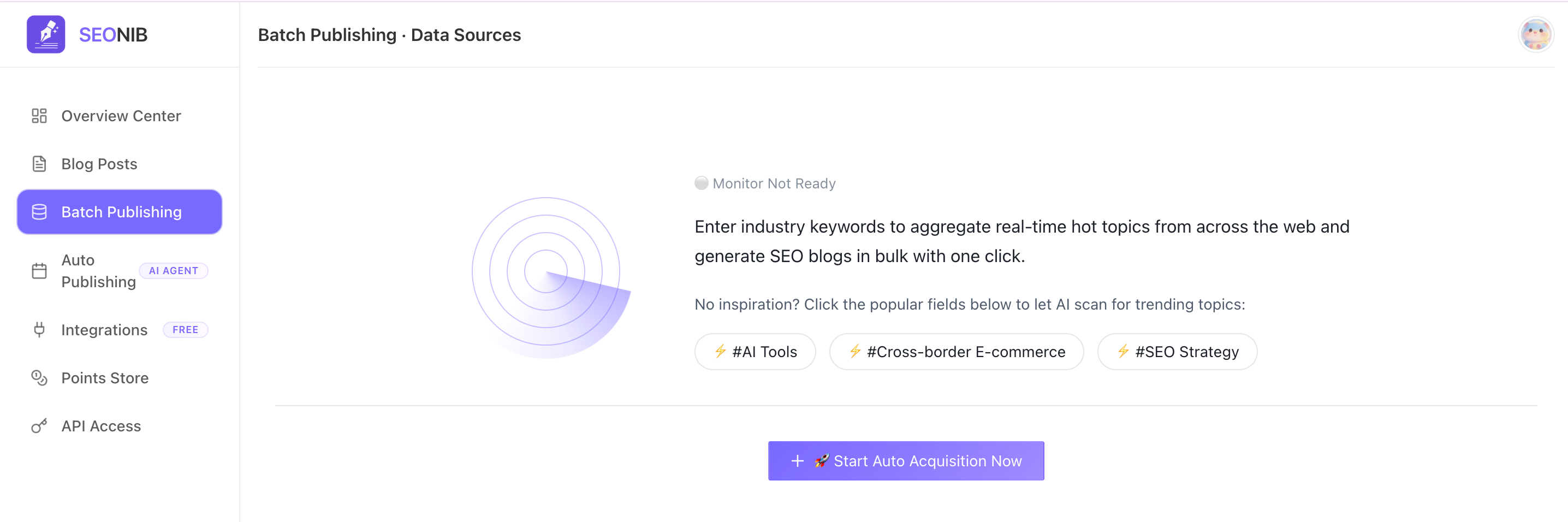
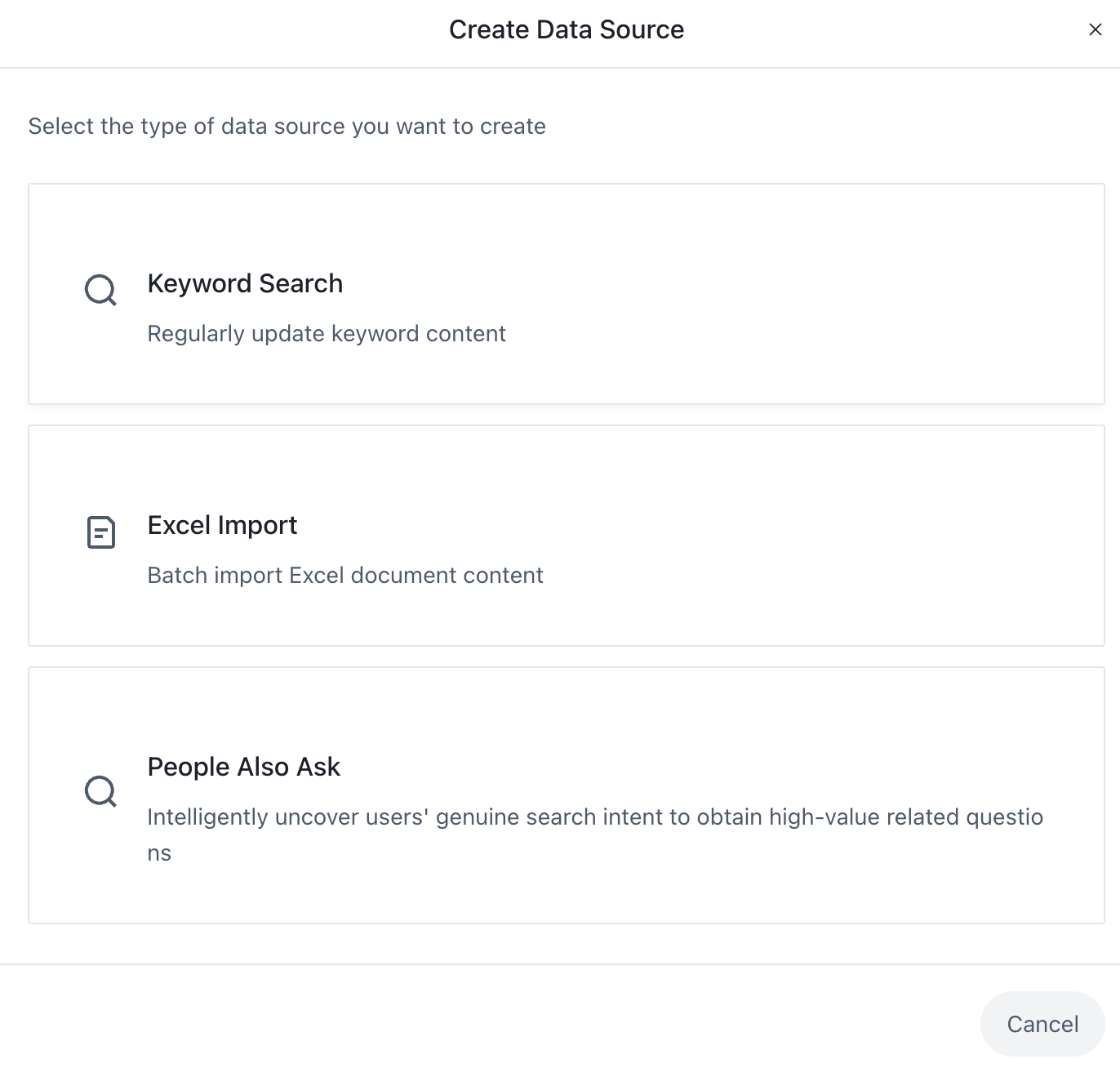
Taking automated pipelines like SEONIB, which I use, as an example, the design of its “Batch Publishing · Information Source” module perfectly embodies this logic. It’s no longer a passive keyword input box, but an automated content engine. You can create various types of “automated information sources”:
- Keyword Search Source: Used for 7x24 monitoring of industry hot topics, automatically capturing global trending topics, and maintaining content timeliness.
- People Also Ask Source: Deeply mines search intent, directly addresses users’ real pain points, and is ideal for building Q&A knowledge bases and capturing long-tail traffic.
- Excel Import Source: Used to execute specific marketing plans or batch reorganize existing content assets, achieving semi-automated targeted output.
The value of this information source module lies in its ability to achieve unattended operation for “topic finding,” the most time-consuming creative stage. The system automatically scans, deduplicates, and populates your topic library at your set frequency. As an operator, my job shifts from “finding” to “screening and decision-making” – selecting those from the list of high-quality materials automatically captured by the system that best match current business goals for the next stage of production.
Next, the “Batch Generate Blog” function sends the selected topics to the pre-set content production line with one click. This integrates multilingual generation, SEO optimization, and formatting, producing drafts that can be published directly. Finally, through linkage with the “Automated Publishing” AI agent, these articles can be automatically published to integrated CMS (such as Shopify, WordPress) according to the pre-set schedule.
Thus, a complete closed loop from “trend discovery -> content creation -> online publishing” is established. This triangular synergy system essentially builds an SEO traffic growth system that can operate autonomously.
The New Role of Operators in a Fully Managed Model: Strategist and Tuner
With the fundamental aspects of content production taken over by automated pipelines, the role of SaaS content operators has fundamentally changed. We no longer need to obsess over “how to write an article,” but rather need to consider higher-dimensional questions:
- Information Source Strategy Configuration: Which core keyword combinations should I monitor? How can I use PAA (People Also Ask) to deeply explore user questions in niche areas? How should I plan thematic content for Excel import to align with product launches or brand activities? This requires a deeper understanding of the market, users, and competitive landscape.
- Content Quality and Brand Tone Calibration: Although AI is responsible for generation, the final output must conform to brand voice and professional standards. We need to continuously train and fine-tune the generation model through feedback and instructions to ensure that the articles it produces meet standards in professionalism, readability, and commercial value.
- Data-Driven Optimization: The fully managed system will generate a large amount of data – which information sources produce topics with high conversion rates? Which types of articles bring the most organic traffic or conversions? How do publishing frequency and timing affect results? The core work of operators becomes analyzing this data and adjusting information source configurations, generation instructions, and publishing strategies accordingly, making the entire automated system run more precisely.
In other words, we have transformed from “operators” to “strategists” and “tuners.” Our core value lies in setting the right goals for the AI system, providing high-quality “fuel” (strategies and instructions), and interpreting its “operation logs” (data analysis) to guide the entire system towards the core goal of business growth.
Practical Observations: Efficiency Improvement and Risk Mitigation
After nearly a year of operating such an automated pipeline, I have several profound observations:
Efficiency is disruptive. Work that used to take a week for content planning, creation, and publishing can now be done in an afternoon of configuration and review. This frees up significant human resources to focus on more creative and strategic tasks such as content strategy, link building, and community interaction.
However, “full managed hosting” does not mean “full delegation.” In the initial stages, meticulous calibration is essential. For example, if the keyword settings for information sources are too broad, they will introduce a lot of irrelevant topics; if the generation instructions are too brief, the articles will lack depth and personality. I recommend adopting a “small steps, fast iteration” approach: start with an information source for a niche area, generate a small amount of content, review the results, adjust instructions, and then gradually expand the scope.
Another key is ensuring content uniqueness. Relying entirely on AI to crawl and reorganize public information can lead to content homogenization. Therefore, it is necessary to combine automated information sources with unique internal data, case studies, customer interviews, and other content. For example, internal user feedback and product usage data can be imported via Excel as an information source, allowing AI to create content based on these exclusive materials, thus producing content that competitors cannot replicate.
Outlook: The Future of Automated Pipelines
Looking ahead, I believe content automation pipelines will evolve towards greater intelligence and integration. For example, the system will not only be able to capture topics but also predict their trend heat; it will not only generate articles but also automatically perform A/B testing and optimize subsequent content strategies based on real-time performance data (click-through rates, dwell time, conversion rates) after publishing; deep integration with systems like CRM and CDP will enable content creation to perfectly match user lifecycle stages, achieving truly personalized content experiences.
The silent revolution of 2026 lies in its redefinition of the boundaries of SaaS content operations. Competition will no longer be limited to who writes better articles, but to who can faster and more intelligently build and leverage a self-evolving, continuously producing content growth engine. For practitioners, embracing automated pipelines and completing the role transition from executor to strategist will be key in this new era.
FAQ
Q: What is the fundamental difference between automated information sources and traditional RSS subscriptions or keyword monitoring tools? A: Traditional tools are primarily “information movers,” providing raw data or link lists that require manual secondary screening, interpretation, and creation. Automated information sources (like the design in SEONIB) are “content engines.” They integrate monitoring, mining, deduplication, and preliminary structuring, producing “creative materials” or “topics” that can be directly used for AI content generation. The goal is seamless integration with the next stage of batch production, achieving pipeline flow from information to finished product.
Q: How can fully automated content production guarantee content quality and brand uniqueness? A: Quality assurance relies on two levels: first, the generation model’s capabilities and rich adjustable parameters (such as tone, style, professionalism instructions) of the system itself; second, the operator’s “tuning” work. The system needs to be trained to meet brand requirements through repeated generation-review-feedback loops. Uniqueness is achieved through information source strategies, such as mixing public trend monitoring with exclusive internal data import, to ensure that the “raw materials” processed by AI have a differentiated advantage.
Q: For newly launched independent websites or small teams, is it too costly or complex to immediately set up such an automated system? A: On the contrary, these automated pipelines lower the barrier to entry for professional content operations. Through templated, wizard-like configuration (e.g., using popular industry templates to quickly create information sources), small teams can quickly establish a sustainable content production foundation without needing to build a complete content team or learn numerous complex tools. Its pay-as-you-go model and points that never expire also allow small teams to flexibly control costs and scale smoothly according to business rhythm.