2026: Why Are More SaaS Professionals Launching Independent Content Sites?
In the past few years, we’ve witnessed a clear trend: the risks of relying solely on a single platform for traffic, whether it’s social media or an e-commerce store, are increasing. Algorithm changes, policy adjustments, or the rise and fall of the platform itself can wipe out traffic accumulated overnight. Therefore, building a content hub that is entirely under one’s own control, capable of continuously accumulating brand and SEO assets, has gradually transformed from an “optional choice” into a “must-have” for many SaaS and e-commerce professionals.
However, building and maintaining an independent website traditionally means investing in server costs, front-end development, back-end operations, and continuous content updates. This presents a significant barrier for teams without a technical background or for resource-limited startups. The market needs a solution that seamlessly integrates high-quality content production with zero-barrier website hosting. This is not just about building a website; it’s about establishing a sustainable, automated system for content output and brand exposure.
A One-Stop Closed Loop from Content Generation to Brand Hub
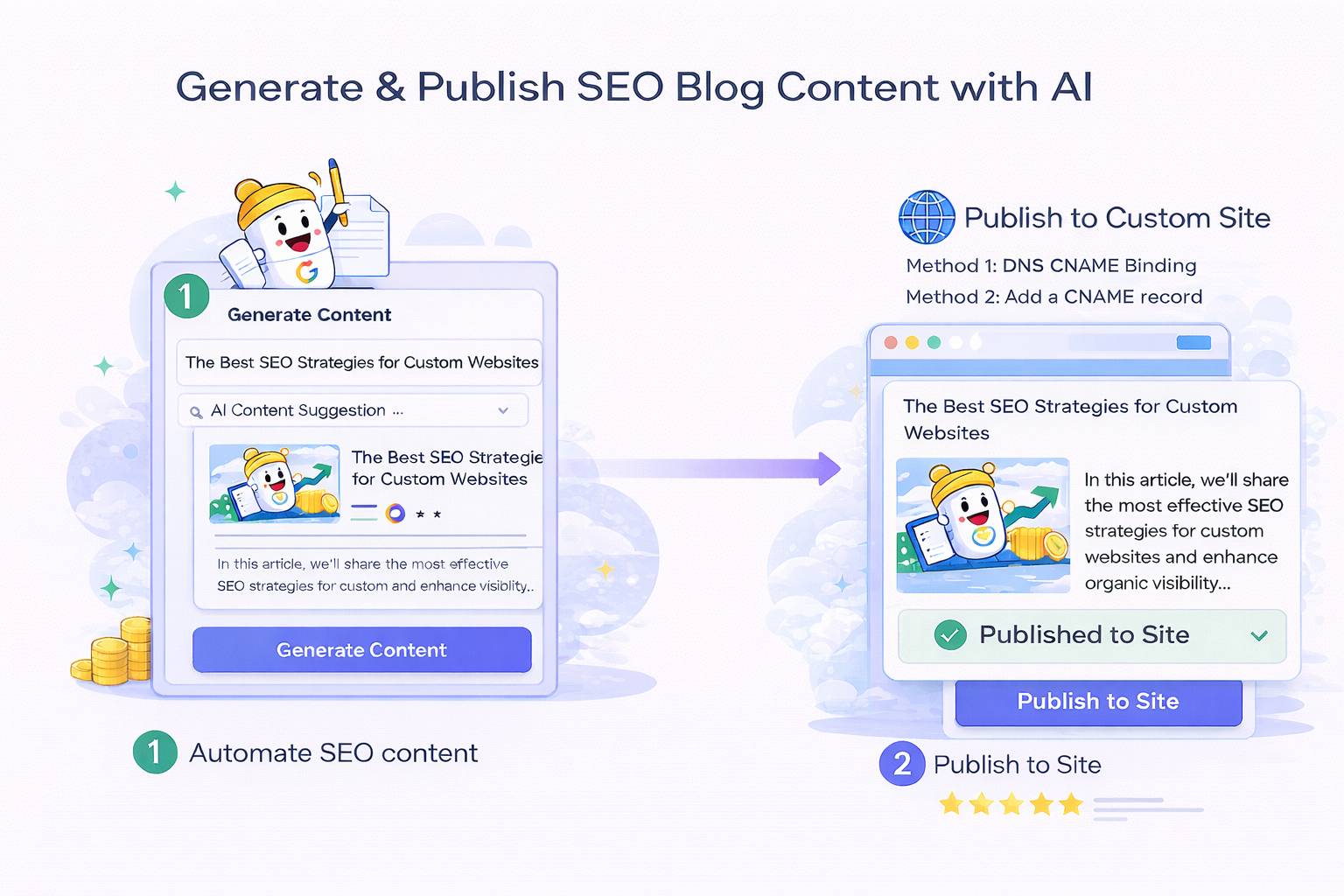
Many content automation tools stop at the “generation” stage. They can produce decent articles, but how to effectively publish this content and form an independent site with brand recognition often requires users to figure it out themselves. This creates a workflow disconnect: content production is automated, but content publishing and site management remain manual and fragmented.
True efficiency gains come from a closed loop. The ideal workflow should be: select a topic or source material → AI generates multilingual SEO articles → publish with one click to a website that completely belongs to your brand. This website doesn’t require you to purchase servers, configure environments, or write code; it should exist as a natural extension of the content production process. Users’ core energy should always be focused on content strategy and business growth, not technical implementation.
This is precisely the evolution of demand we’re seeing in practice. Professionals are no longer satisfied with simply publishing articles on third-party blog platforms; they need an “owned website” that can carry their brand image, accumulate independent domain authority, and be deeply integrated with their existing content workflow. This website serves as the ultimate carrier of content, the cornerstone of brand trust, and a direct entry point for search engine traffic.
How to Launch Your Brand Content Site at Zero Cost
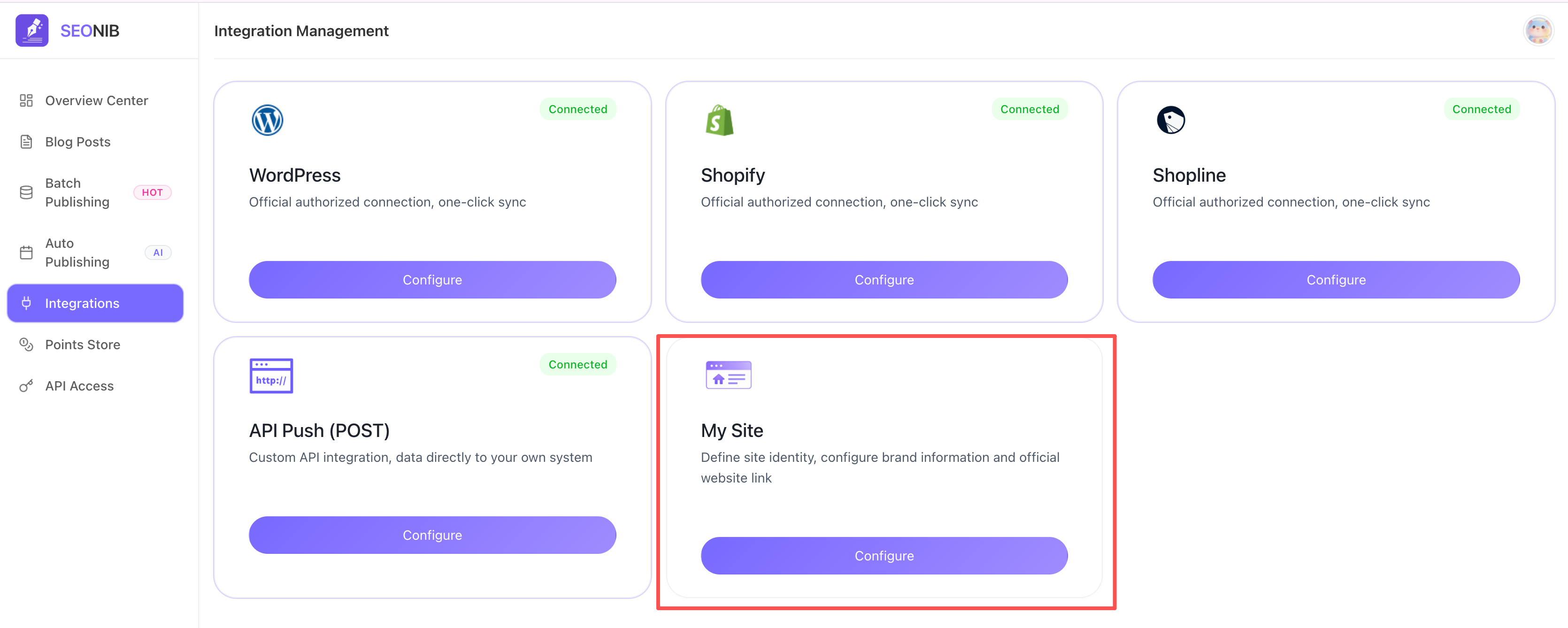
Based on the aforementioned needs, corresponding solutions have emerged in the market. Taking SEONIB as an example, its “Owned Website” feature offers a very intuitive entry point. It is essentially a hosted, highly customizable brand content site deeply integrated with the platform’s content generation engine.
After registering, users don’t need any additional operations. The system will automatically assign a temporarily accessible domain name, formatted like https://xxxx.site.seonib.com. This site is fully functional, and you can start publishing content and testing features immediately. More importantly, building this site itself is free. You don’t need to pay any fees for the website’s basic infrastructure, hosting, or maintenance, which completely removes the technical and cost barriers during the startup phase.
Of course, a temporary domain is more suitable for testing and initial use. For formal brand operations, binding your own domain is essential. This process is also designed to be as simple as possible. The platform typically offers two mainstream methods: one is the CNAME resolution method recommended for the vast majority of users, which only requires adding a record in the domain registrar’s backend; the other is for users with existing servers who wish to integrate the blog as a subdirectory of their website, providing Nginx reverse proxy configuration examples. The official documentation provides detailed step-by-step guides, and for users with basic operational experience, configuration can be completed in a very short time.
For specific connection and configuration steps, SEONIB’s official help center has a very clear tutorial covering the entire process from creating a website, publishing articles, to binding a custom domain. You can view this latest updated document at https://seonib.com/help/8.
Core Value and Observations of Operating an Owned Content Site
Once we operate such an owned website, some long-term values begin to emerge. Firstly, it becomes a stable pool for accumulating SEO assets. All published content continuously builds authority for the same independent domain. This accumulation is linear and predictable, unaffected by drastic fluctuations in third-party platform algorithms.
Secondly, brand control is significantly enhanced. From the website logo and name to the overall visual style, everything can be customized according to brand guidelines. From the moment visitors enter the site, they receive a complete and consistent brand experience, greatly enhancing professionalism and trust. Furthermore, the multilingual support feature allows the system to automatically generate corresponding content pages for selected languages, providing an excellent testing ground and publishing channel for global content strategies.
From an operational perspective, the most profound realization is the “simplification of workflow.” When content generation and publishing are within the same platform, management efficiency is significantly improved. Selecting an AI-generated article from the content list and clicking “Publish” to “My Website” will automatically display the article in the corresponding category or page on the website. This seamless integration makes large-scale, multilingual content matrix operations possible without the need to switch back and forth between different tools and interfaces.
Thoughts on Future Content Strategy
Looking ahead, the role of independent content sites is likely to be further strengthened. With the diversification of the search ecosystem and the growing user demand for direct brand engagement, a professional, continuously updated owned website will not only be a traffic channel but also a comprehensive center for customer education, product display, and trust building. It will integrate content marketing, SEO, and brand building.
For SaaS, e-commerce, or any business that relies on online influence, investing in an owned website with zero technical barriers and seamless integration with automated content production workflows is no longer a complex decision. It’s more like a “standard configuration” for modern business. The key is to find the tool that creates a perfect closed loop between “generation” and “publishing,” freeing your team from tedious technical details to focus on content strategies that truly create value.
FAQ
Q: Do I need to prepare my own server to build such an owned website? A: Absolutely not. Taking the solution mentioned in the article as an example, website hosting services are automatically provided by the platform. Users do not need to worry about any back-end technical issues such as server purchase, configuration, or maintenance, truly achieving zero-technical-barrier website building.
Q: Are there any functional differences between using a temporary domain and binding a custom domain? A: There are no differences in core functionality. The temporary domain already has complete content publishing, display, and access functions. Binding a custom domain (e.g., blog.yourcompany.com) is primarily for brand image, SEO authority accumulation, and user experience, allowing the site to be fully integrated into your brand system.
Q: Is binding my own domain free? Will there be any additional costs? A: The service of binding a custom domain is provided free of charge by the platform. You need to own your domain name (which can be purchased from domain registrars like GoDaddy, Alibaba Cloud, etc.), and there are no fees charged by the platform for the binding process. The platform only charges for content generation and related services.
Q: Does the website support multilingual content? A: Yes. When creating a website, you can select the languages you need to support (e.g., English, Chinese, Japanese, etc.). When publishing content later, the system can automatically generate corresponding pages for different languages based on your settings, making it convenient for you to manage your global content strategy.
Q: If I already have an existing company website, can I integrate this blog as part of the main website? A: Yes. In addition to using an independent subdomain (e.g., blog.example.com), you can also integrate the blog as a subdirectory of your existing main website (e.g., example.com/blog/) using reverse proxy technology. This requires you to have configuration permissions for your main website’s server and follow the guide for Nginx or other server configurations.