2026: When SEO Becomes an Intelligent System of Human-Machine Collaboration
In the realm of digital marketing in 2026, a prevailing consensus is taking shape: the marginal returns of traditional SEO paradigms, centered on keywords and backlinks, are diminishing rapidly. This is not because search engines are becoming less important—quite the contrary, search behavior itself is more deeply embedded in the fabric of digital life—but because the underlying logic driving search, and the way users interact with information, has undergone a fundamental transformation. Search engines are no longer merely tools for answering questions; they are evolving into intelligent agents that understand intent, predict needs, and proactively offer solutions. Consequently, the role of SEO professionals is shifting from “optimizers” to “information architects” and “context engineers.”
From Keyword Matching to an Symphony of Intent
In the past, we dedicated significant effort to researching keyword search volume and competition, attempting to precisely match content with these terms. By 2026, this thinking appears overly linear. New-generation search systems, powered by Large Language Models (LLMs) at their core, possess semantic, context-driven, and even multimodal understanding capabilities. A user’s brief query may be linked to a series of complex, unstated needs.
For instance, a technical lead at a SaaS company searches for “improving team code quality.” In a traditional model, we might create an article about code review tools or best practices. However, in an AI-driven search environment, the system can recognize that this user might be in the middle of a project, facing delivery pressure, and their deeper intent could be “systematically reducing production environment error rates without significantly extending the development cycle.” Therefore, a truly effective SEO strategy involves building a content ecosystem that can respond to this composite intent: it might include case studies (showcasing how similar SaaS companies achieve goals through process improvements), tool integration solutions (such as seamlessly embedding code quality scanning into existing CI/CD pipelines), and ROI calculation models. Content no longer exists in isolation but becomes a node within a network of intent response.
In practice, this means that the upfront work of content planning has undergone a massive change. We no longer start with a keyword list but with the “Job-to-be-Done Journey” of a user persona within a specific business context. We need to map out the user’s entire process from problem recognition to solution evaluation and implementation decisions, identifying the various forms of “inquiries” they might pose to search engines (or AI assistants) at each stage. These inquiries could be text, voice, or even an image query from a screenshot (“What does this error log mean?”).
Authority: How It’s Redefined in the Eyes of AI
The E-E-A-T (Experience, Expertise, Authoritativeness, Trustworthiness) guidelines have been emphasized for years, but in the new era of AI content evaluation, their meaning is imbued with more dynamic and verifiable dimensions. Authority is no longer solely endorsed by backlinks from authoritative websites. AI systems can form their own judgments of authority by analyzing vast data sources, cross-validating the accuracy, timeliness, and consistency of information.
What does this mean for a SaaS company’s website? Firstly, depth and original research become paramount. Publishing industry benchmark reports based on your own real customer data (anonymized) or original solution white papers for specific technical challenges provides unique value that is difficult to replicate elsewhere, making it easily recognizable by AI as a high-authority signal. Secondly, the explicit visualization of expert networks. Having domain experts within the team (not just executives, but also frontline solution architects and senior engineers) contribute insights under their real names and participate in industry forum discussions allows their professional backgrounds to be linked and evaluated in the open web, thereby enhancing the entire brand’s expert image.
Furthermore, the deep application of structured data has become the infrastructure of authority. This goes beyond marking up product information or articles; it involves providing key metrics from case studies (such as percentage increase in efficiency, cost savings data), API parameters from technical documentation, and core data points from industry reports in rich structured formats (like JSON-LD). This is equivalent to providing an efficient, unambiguous “data superhighway” for AI evaluators, enabling them to quickly extract and verify core claims.
The Intelligent Evolution of Technical SEO: From Diagnosis to Prediction
The foundations of technical SEO—crawling, indexing, rendering, and Core Web Vitals—remain crucial, but the tools and methods for maintaining these foundations have become intelligent. The era of manually auditing thousands of URLs is long gone. Current technical SEO platforms are more like “predictive maintenance centers” for site health.
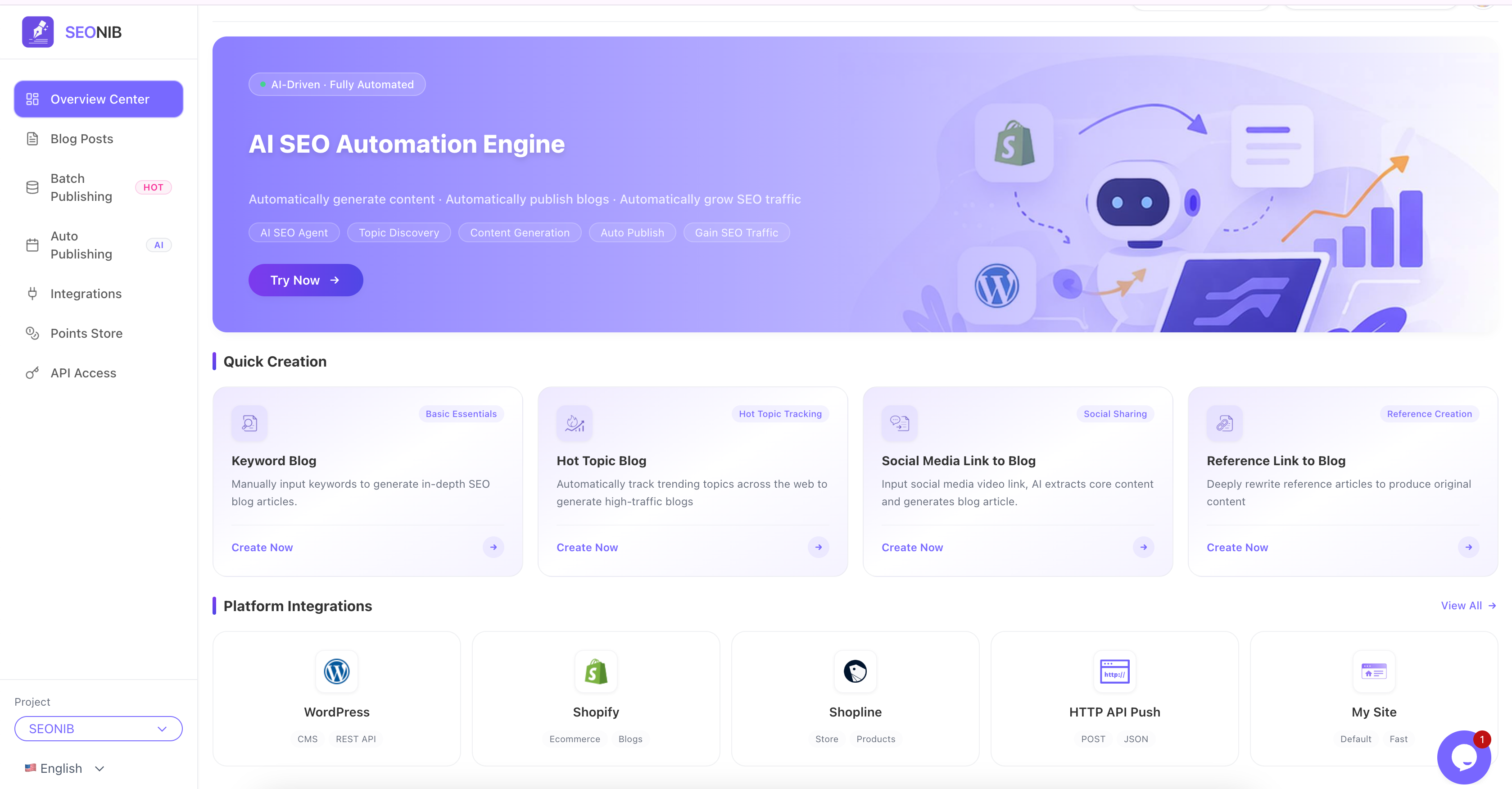
Taking our experience with platforms like SEONIB as an example, they not only monitor index coverage and crawl budget allocation efficiency in real-time but also utilize machine learning models to predict which pages or technical configurations might be at risk in future algorithm updates or user experience evaluations, based on historical data and industry benchmarks. For instance, the system might issue a warning: “Based on the analysis of upcoming Core Web Vitals weighting adjustments, the loading pattern of interactive elements on your product comparison pages may cause the CLS (Cumulative Layout Shift) score to decline in the next four weeks. Prioritization of optimization is recommended.” This shifts the work of SEO teams from passively responding to problems to proactively planning optimization roadmaps.
Simultaneously, the integration of technical SEO with DevOps is closer than ever. Integrating SEO platforms with CI/CD pipelines via APIs has become standard practice for many advanced SaaS teams. Any new feature deployment or code commit can automatically trigger a set of pre-release checks for core SEO elements, ensuring that new changes do not inadvertently break existing search visibility assets.
The Art of Balancing Personalization and Privacy
With tightening global data privacy regulations and browser restrictions on third-party cookies, personalized marketing that relies on fine-grained user behavior tracking faces challenges. However, AI-driven SEO has found new avenues for delivering “contextually relevant” content. It no longer relies on tracking individual user history but achieves dynamic matching through a deep understanding of the immediate context of the query and the semantic depth of the content itself.
For example, when a user searches for “SaaS customer retention strategies,” the search engine’s AI can analyze in real-time the industry potentially associated with the query (through the user’s public professional information or subtle word choices in the query), the company’s stage of growth (retention strategies differ significantly between startups and mature companies), and even the current economic cycle context. It then searches its index for pages that explicitly indicate their applicable scenarios (through good structured data and in-context cues within the content) for priority display.
This requires our content creation to be more layered and modular. A comprehensive guide on “customer retention” should be clearly structured internally, allowing AI to easily identify modules such as “early-stage retention tactics for PLG (Product-Led Growth) SaaS” and “annual renewal negotiation strategies for enterprise SaaS,” thereby presenting the most relevant snippets to users for corresponding segmented query intents.
Human-Machine Collaboration: The New Positioning of SEO Professionals
Looking ahead to 2026, the most successful SEO strategies will no longer be purely human-driven or purely automated but will involve a high degree of human-machine collaboration. AI tools (such as content generation assistants, trend prediction models, competitive intelligence analyzers) will handle massive data, generate preliminary insights, and execute repetitive tasks. The value of human experts will lie in three areas:
- Strategic and Ethical Judgment: Setting optimization goals, balancing short-term traffic with long-term brand authority, and ensuring content strategies align with brand values and business ethics.
- Creativity and Emotional Connection: Injecting unique industry insights, narrative techniques, and emotional resonance that only humans can provide, transforming AI-generated information skeletons into persuasive and memorable content.
- Complex Problem Solving: Addressing anomalies that AI cannot handle, coordinating cross-departmental resources, and making critical decisions based on deep industry knowledge.
SEO professionals are becoming “search experience architects.” They need to understand the “thinking” of AI, skillfully utilize intelligent tools, and simultaneously infuse the entire optimization process with uniquely human strategic thinking, creativity, and empathy, ultimately building a digital asset system that is both efficiently understood by machines and deeply resonates with people. The core of this transformation is shifting from “optimizing to cater to algorithms” to “building to serve users,” and AI is our unprecedentedly powerful ally in achieving this ultimate goal.
FAQ
Q: Will AI-generated content (AIGC) be penalized by search engines? A: Search engines (like Google) have explicitly stated that their policies target content quality, not the method of generation. Whether created by humans or AI, low-quality, valueless “spam content” created solely for search rankings will be penalized. The key is whether the content provides unique value, expert insights, and a good user experience. AI can serve as a powerful research and drafting tool, but it must be combined with in-depth human review, fact-checking, and value injection.
Q: In the era of AI search, is link building still important? A: Backlinks, as third-party voting signals of authority and trustworthiness, remain fundamentally important. However, the strategy for acquiring backlinks needs to be upgraded. Pursuing a large volume of low-quality links is no longer effective. The focus should shift to obtaining natural citations from genuinely relevant, high-authority sites, which often stem from excellent original research, innovative tools, or in-depth viewpoints that spark industry discussion. AI is more intelligent in evaluating link context and relevance.
Q: For small and medium-sized SaaS companies with limited resources, how can they start adapting to AI-driven SEO? A: It is recommended to focus on two core areas: 1. Deep Intent Mining: Utilize free AI conversational tools (like ChatGPT, Claude) to deeply analyze your core customer personas, simulate and list the various questions they might ask at different decision stages, and use this as a blueprint for content planning. 2. Focus on E-E-A-T: Concentrate resources on creating 1-2 “flagship content” pieces, such as a segmented market status report based on your customer data, or a free diagnostic tool that solves a niche but critical pain point. Depth is superior to breadth, and authoritative assets can yield long-term returns. Additionally, utilizing intelligent monitoring features of platforms like SEONIB can efficiently manage technical health, allowing limited human resources to focus on strategy and content creation.