From Product Link to Traffic Entry: How to "Lock In" a Customer with a Blog Post in 2026

Over the years of operating global SaaS and e-commerce businesses, I’ve increasingly felt that the battleground of content marketing has shifted from “whether content exists” to “whether content can directly drive conversions.” Especially in 2026, as search engines’ AI comprehension grows stronger and user patience shortens, a lengthy industry analysis might be less effective than a blog post that directly answers “how to use this product” or “is it worth buying.”
Our team also took detours early on. We believed in “content is king” and invested heavily in in-depth industry reports and product white papers. The data looked good, page dwell times were long, and shares were plentiful, but conversions stalled. The top of the funnel was wide, but the bottom was narrow. Later, we reviewed and realized the problem lay in the “distance between content and product.” Our content was explaining “why,” but users searching were more interested in “how to use it” and “where to buy it.”
The Silence of Product Pages vs. the Proactivity of Blogs
A typical dilemma is that no matter how beautifully designed your product detail page is, it’s essentially a passive page. It waits for users to find it through ads, social media, or direct brand searches. It doesn’t generate new search traffic on its own. In contrast, a blog post written around a “problem” that the product solves or a “scenario” it creates can proactively capture search traffic from users who haven’t yet formed a clear brand intent.
For example, we have a project management SaaS tool for small and medium-sized businesses. Its product page describes its comprehensive features. However, through search analysis, we discovered that a large number of users were searching for “how to manage small teams remotely” or “what tools do startups use to track tasks.” These search terms would never point to our brand or product name, but they represent the most authentic pre-purchase needs.
In the past, we had to manually create content based on these keywords, a tedious process: finding keywords, analyzing competitors, planning angles, writing, optimizing, and publishing. An operator could produce two to three high-quality pieces of content a week at best, which was a drop in the bucket for e-commerce businesses with hundreds or thousands of SKUs.
“Product to Content” Practice and the First Pitfall
We began to explore automation. The initial idea was simple: feed the product title, description, and images to AI and have it expand them into an article. The generated content was mostly generic, like an extended product manual, with poor readability and no SEO value. This made us realize that what’s missing between “product information” and “marketing content” isn’t word count, but the conversion of perspective and structure.
Product descriptions are “inside-out”: my features are A, B, C. A good marketing blog is “outside-in”: you’re facing problem X, it manifests as Y, and our product can help you solve it from perspective Z. This transformation requires AI to understand the product’s application scenarios in the real world and users’ emotional needs, not just simple text restructuring.
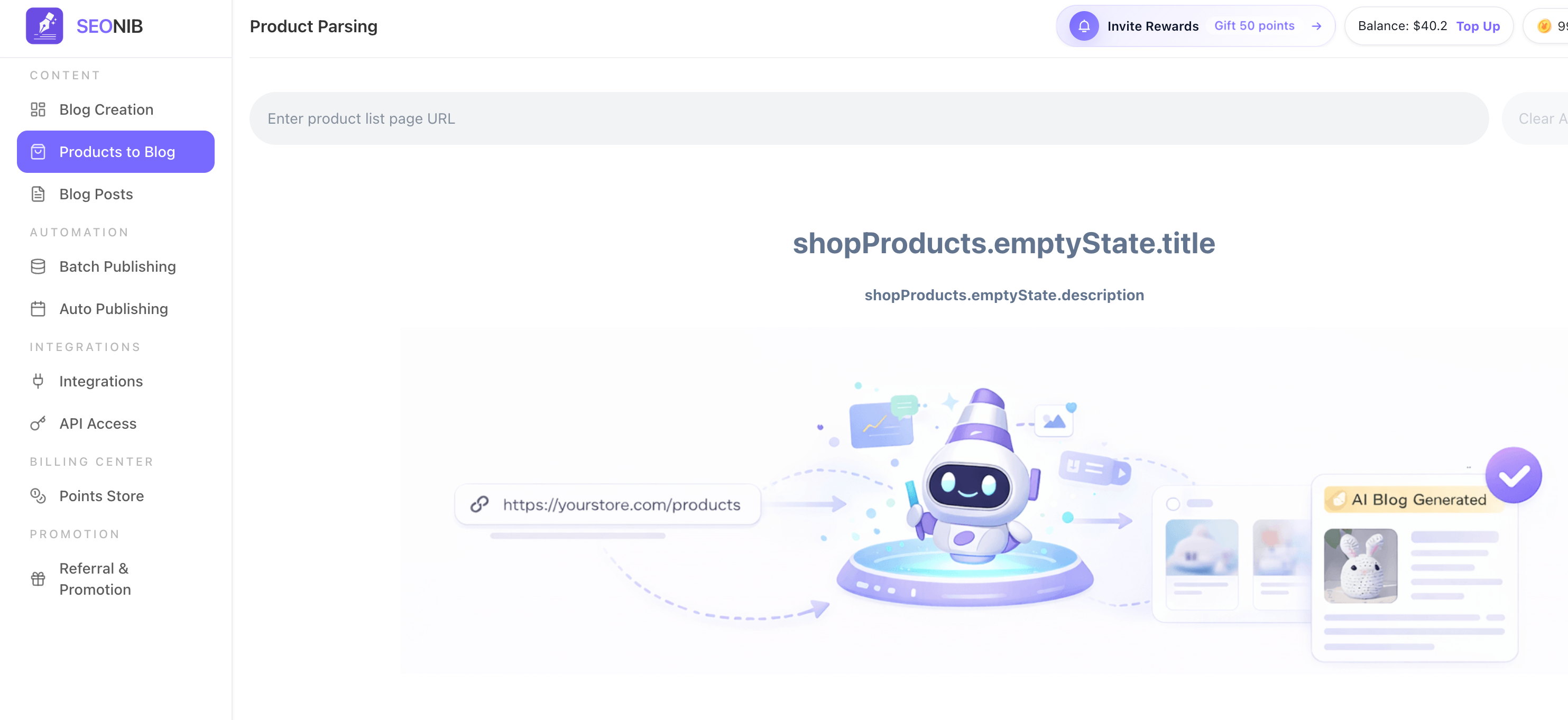
During this process, we started using SEONIB. What attracted me wasn’t its ability to “generate articles,” but the crucial “parse-plan” step in its workflow. It doesn’t start writing immediately; instead, it first analyzes the product link like a human and proposes several different blog angles.
For instance, when analyzing a “wireless Bluetooth earphone” product page, SEONIB might suggest angles like “Commuting Noise Cancellation Guide,” “Choosing Sports Earphones: Pitfalls to Avoid,” or “Sound Quality Test of Budget Earphones,” along with relevant long-tail keywords. This effectively breaks down a single product into multiple potential user search intents. This step pulls us back from the mindset of “writing about the product” to the track of “solving user problems.”

The Challenge of Scale: Quality, Consistency, and “Content Noise”
When we applied this process to dozens or hundreds of products, new problems emerged: how to ensure consistent quality in batch-generated content? And how to avoid creating “content noise”?
We encountered situations where AI-generated articles were acceptable individually, but when we published blog posts for ten different models of earphones from the same brand, we found that the article structures, tones, and even some examples were highly repetitive. This creates a poor experience for website visitors, and search engines might also classify it as low-quality or duplicate content.
Our strategy to cope was “human intervention at key nodes.” We no longer pursued full automation but established two checkpoints:
- Angle Selection: After batch parsing products, we manually review or adjust the AI-suggested blog angles to ensure differentiated positioning for content within the same category.
- Templates and Variables: For similar types of products, after SEONIB generates the first draft, we introduce more refined content templates and variable pools (such as different user scenario stories, industry data citations, etc.) to ensure a baseline quality and diversity through secondary processing.
This might sound like increased workload, but it’s actually much faster than creating from scratch. AI handles the time-consuming foundational work of information extraction, angle suggestion, and draft writing, while humans apply judgment, aesthetics, and strategic thinking for calibration and enhancement. This is an efficient form of “human-machine collaboration.”
The Most Unexpected Gain: Content Becomes a New Product Feedback Channel
An unexpected byproduct of this endeavor is that these blog posts, generated around products, have become an excellent channel for us to gather genuine user feedback. Because the articles address specific usage scenarios, the discussions in the comment sections are often highly focused.
We generated a tutorial blog post for a design software titled “How to Quickly Create Social Media Posters.” In the comments, users not only discussed the tutorial itself but also spontaneously shared their creations made with our software and offered suggestions like, “It would be more convenient if there was an XX feature.” This information is more direct and vivid than any user research. Content is no longer just a traffic-driving tool; it has become a community where the product and users converse.
This prompted us to adjust our content strategy: we began consciously asking AI to leave some open-ended, discussable hooks when generating content, such as “What is the biggest challenge you usually face?” or “What feature would you most like to see added in the next version?” This gives each piece of content a dual mission: to attract traffic and collect insights.
Final Thoughts on ROI
Many people ask, what is the ROI of investing effort in this? My view is that you cannot solely calculate the number of direct orders a single blog post brings. Its value is cumulative:
- SEO Asset Accumulation: Every high-quality blog post with search rankings is a long-term, free traffic entry point.
- Brand Awareness Building: Establishing professionalism and trust by solving specific problems is more effective than mere feature promotion.
- Product Ecosystem Extension: Content enriches the usage context of a product, turning a tool into part of a solution.
- Source of User Insights: As mentioned above, the comment section is a goldmine.
By 2026, I believe the lines between “product” and “content” will become increasingly blurred. The most successful product pages will themselves be the content that best solves user problems; and the most successful content will seamlessly guide users toward product solutions. What we are doing is building countless strong bridges between these two through automation.
FAQ
Q: Will search engines penalize AI-generated blog posts? A: Based on our practice and data over the past year, as long as the content provides real value, solves specific problems, and is not purely keyword stuffing or illogical text, search engines (especially Google) with their AI can effectively recognize its value. The key lies in “perspective transformation” and “information increment,” not whether the text is machine-generated. Our core work is to ensure that AI-produced content adheres to the first principle of “usefulness.”
Q: Is this model suitable for all types of products? A: Not entirely. It may be less effective for standardized, low-decision-cost products (like daily consumer goods) compared to high-decision-cost products that require market education (such as SaaS software, professional tools, complex electronics). For the latter, users have a stronger “learning by searching” need, and content is more likely to match their purchase journey. For the former, content angles might need to lean more towards lifestyle, comparative reviews, or usage tips.
Q: Will batch-generating content lead to overly dispersed website content themes, affecting professionalism? A: This is a good question, and it’s a pitfall we’ve encountered. The key lies in “category aggregation” and “internal linking.” We don’t let all generated blogs scatter in the blog directory. Instead, we establish topic pages or resource centers based on product lines and user scenarios, aggregating related blogs together and connecting them tightly through internal links. This way, individual blogs attract precise traffic, while aggregated pages showcase professional depth, and the two complement each other.
Q: Besides SEO traffic, are there other channels to promote these blogs? A: Absolutely. This scenario-based content is excellent material for social media advertising, EDM marketing, and even automated customer service responses. When a user complains about a problem on social media, you can directly share a link to the blog post that solves it, rather than a blunt product advertisement. It makes marketing feel more like “helping” than “selling.”
Q: How do you measure the success of a “product to blog” content piece? A: We look at a combination of metrics: 1) Search rankings and organic traffic; 2) Page engagement (dwell time, scroll depth); 3) Conversion path click-through rate (clicks on links/buttons pointing to product pages within or at the end of the article); 4) User interaction (comments, shares). A good piece of content should perform healthily across multiple metrics.
分享本文