From Zero to Millions of Traffic: How I Built a Continuously Growing Blog Matrix with AI Automation in 2026
This time last year, my SaaS product blog was in an awkward spot: the team spent a lot of time writing “in-depth” articles that garnered little readership; the occasional viral hit brought traffic that quickly left, failing to convert. We were fumbling in the dark, unsure of where the next traffic breakthrough would come from. Until I started systematically thinking about one question: in the information-overloaded year of 2026, what does the sustained growth of a blog truly depend on?
The answer might not be one or two “viral hits,” but a content system that can continuously capture real search intent. This shift in understanding, coupled with the subsequent establishment of an automated workflow, allowed my blog matrix to grow from near zero growth to consistently acquiring millions of organic traffic per month within a year. This isn’t magic, but a series of practical operations concerning trend discovery, content generation, publishing strategies, and system integration.
The Pitfalls We Initially Fell Into: Why “Manual Topic Selection” No Longer Works
In the early days, our content strategy was traditional: weekly topic meetings, competitor analysis, and writing tutorials based on product updates. The result? Content was either too niche or fell into homogeneous competition. More critically, the “industry insights” we relied on were often lagging. By the time we finished writing and publishing, the topic’s popularity window might have already closed, or it had been overtaken by larger content farms.
I recall a detailed tutorial on “Shopline Store SEO Setup” that we believed was of extremely high quality. After publication, it performed well internally, but traffic from search engines was almost zero. We only discovered after using a tool that the top two pages of search results for this keyword were already filled with templated but clearly structured “step-by-step guides,” many of which were bulk-generated by tools like SEONIB. Our “depth” actually became a burden – when users searched for this problem, they wanted quick, clear steps, not lengthy discourse.
This lesson made me realize: in the 2026 search environment, covering users’ real search needs is more important than pursuing content “depth” or “uniqueness.” Real needs are often reflected in specific, long-tail keywords with clear intent and “People Also Ask” (PAA) questions. Manually digging for these is inefficient and unscalable.

The Turning Point: Shifting from “Writing Content” to “Operating a Content Sensing System”
My goal became clear: I needed a system that could:
- Continuous Discovery: Automatically scan trends, keywords, and PAA questions to find opportunities with search volume and moderate competition.
- Batch Generation: Quickly produce clearly structured article drafts based on these opportunities, meeting basic SEO requirements.
- Seamless Publishing: Generated content could be published to our various content platforms (main blog, Shopline store blog, Medium, etc.) with one click or automatically.
- Closed Loop: Performance data after publishing (e.g., click-through rate, time on page) could feed back into the system to optimize subsequent generation strategies.
This sounded like a massive undertaking. Initially, I tried piecing together a bunch of APIs (Google Trends, Ahrefs/Semrush, OpenAI, WordPress REST API) myself, but the maintenance cost was extremely high, and the links were fragile. Later, I turned to finding a solution that could integrate these steps. I chose SEONIB, primarily because its workflow design almost perfectly mapped my needs: input keywords or data sources → automatically generate optimized articles → one-click publish to integrated platforms.
Its “multi-source generation” feature was key. I no longer relied solely on keyword lists. I could:
- Input a batch of core long-tail keywords for competitor products to generate comparison or review content.
- Import common user questions (PAA) scraped from forums and social media to generate direct answer articles.
- Even drop in a link to an excellent third-party article and have it generate a “reference” piece with a different angle and optimized structure. This is particularly suitable for quickly following hot news or industry reports.
Scaled Execution: Practical Details of Batch Generation and Platform Integration
With the tools in place, the real challenge lay in the scaling strategy. My core approach became: exchange quantity for quality, and breadth for long-tail traffic.
I set a goal of publishing 10-20 pieces of content daily. These content topics were diverse, covering everything from core functionalities to extremely niche use cases. SEONIB’s batch generation and scheduled publishing features made this possible. I usually prepared the data sources for the following week on weekends (e.g., an Excel sheet containing hundreds of long-tail keywords) and set the publishing times (e.g., 9 AM on weekdays), and the system would execute automatically.
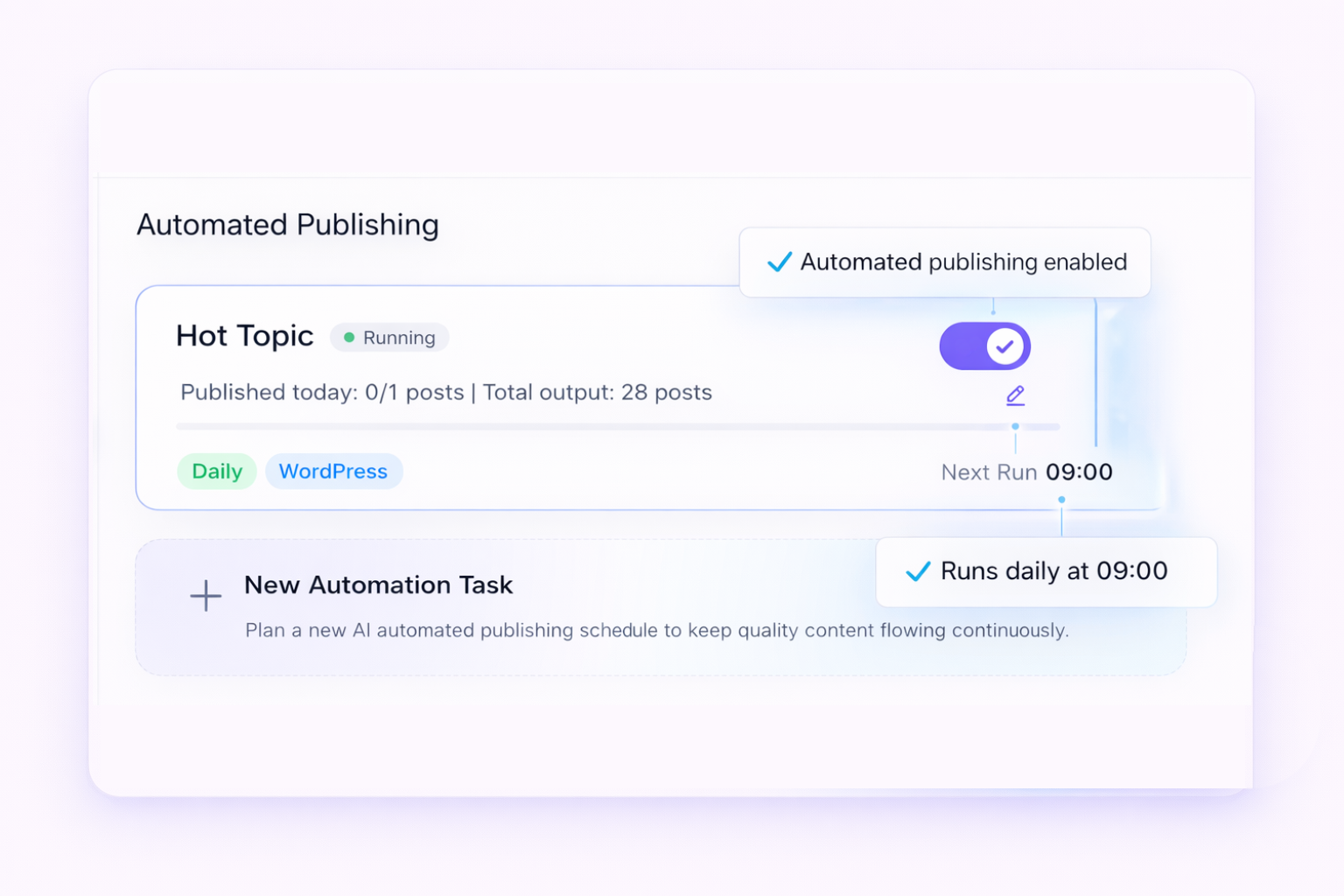
A crucial integration was the Shopline store blog. For SaaS products, the audience and search intent of the official blog and the e-commerce store blog have subtle differences. The official blog is more suitable for brand stories and industry insights, while the store blog (like our Shopline app store page) is better for directly addressing high-conversion intent questions like “how to use,” “how to set up,” or “comparison with XXX.” Through SEONIB, I could directly and automatically publish content generated for the latter type of intent to the Shopline store’s blog, and this integration process was very smooth. Specific setup can be referenced on this app’s detail page in the Shopline App Store, which clearly shows how to connect and configure it. This is equivalent to establishing a content hub for our product that is closer to the conversion path.
Unexpected Results and Data Validation
After three months of running this system, some interesting data began to emerge:
- Shift in Traffic Structure: The proportion of traffic from long-tail keywords in our blog’s total traffic increased from less than 30% to over 65%. Homepage traffic decreased, but overall traffic and user visit depth significantly increased.
- Content “Lifecycle”: “Viral” articles written manually typically peaked in traffic 1-2 weeks after publication and then rapidly declined. The large volume of long-tail articles generated by the automated system might have had modest traffic in the first few weeks after publication, but as indexing stabilized and with a little external link building, traffic would slowly climb and reach a stable state after several months. This formed a very healthy traffic base.
- Indexing Scale and Authority: The number of indexed pages on the website increased nearly 10-fold within six months. Search engines seemed to favor this continuous, regular content update pattern, and the overall Domain Authority of the website also improved significantly, which in turn promoted faster indexing and ranking of new content.
- Human Resources Freed Up: The content team was freed from the heavy tasks of topic selection, writing, and basic SEO optimization, shifting their focus to higher-level strategy formulation, data analysis, and in-depth content creation for a few core pages.
Reflection: AI Automation is Not “Replacement,” but “Enhancement”
As I’ve come to this point, I increasingly feel that the value of tools like SEONIB lies not in replacing human creators, but in freeing humans from repetitive, mechanical, and scalable labor. It’s responsible for laying the foundation – covering massive basic information needs and building a traffic moat. Human teams, on the other hand, should build a more sophisticated “superstructure” on this foundation, one that is more influential to the brand and requires more emotional and creative connection.
For example, after an article generated by the system about “cross-border e-commerce independent site payment setup” gained good traffic, our content editors would intervene, expand it into a definitive guide including the latest policies, case studies of risks, and advanced techniques, and proactively seek reprint collaborations with industry sites. This is a perfect example of human-machine collaboration: machines pioneer, humans cultivate.
In 2026, rejecting content production automation might mean actively giving up a large part of the battlefield in information competition. The key is how you design the process to make the automation system an efficient and reliable component of your overall content strategy, rather than a “black box” blindly churning out content.
FAQ
Q1: Will the quality of bulk-generated content be poor? Will it be penalized by search engines? A: This is the most common concern. The key lies in the definition of “quality.” If the goal is to cover a specific search query (e.g., “How to bind a domain in Shopline”), then a short article that is clearly structured, step-by-step, and accurate in its information is considered qualified in terms of “quality” for both users and search engines. AI tools can now accomplish this task well. Penalties usually stem from completely meaningless, keyword-stuffed spam content. As long as the generated content is coherent, relevant, and useful, the risk is extremely low. Our practical data also proves this point.
Q2: Is this method suitable for all types of blogs? For example, personal brand blogs? A: The emphasis differs. For brand/product blogs (especially B2B, tool-based SaaS), the goal is to acquire precise traffic and establish professional coverage, and this method is very effective. For personal brand blogs that heavily rely on personal opinions, narratives, and unique voices, automation is more suitable for auxiliary content (e.g., compiling resource lists, quickly summarizing news). Core content still needs to be done personally. A hybrid approach can be used.
Q3: How to ensure the factual accuracy and timeliness of automatically generated content? A: Tools cannot guarantee 100%. Our process is: First, when inputting data sources, try to choose topics with strong factual basis and little controversy (e.g., operational steps, feature comparisons). Second, for content involving data, policies, or major events, set up manual review stages or use the tool’s “reference link generation” feature to have it generate content based on specified authoritative sources and cite them in the text. Third, for content that requires continuous updates, you can utilize the system’s scheduled rewrite/update functions.
Q4: When starting out, where should I get the first batch of keywords or content sources? A: It is recommended to start from these places: 1) User frequently asked questions collected from your product backend; 2) Topic ideas from competitor websites or help centers; 3) Search your core product terms on Google and check the “People Also Ask” and “Related Searches” sections below; 4) Topics repeatedly discussed by users in industry forums and communities (e.g., Reddit, Facebook Groups). Compile these into a list, which will be your initial content fuel.
Q5: After seeing traffic growth, what is the next optimization direction? A: Once traffic picks up, the focus should shift to conversion and content upgrading. First, analyze content on high-traffic but low-conversion pages and optimize calls to action (CTAs). Second, select high-traffic topics and invest resources in creating more in-depth, multimedia flagship content (e.g., video tutorials, e-books). Finally, leverage the accumulated pages and authority to strategically build internal links and target some more competitive core keywords for ranking, forming a traffic pyramid.
分享本文