I Escaped the Copy-Paste Hell with SEONIB

If you’ve ever managed more than one primary website platform (like a Shopify standalone store) plus a secondary site (like a WordPress blog), you’ll deeply understand this tedious process:
After painstakingly crafting a product blog post, you first have to copy it to the WordPress backend to publish. Then, you switch to your Shopify standalone store, re-paste the content, adjust the formatting to suit the platform, re-upload images, and check and modify internal links (to avoid redirect errors). You might even need to sync it to another lightweight site (like a Wix brand showcase). While there’s no technical barrier, the entire process is filled with repetitive, mechanical operations that are time-consuming, inefficient, and prone to errors like formatting issues or missing images, all of which impact user experience.
What’s even “better” is that if you want to optimize a title or a paragraph based on data feedback, this entire process has to be repeated. Our team used to jokingly call this “digital-age textile workers,” except we were weaving the same text countless times across different backends. Low efficiency is a minor issue; the real danger lies in human error: missing a platform, or forgetting to update a version on a certain platform, leading to inconsistent information, damaging both user experience and SEO ranking.
Why is “Seamless Sync” Always “Leaky” in Reality?
Theoretically, many platforms offer APIs that seem to enable automation. But anyone who has actually tried knows how difficult it is to patch these “leaks.”
First, there’s the ghost of formatting. Do you think Markdown or HTML are universal languages? Think again. WordPress’s Gutenberg editor, Shopify’s rich text editor, and Wix’s proprietary modules can interpret the same HTML code very differently. A table that’s perfectly formatted in WordPress might turn into a mess of garbled text when pasted into Shopify. Not to mention custom shortcodes that become completely useless outside their native environment.
Second, there’s the wandering of media files. Images in a blog post, once uploaded to Platform A, are stored on A’s servers and generate A’s exclusive links. If you directly copy the HTML of this article to Platform B, the image links will still point to Platform A’s address. This not only can slow down Platform B’s loading (cross-domain issues) but also creates a hidden risk: if Platform A’s image links become invalid or the platform migrates, the content on Platform B will instantly “lose its face.” True synchronization means media files also need to be copied or re-uploaded to each platform, and links replaced—the complexity of automating this process increases exponentially.
Finally, there’s the fragmentation of workflow. Even if you use tools like Zapier or Make (formerly Integromat) to build connections, they usually only sync the “publish” action. The entire workflow from content ideation, generation, optimization, to final publication remains scattered. Your keyword research might be in Ahrefs, the outline in Google Docs, the draft in another tool, and finally, publishing requires switching between multiple backends. Constant context switching prevents you from ever achieving a flow state.
We once tried to solve this with custom scripts, but the time spent maintaining the scripts quickly exceeded the time saved by manual operations. Every time a platform’s API updated, the script would “go on strike,” and late-night alert emails became commonplace.
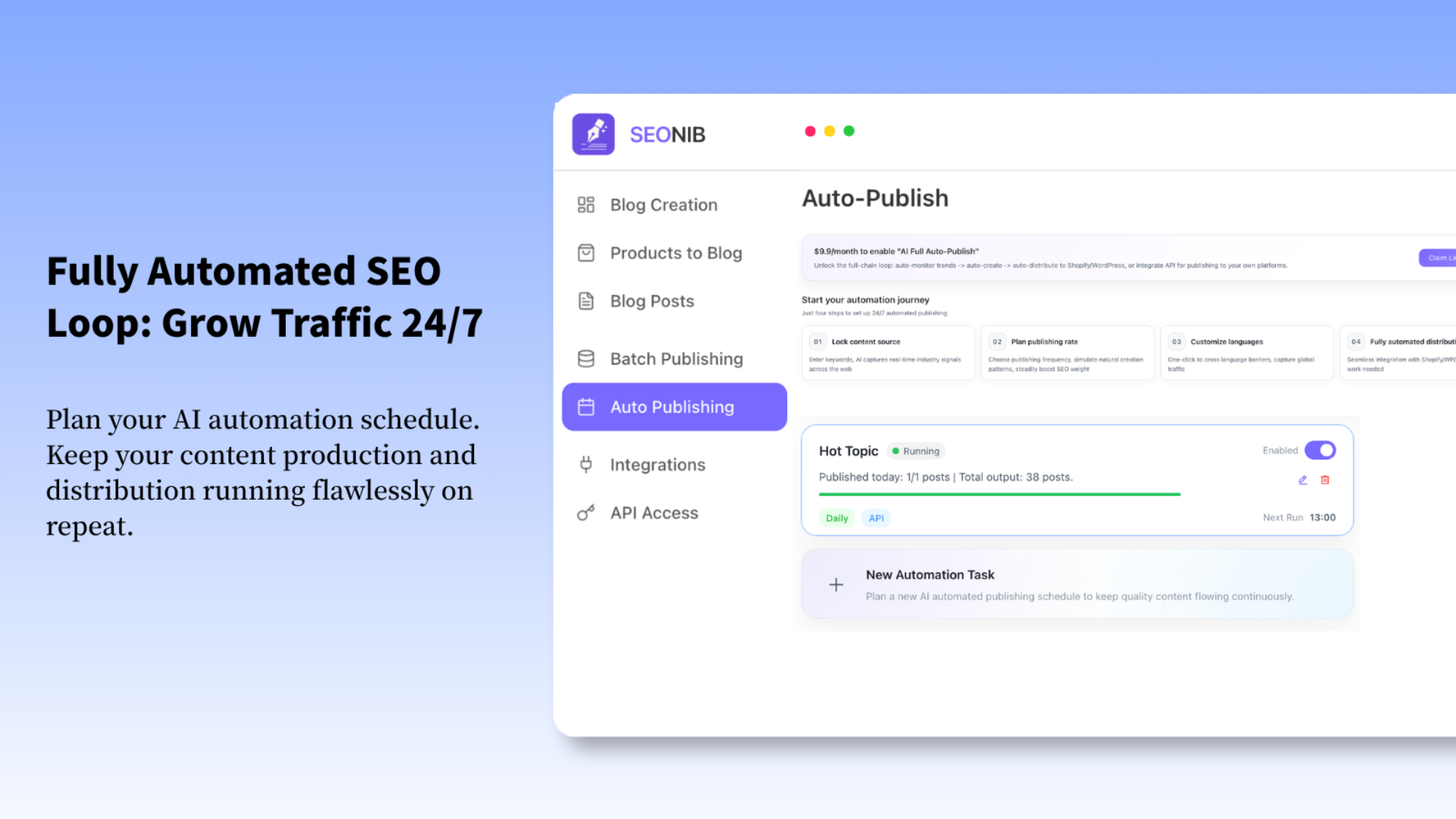
The Turning Point: When Content Generation and Publishing Become a Pipeline
The core of the problem gradually became clear: what we needed wasn’t just “publish sync,” but a complete pipeline from “content production” to “multi-platform distribution.” By chance, while optimizing SEO content for a niche product line, we tried SEONIB. Initially, we were drawn to its ability to quickly generate targeted blogs based on keywords and product links, aiming to solve content production capacity issues.
But the moment we truly felt “this is it” was during our first use of its multi-platform publishing feature. After generating a buyer’s guide on “Beginner Crochet Tool Kits” in the SEONIB backend, we didn’t receive a piece of text to copy as usual. Instead, the backend presented a publishing panel, listing the pre-configured sites: our main brand WordPress blog, the blog module of our Shopify product site, and a Shopline store page for content aggregation.
One check, one click. About two minutes later, new articles appeared in the backends of all three platforms, with complete formatting, localized image storage, and even product internal links automatically adapted to each platform’s URL structure. It felt like someone who had been manually filling multiple pools suddenly discovered all the pipes were connected to the same water source, and every faucet had automatically turned on.
SEONIB’s role here isn’t just a simple publishing tool, but a “master control valve” for the content pipeline. It seamlessly integrates the most time-consuming part of content creation (AI generation based on SEO and product data) with the most tedious distribution actions (multi-platform adaptation and publishing). We no longer had to think about “which platform should this article be published on first, and how,” but simply “is this product or topic worth creating content for.” The decision point moved forward, and operational costs were reduced to zero.
Unexpected Operational Advantages from Cross-Platform Synchronization
After solving the basic technical synchronization, deeper operational advantages gradually emerged, which we simply didn’t have the bandwidth to consider in the manual era.
1. “Focused Attack” and “Diversion” Experiments for SEO Strategy Become Feasible. Previously, we were hesitant to publish highly similar content on multiple owned platforms using the same core keyword, fearing being flagged as a link farm or duplicate content by search engines. But now, we can do so strategically. For example, the main site can compete for core keywords with a highly authoritative “Ultimate Guide to Beginner Crochet,” while the Shopify store’s blog can publish content more focused on the purchase scenario, like “Comparison of X Beginner Crochet Tool Kits,” and Shopline can lean more towards community experience and skill sharing. Although the themes are related, the angles, intentions, and content details are flexibly adjusted by AI, forming a content matrix. After publishing synchronously via SEONIB, we can clearly compare the traffic quality and conversion paths brought by different platforms on the same topic, something that was impossible to systematically analyze with fragmented publishing in the past.
2. Content Version Management and Salvation for Urgent Updates. Product price changes, discovery of critical errors, or the need to add important information—these content update requests are an operational nightmare. In the past, an operations colleague would have to shout in the group chat, “All platforms need to change the third paragraph of that XX article!” and then the responsible parties would frantically log into their respective backends. Now, you just need to find the source article in SEONIB, make the changes, and re-execute a sync publish (you can choose to overwrite existing articles). Content on all associated platforms will be updated uniformly in a short period. This not only saves time but also reduces customer complaints and brand risks caused by untimely or inconsistent updates.
3. Cost Structure Shifts from “Subscription Pressure” to “Production Driven.” This is something we greatly appreciate about SEONIB. Many SaaS tools are subscription-based, with monthly or annual fees. Even if you don’t produce anything that month, the cost continues to accrue. This creates a strange psychological pressure: either you’re forced to produce content to “get your money’s worth,” or you feel anxious about paying for idle subscriptions. SEONIB’s credit system (approximately $0.199 per generated article), with credits that never expire, directly links costs to content output. No output, no cost. This allows us to plan content rhythm more calmly, ramp up efforts during peak sales seasons, and calmly review during off-peak periods, making financial management very clean. Moreover, the 8 credits you receive upon registration are enough for you to experience the complete process of generating and multi-platform syncing for two to three articles at zero cost, verifying if it suits your business. This sincerity is rare in B2B tools with high trial-and-error costs.
Integration Example: Reality Isn’t a Fairy Tale, But It’s Good Enough
Taking our integration with Shopify and our own WordPress site as an example. The process isn’t instantaneous like magic, but it’s simple enough.
- In the SEONIB backend, find “Platform Settings” or “Connect Sites.”
- Select Shopify, enter your store’s domain, and then follow the instructions to install the app and authorize it in your Shopify backend. This process is no different from connecting any other Shopify app (like review tools or email marketing).
- For WordPress, enter your store’s domain, username, and password.
- Once configured, these two platforms will become options in the article generation and publishing stage. You can choose to publish to one of them, or to multiple simultaneously.
It’s important to note that the initial configuration requires some technical integration (mainly authorization), which might require your team’s development or operations colleagues to spend about ten minutes on it. But this is a one-time investment that yields a permanent automation. Compared to repetitive manual labor every month, the return on investment is astonishingly high.
Final Thoughts: After Synchronization, What Should We Be Thinking About?
When technical synchronization is no longer an obstacle, we need to address more fundamental questions: Why are we creating multi-platform content? Are the audiences on each platform truly the same? Should synchronized content be slightly adjusted for platform-specific characteristics?
Tools like SEONIB provide “seamless synchronization,” freeing our hands and our low-efficiency, repetitive brainpower, but they don’t replace our strategic minds. They transform us from “movers” back into “commanders.” Now, we can focus more on:
- Content Strategy: What is the role of each platform? (Is it conversion, brand visibility, or community cultivation?)
- Topic Planning: Which topic matrices are suitable for amplifying reach across multiple platforms?
- Data Analysis: After synchronized publishing, which platform’s user engagement is deeper? Which type of content leads to higher cross-domain conversion rates?
Tools solve the “how to synchronize” problem, while we need to answer “why synchronize” and “what to synchronize.” This is perhaps the greatest gift technology gives us: it encapsulates complexity, allowing us to return to the essence of business and creation.
FAQ
Q1: Does it support synchronization to social media platforms like Douyin and Xiaohongshu? A: Currently, SEONIB’s core synchronization capabilities are focused on “content asset” platforms like websites and blogs, such as WordPress, Shopify, Wix, Shopline, etc. For highly interactive and specially formatted social media platforms like Douyin, Xiaohongshu, and Weibo, directly synchronizing long blog posts is usually not suitable. These platforms require content that is more adapted to their ecosystem, such as short content, videos, or illustrated notes. However, you can use the core points of long articles generated by SEONIB as a source for short social media content.
Q2: Compared to subscription models, which is more cost-effective in the long run for the credit system? A: This entirely depends on your content output frequency and volatility. If your content needs are stable and substantial, some subscription models with unlimited publishing might be cheaper when amortized. However, for most businesses with fluctuating demand, seasonal variations, or pulsed content needs (e.g., in conjunction with product launches), the credit system offers significant advantages: 1) Costs perfectly match output, with no idle waste; 2) No subscription pressure, allowing you to start or pause as needed; 3) Credits are permanently valid, suitable for flexible planning. For most small and medium-sized teams and startups, the credit system offers higher financial friendliness and flexibility.
Q3: Will automatically generated content lack “human touch” and brand personality? A: This is a valid concern. If you rely entirely on AI generation without any intervention, the initial content might indeed appear templated. The value of tools like SEONIB lies in providing high-quality, SEO-friendly first drafts, greatly improving efficiency. However, “human touch” and brand personality require you to “train” it during use: by providing your brand style guide, using past excellent articles as references, and personalizing the introduction and conclusion after generation. It handles the “from 0 to 1” and “from 1 to 100” scaling issues, while you focus on injecting the “from 1 to 1.5” brand soul. The combination of both is the best practice.
分享本文