
Advanced SEO Tool Breakdown: SEONIB Bulk Distribution to WordPress, How to Turn Your Blog into an "Automated Content Factory"
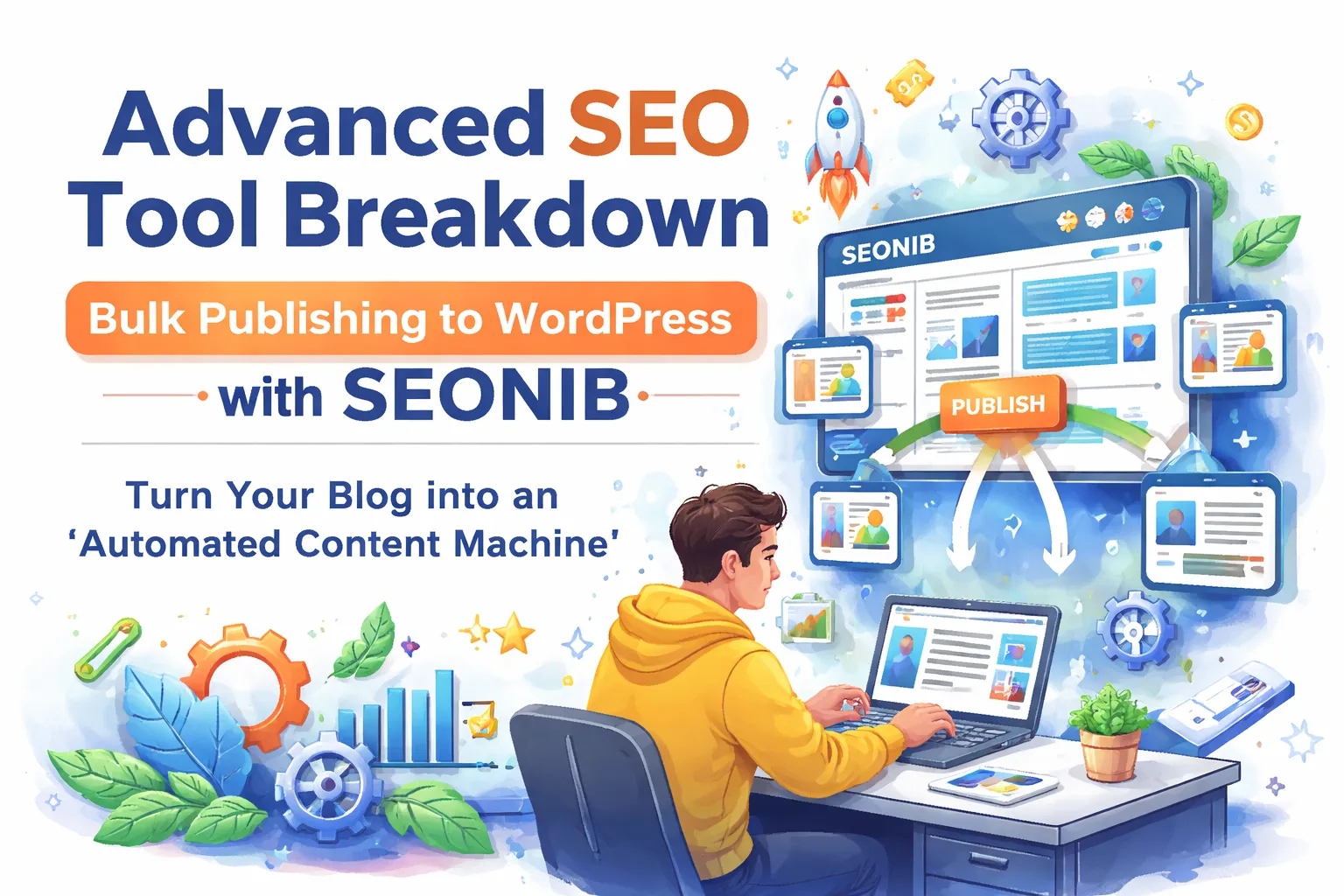
For the vast majority of content sites, SaaS official websites, and e-commerce standalone sites, WordPress remains the primary battleground for SEO content: its plugin ecosystem is mature, it offers strong control, and migration is convenient. The real difficulty has never been “whether articles can be published,” but rather:
- Who will continuously write them?
- Who will format and schedule their publication?
- How to maintain a unified rhythm across multiple categories, languages, and sites?
SEONIB positions itself as a “blog automation assembly line,” with one of its core capabilities being the one-click generation of SEO blogs from various content sources and bulk distribution to multiple CMS platforms, including WordPress. This part can essentially upgrade your WordPress blog from a “purely manual workshop” to an “automated factory.”

I. What Does the Overall Closed Loop of SEONIB + WordPress Look Like?
To summarize this closed loop in one sentence:
Topic Selection → Multi-Source Article Generation → Unified Review/Fine-tuning → Bulk Push to WordPress → Scheduled Automatic Publishing → SEO Data Feedback and Adjustment.
In this workflow, WordPress continues to serve as “your main repository for content assets and front-end display,” while SEONIB becomes the “back-end production line” and “automatic uploading assistant.”
II. Multi-Source Generation: Not Just Writing from Keywords, but Turning All Materials into Blogs
The first value SEONIB offers to WordPress site owners is a greatly expanded range of content sources.
Common sources include:
Keywords / Topic Words: Input core keywords and types (tutorials, lists, comparisons, etc.) to generate structured, long-form SEO articles with one click, suitable for building a foundational content matrix.
Industry Trends / News Links: Paste URLs of industry reports or trend articles, and it will automatically extract key points and rewrite them into blog posts with your brand’s perspective, suitable for news/opinion sections.
Video / Social Media Content: Links to videos or long-form content from TikTok, YouTube, Instagram, Facebook, X, LinkedIn, etc., can be directly converted into illustrated tutorials or breakdown articles.
Competitor / Reference Article URLs: Use well-performing “benchmark content” as a reference, and through in-depth rewriting and structural reorganization, develop it into a new article for your own site.
For WordPress, this means: You no longer have to rely entirely on “writing from scratch.” Instead, you can pull content assets from various channels back to your WordPress blog and use a unified structure to capture SEO traffic.
III. Bulk Distribution to WordPress: From “Copy-Paste” to “Automatic Upload”
1. One-Time Connection, Subsequent Fully Automated Push
SEONIB’s publishing logic is implemented through integration with CMS platforms:
- Configure the connection for your WordPress site in the SEONIB backend (site address + authorization method).
- Once configured, generated articles can be directly “sent to WordPress” as drafts or published articles.
The result of this approach:
- You no longer need to copy each article into the WordPress editor, reformat it, and set categories.
- You can perform the “push to WordPress” operation on multiple articles at once within SEONIB, achieving bulk distribution.
2. Bulk & Scheduled Publishing
In the world of WordPress, “scheduled publishing” is natively supported, but it typically requires your articles to be on the site and set individually.
With SEONIB, the process can become:
- Complete within SEONIB first: Generate → Review → Unified Category/Tag Settings → Select Target Sites for Push.
- When pushing to WordPress, you can:
- Publish directly (suitable for high-frequency updates and less critical long-tail content).
- Push as drafts, and editors can do the final scheduling within WordPress.
- Schedule publishing according to a preset rhythm to maintain a stable update frequency.
For teams managing multiple WordPress sites (or a single site with multiple language sub-sites), this effectively transfers “bulk + scheduling” to a unified backend instead of repeating the same work on each site’s backend.
IV. How Can WordPress Site Owners Utilize This “Bulk Distribution” Capability?
Scenario 1: Automatic Updates for Tech Review / Media Sites
- Usage Habits: WordPress as the main site, with a large volume of video reviews and unboxing content.
- Operational Approach:
- Import video links into SEONIB → Bulk generate review blog posts.
- Unify category settings within SEONIB (e.g., Mobile Phones / Cameras / Headphones), and add tags.
- One-click push to WordPress, set as drafts.
- Editors only need to perform final review and scheduling, significantly reducing the time spent on “transferring + basic formatting.”
Scenario 2: SaaS Blogs / B2B Content Sites
- Usage Habits: WordPress as the official blog, requiring continuous output of tutorials, case studies, and comparison articles.
- Operational Approach:
- Generate a batch of long-form articles in SEONIB each month based on keyword plans.
- Use “Project Settings” to pre-set product names and official website links, automatically incorporating them into article CTAs.
- Bulk push to WordPress weekly, ensuring a stable update rhythm for the blog.
Scenario 3: Multi-Site / Multi-Language WordPress Clusters
- Usage Habits: Multiple WordPress sites (segmented by country or business line).
- Operational Approach:
- Create different projects in SEONIB for different sites based on the “Project” dimension.
- Quickly populate each language site with native language drafts + multi-language generation, then bulk push to the corresponding WordPress sites.
- Content is then handled through WordPress’s native multi-site management or standalone installations, with local SEO fine-tuning.
V. Actual Value for SEO: Not Just “Publishing More,” but “More Stable, More Controllable”
The value of bulk distribution to WordPress for SEO goes beyond simply increasing the number of articles; it also includes several layers:
Stable Update Frequency
- By leveraging SEONIB’s bulk production + scheduled publishing capabilities, you can pre-schedule articles for the next few weeks or even months, allowing your WordPress blog to maintain a consistent update rhythm rather than being sporadic.
Unified Structure and Templates
- Using fixed article structure templates (introduction, H2, FAQ, CTA, etc.) uniformly within SEONIB and then bulk distributing them to WordPress helps maintain consistency in the entire site’s content structure, which is a plus for user experience and SEO.
Freeing Up Time for WordPress Practitioners
- The true value of SEO often comes from “topic selection strategy + internal linking layout + external linking plan + technical optimization,” not from mechanical copy-pasting and formatting.
- Using SEONIB for “execution-level automation” allows site owners and SEO professionals to spend their time on strategy and optimization, leading to a higher overall return on investment.
Conclusion: When Should You Seriously Consider the “SEONIB + WordPress” Combination?
If you meet any two of the following criteria, you should seriously consider incorporating this combination into your tool stack:
- Your site is WordPress (or one of them), and you need to publish more than 20 blog posts per month.
- In addition to purely handwritten articles, you have a large amount of material from videos, social media, and reference articles that you want to consolidate into your blog.
- You manage more than one site, or more than one language version.
- You find your team spending more and more time on “transferring + formatting + publishing” rather than “topic selection + optimization + operation.”
In such cases, allowing WordPress to focus on being the “front-end for content hosting” and the underlying SEO technology, while handing over “production and bulk uploading” to SEONIB, can often increase overall content operation efficiency by an order of magnitude.
Share Article