Advanced SEO Tool Breakdown: SEONIB Keyword-Driven In-Depth Long-Form Content, Build High-Authority Sites from Scratch
For newly launched websites, the biggest challenge has never been “whether or not to do SEO,” but rather “I don’t know how to choose keywords, I can’t write systematic long-form articles, let alone consistently update dozens of them every week.”
SEONIB consolidates this entire process into one sentence: Input keywords + Select template → Automatically generate rankable in-depth long-form content → Batch publish to your site. For site owners with zero experience, it’s more like a helicopter that directly takes you to “content altitude.”
I. What is “Keyword-Driven In-Depth Long-Form Content”? The Underlying Logic of SEONIB
The basic steps of traditional SEO writing are: select keywords → break down search intent → write outline → write body → write Meta, and then continuously optimize. In its “keyword-driven mode,” SEONIB highly templates these steps: as long as you can provide a directional keyword, it can automatically generate a long-form article with a complete structure, revolving around that keyword.
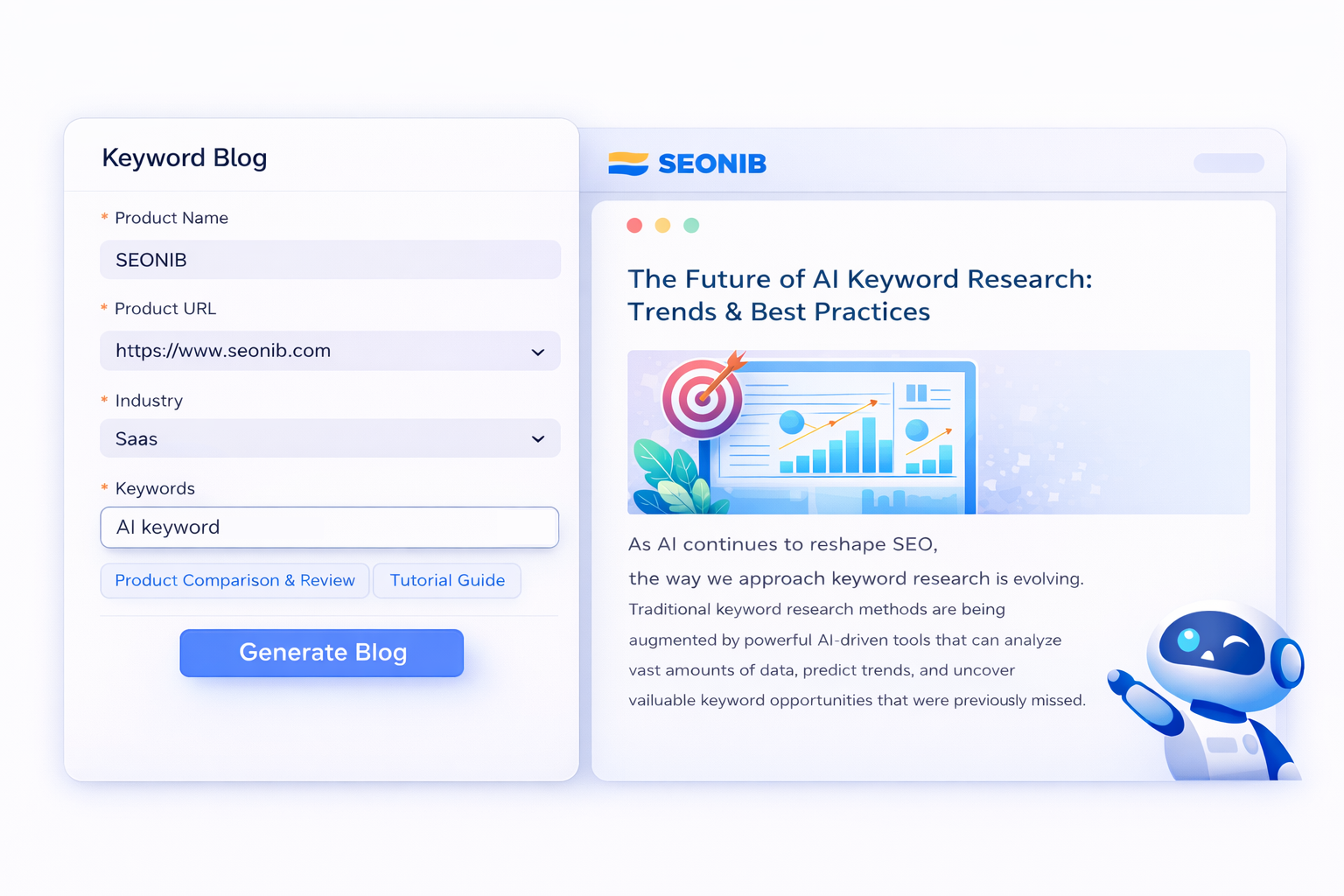
Keyword-driven generation by SEONIB generally includes several key points:
Input core keyword + desired word count: For example, “shopify seo apps,” “cross-border independent site building tutorial.”
Select article type template: Comparison reviews, usage tutorials, listicles, problem-solving, etc.
Automatically build outline: Generate H2/H3 structure based on the typical search intent of the keyword.
Fill in body text + examples + summary: Form an in-depth long-form article that can be directly published to the site, rather than a few hundred words of “fluff.”
This means:
Even if you only know “I want to do Shopify SEO related keywords,” you can get a set of long-form article drafts in minutes, covering multiple sub-issues within that topic.
II. Why is “Keyword-Driven In-Depth Long-Form Content” Particularly Crucial for New Site Authority?
When search engines grant authority to new sites, they primarily look at two things:
- Is your content built around real search needs?
- On certain topics, are you truly “comprehensive and continuously updated”?
SEONIB’s keyword-driven mode perfectly addresses these two shortcomings for new sites:
1. It Makes You Write Content “Around Keywords” Instead of “By Feeling”
Traditionally, novice site owners tend to “write whatever comes to mind”; SEONIB forces you to start from keywords, tying each article to a clear search term.
Paired with basic keyword research (which can be done with any SEO tool or public data), you can:
- First, create a list of “core business keywords + long-tail keywords”;
- Then, use these keywords in SEONIB to drive content generation.
The result is:
Each piece of content serves a specific keyword/phrase, and the entire site quickly accumulates a “topic-article” network.
2. It Makes “Content Depth” the Default, Not the Exception
To stand out from the competition, high-quality long-form content is key for new sites:
- Complete structure, covering users’ main questions;
- Includes details and case studies, not just vague discussions.
SEONIB’s keyword mode is inherently geared towards “in-depth long-form content,” effectively setting “write comprehensively enough” as the default option:
- Defaults to a longer word count range;
- Templates include modules like FAQs, pros and cons, step-by-step breakdowns, making the article structure naturally more complete than “randomly written blog posts.”
For new sites, this is equivalent to:
You instantly raise the “content quality threshold” to a decent starting point, and then gradually refine it from there.
III. How Can Zero-Experience Site Owners Use SEONIB to Be a Site Owner Who “Takes a Helicopter Ride”?
Here’s a practical workflow you can directly copy, applicable to SaaS, content sites, e-commerce blogs, tutorial sites, etc.
Step 1: Create a “Keyword Roadmap,” No Need to Be Too Complex
- Core business keywords: 10–20 words directly related to your product/service.
- Scenario/Problem keywords: Long-tail questions users frequently ask, such as “how to do,” “how to choose,” “compare with X.”
- Brand/Competitor keywords: Your brand name + category term, primarily for brand authority.
Even with the most basic search volume tools or experienced judgment, as long as you can determine that these keywords “are being searched for,” that’s enough.
Step 2: Generate In-Depth Long-Form Content by “Topic Clusters” in SEONIB
Taking “Shopify SEO” as an example, you can break it down like this:
- Primary topic: Shopify SEO
- Sub-topic keyword groups:
- shopify seo apps
- shopify blog seo
- shopify meta title description settings
- shopify image alt optimization
- shopify off-site traffic generation techniques
In SEONIB, for each sub-keyword:
- Select a “tutorial/guide template”;
- Set the desired length to “long-form” (e.g., over 2000 words);
- Let it generate an in-depth long-form article covering the main steps, precautions, and common pitfalls.
With this process, you’ll have a small content cluster around “Shopify SEO,” rather than a “single, isolated overview.”
Step 3: Publish Consistently to Your Site and Implement Internal Linking
One of SEONIB’s advantages is its ability to batch distribute directly to CMS platforms like Shopify, WordPress, and Shopline.
Operational approach:
- Publish articles from the same topic cluster sequentially to the corresponding categories on your site.
- Within each long-form article:
- Add internal links pointing to the “parent keyword” (e.g., from a specific optimization point to the general guide);
- In the general guide, link back to each specific tutorial, forming a small “internal linking loop.”
The benefits of this for new site authority are:
Search engines can more easily determine that “you are a content provider with structure, hierarchy, and breadth on a certain topic,” rather than just writing a few articles and calling it a day.
IV. Note: Helicopters Can Only Take You Up, Whether You Fly Steadily Depends on Your Piloting Skills
Finally, it’s important to clarify that no matter how powerful SEONIB is, it doesn’t mean “lying down and waiting for authority to soar.”
From a practical perspective, you still need to coordinate with several things:
- Keyword strategy should be as reliable as possible: Don’t blindly chase high-competition keywords; new sites are better suited to capture long-tail, niche keywords first.
- Regularly check Search Console and analytics tools: See which long-form articles are starting to get impressions and clicks, and which need to be supplemented, merged, or deleted.
- Maintain moderate manual review: For articles on important business keywords, it’s recommended to manually polish, supplement with case studies and data, based on SEONIB’s output, to make the content truly “sound like you wrote it.”
- External links and technical SEO cannot be completely abandoned: Site speed, structural optimization, and link building that should be done still need to be done.
What should you consider it?
Think of SEONIB as “a helicopter that helps you quickly raise your content level to a decent standard,” rather than “an autopilot passenger plane responsible for flying the entire journey for you.”
分享本文