How to Choose a Video-to-Blog Tool? A Comprehensive Comparison of SEONIB and VideoToBlog.ai
Date: 2026-03-25 10:02:20
Brief Conclusion:
- VideoToBlog.ai is more like a “one-stop tool for YouTube creators: one video → one SEO blog.”
- SEONIB’s video-to-blog feature is just one part of an entire “multi-source → blog → multi-site automatic publishing” pipeline, focusing on scalability and e-commerce/SaaS site integration.
Core Positioning Differences
- SEONIB: Blog Automation Pipeline + E-commerce / CMS Integration
- Video is just one of the content sources, alongside keywords, trends, and URLs.
- Generated content can be directly pushed to sites like Shopify, WordPress, and Shopline, with batch scheduling for publishing.
- Suitable for teams looking to systematically convert social media video assets into on-site SEO assets.
- VideoToBlog.ai: Focus on “Video → Single Blog Post”
- Core usage: Paste a YouTube video link → generate an SEO blog post in minutes, exportable to WordPress, Shopify, etc.
- Positioned more as a “reusable tool for video creators,” enabling each video to have a corresponding blog post.
Supported Platforms and Input Scope
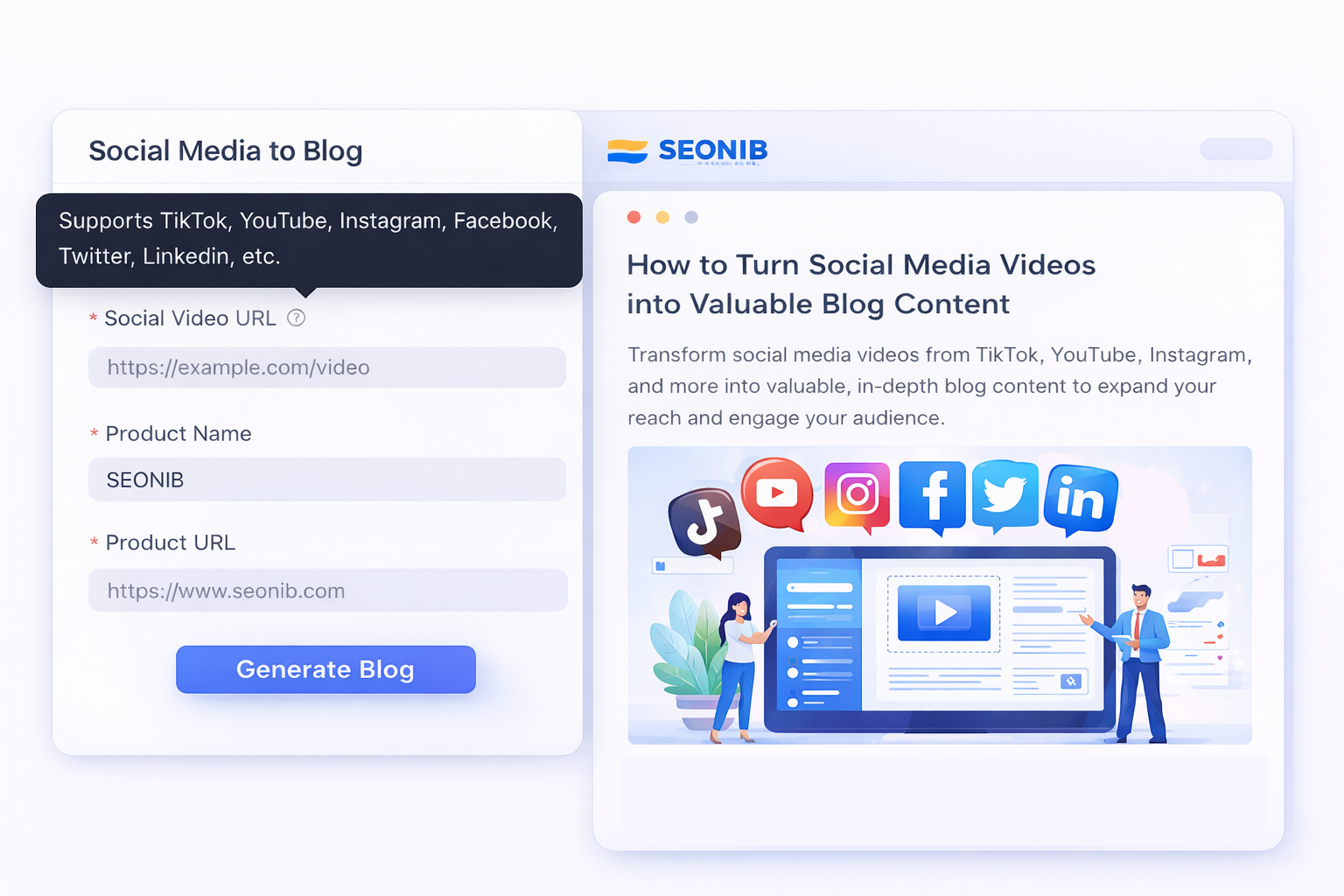
- SEONIB Video-to-Blog Supports:
- Links from mainstream social media/short video platforms like TikTok, YouTube, Instagram, Facebook, X, LinkedIn, etc.
- Essentially, “broadly defined video/social media content → blog,” not limited to YouTube.
- VideoToBlog.ai Supports:
- Primarily YouTube, supporting direct pasting of YouTube links, uploading video/audio files, or integrating entire channels.
- Some descriptions also mention exporting to platforms like WordPress, Shopify, and Medium, but the focus remains on “YouTube → Blog.”
Feature Capability Comparison (From One Video to One Blog Post)
| Dimension | SEONIB Video-to-Blog | VideoToBlog.ai |
|---|---|---|
| Supported Sources | Multi-platform video/social media links (TikTok, YouTube, IG, FB, X, LinkedIn, etc.) | Primarily YouTube, also supports file uploads/channel integration |
| Output Structure | SEO Blog: Title, paragraphs, structured subheadings, can incorporate project default CTAs/brand information | SEO Blog: Auto-generated H1/H2/H3, Meta, keywords, FAQs, supports screenshots/AI images, etc. |
| Embedded Video/Screenshots | Can embed original video and images during editing (integrated with SEONIB’s own image system) | Supports automatic extraction of video screenshots, AI-generated images, automatic insertion of links and CTAs |
| SEO Details | Integrates with project-level brand/link configurations, forming topic clusters across multiple articles, handled by your existing site’s overall SEO system | Single-post level Meta, titles, table of contents, FAQs, internal/external links, suitable for individual refinement |
Simple Understanding:
- On a single-post level, VideoToBlog.ai is more like a “video article wrapper,” with a strong focus on details like screenshots, FAQs, and links.
- On a system level, SEONIB is more suitable for converting a large volume of videos into on-site articles and leveraging existing blogs/stores for traffic and conversions.
Integration with Websites / Business Scenarios
- SEONIB is More Suitable For:
- E-commerce, SaaS, and content sites with Shopify/Shopline/WordPress that require long-term SEO efforts. seonib+1
- Teams with consistent video production (YouTube, TikTok, IG Reels, etc.) who want to systematically consolidate them into their own site’s content matrix, rather than scattered exports.
- Scenarios where “video → blog” is just one part of a larger content pipeline, running alongside keyword articles, trend articles, and reference link articles.
- VideoToBlog.ai is More Suitable For:
- YouTube-centric creators who publish several videos weekly and want to quickly create a corresponding SEO blog post for each.
- Bloggers who use WordPress/Medium and want to convert certain videos into illustrated tutorials, ensuring each post is well-equipped with screenshots, FAQs, and SEO metadata.
One-Sentence Difference Summary
- If your need is: > “I’m primarily a YouTube creator and just want to quickly turn each video into a complete SEO blog post.” > → VideoToBlog.ai is intuitive and easy to use.
- If your need is: > “I have an e-commerce site/official website/content site, I post videos on multiple social media platforms, and I want these videos to be long-term, rankable content on my site, operating at scale alongside other SEO content.” > → SEONIB’s video-to-blog feature combined with its multi-source generation and automatic publishing pipeline would be a better fit for you.
分享本文