How SHOPLINE Independent Stores Achieve SEO Traffic Growth Through AI Blog Automation
By 2026, many SHOPLINE independent store sellers are realizing that relying solely on paid advertising for traffic is becoming increasingly costly and unsustainable. A shift towards SEO for organic traffic has become a consensus, but practical implementation is fraught with challenges. We’ve seen countless stores invest months in writing blog posts, publishing dozens of articles, only to see traffic hover in the single digits. Others hire content teams, but the production speed can’t keep up with industry changes, and content quickly becomes outdated.
The core of the problem lies in the fundamental conflict between traditional content creation models and the fast-paced operational nature of e-commerce. Sellers need to focus on products, supply chains, and customer service, rather than researching keywords, writing lengthy tutorials, or chasing weekly hot topics. This division leads to the loss of many valuable SEO opportunities.
A Mindset Shift from “Content Publishing” to “Traffic Acquisition System”
In the early days, our team also experimented with manual blog operations. We consistently produced 2-3 product-related articles weekly, believing the content quality was good. However, after six months, the orders generated were minimal. A review revealed several critical issues:
- Blind Topic Selection: We wrote content “we thought” users needed, rather than content “users were actually searching for.” For example, detailed product material科普 (science popularization) had very low search volume.
- Content Silos: Articles were disconnected from the store’s products. After reading a guide on “How to Choose a Wool Scarf,” readers had no smooth path to our scarf product pages.
- Poor Sustainability: When business became busy, blog updates were the first to be shelved, preventing traffic accumulation.
The real turning point came when we stopped viewing the blog as a “content section” and redefined it as “a 24⁄7, automated traffic acquisition system.” The input for this system is data (search trends, keywords, user questions), and the output is pages indexed by search engines and precise traffic entering the store.
Three Key Stages to Building an Automated Content Pipeline
To build such a system, three stages need to be connected: Discover, Generate, and Publish & Integrate.
The Discover stage is the most easily underestimated. We used to rely on keyword tools, but found they often provided highly competitive “head terms” that offered little opportunity for new sites. We later adjusted our strategy to focus more on:
- “People Also Ask” questions: These are real, specific user queries with high content relevance and relatively low competition.
- Variations of long-tail keywords: For example, not just “men’s running shoes,” but “best men’s running shoes for flat feet under $100.”
- Seasonal/event-driven trends: Utilize Google Trends or social media signals to proactively plan content. For instance, create content related to team-themed apparel two months before the World Cup.
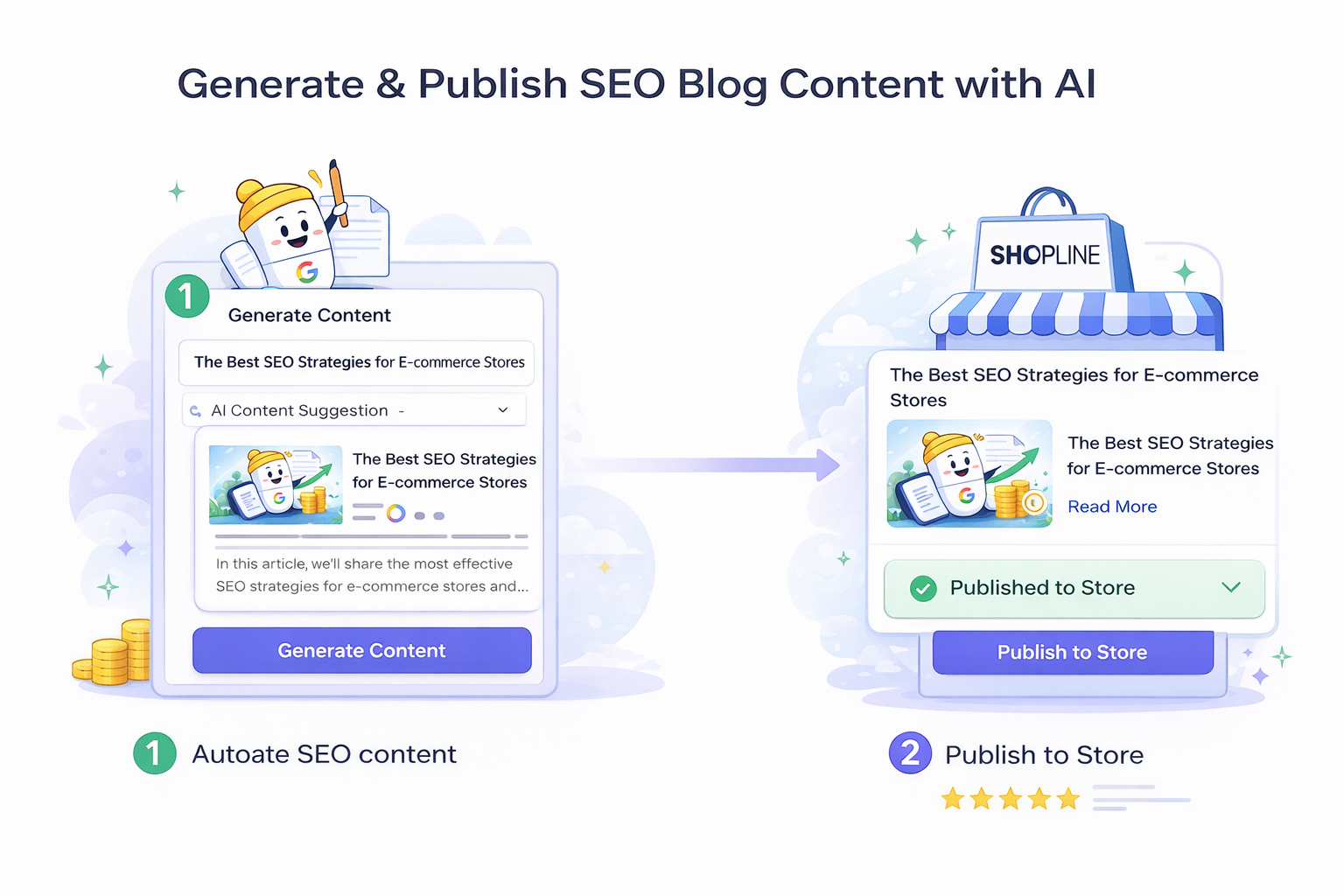
The core of the Generate stage is scalability and consistency. Manual writing cannot solve the scale problem. We began looking for tools that could batch-convert “discovered” topics into drafts. The key here is not to pursue “perfect literary quality,” but to ensure information accuracy, clear structure (SEO-friendly), and relevance to products. We tested several solutions and eventually integrated SEONIB into our workflow. Its role is not to replace human editors, but to act as an efficient “draft factory.” We input a batch of keywords or questions filtered from the “Discover” stage, and it can quickly generate article drafts with complete structures and basic SEO elements (like titles, meta descriptions, heading tags).
The Publish & Integrate stage is the final push for traffic conversion. No matter how good the content, if it just sits in the blog without guiding users into the purchase process, it’s futile. We require any automated solution to be able to:
- One-click publishing to SHOPLINE blog: No manual copy-pasting, avoiding errors.
- Automatic insertion of relevant product cards: When an article mentions a certain type of product, the system can automatically link and insert specific product links or collections from the store.
- Maintain brand tone: The generated content needs to be consistent with the overall style of our store in terms of format and tone, not appear abrupt.
Case Study: An SEO Traffic Climb for a Home Goods Store
We’ll use a SHOPLINE store selling creative home goods as an example to record data changes after 90 days of launching AI blog automation.
Days 1-30: Launch and Testing
- Actions: By analyzing competitor blogs and Google’s “People Also Ask,” we compiled about 150 long-tail keywords and questions related to “small space storage,” “kitchen gadgets,” and “home goods that enhance happiness.” These were imported into SEONIB, with settings to automatically generate and publish 5 articles per week.
- Challenges: Some of the initial content generated was too general and lacked precise product relevance. We added “product keywords” as an additional input during generation and set up content outline templates (e.g., “Problem Scenario - Solution - Product Recommendation - Usage Tips”).
- Early Data: By the end of the first month, approximately 20 articles were published, 15 were indexed by Google, but there were almost no clicks. This is normal; search engines require an observation period.
Days 31-60: Optimization and Initial Results
- Actions: Based on the few keywords that showed impressions, we fine-tuned the content direction. Simultaneously, we enabled the “Hot Topic Capture” feature, allowing the system to automatically scan emerging topics on social media (like Pinterest, Instagram) (e.g., “#cottagecore decor”) and generate related blogs.
- Turning Point: An article titled “Creative Mother’s Day Home Gift Guide,” generated from a Mother’s Day hot topic, began receiving stable traffic in its third week after publication. The article embedded several of our related products, bringing in the first batch of visitors who entered product pages through the blog.
- Data Changes: Monthly organic search traffic increased from single digits to about 200 visits, generating 3 directly traceable orders.
Days 61-90: Scaling and Stable Inflow
- Actions: After verifying the model’s feasibility, we increased the automatic publishing frequency to one article per day. We also utilized the batch generation feature to create 30 in-depth articles for a core category (e.g., “Creative Lighting”) at once, building a content cluster.
- Results: The site’s indexed pages exceeded 100, with daily organic search traffic stabilizing at 50-100 visits. More importantly, the click-through rate of products on blog pages (the proportion of clicks on in-article product links) reached 8%, significantly higher than regular display ads.
- Core Insight: Traffic is not evenly distributed. 80% of traffic is concentrated on 20% of articles, but these “hit” articles are unpredictable. The value of an automated system lies in using enough “content bullets” to cover a wider range, increasing the probability of hitting “hits.”
Pitfalls to Avoid and Important Trade-offs
Even with automated tools, the following pitfalls still require vigilance:
- Risk of Content Homogenization: AI generates content based on public information. If all competitors use similar prompts and keywords, the content may become highly similar. Our solution: Mix and match multiple content sources (keywords + hot topics + reference links), and on top of the generated drafts, add our unique product usage cases, real customer reviews, and other “exclusive information.”
- SEO is More Than Just Content: Generating and publishing articles doesn’t guarantee ranking. Page loading speed, website structure, and internal/external link building are equally important. Automation solves the “presence of content” issue, but “content competitiveness” requires comprehensive optimization.
- The Misconception of “Set It and Forget It”: Automation is not a fully automatic magic trick. You still need to regularly check the quality of generated content, monitor the ranking changes of core pages, and adjust your “Discover” strategy (keyword lists, hot topic sources, etc.) based on data feedback. This is a cycle that requires continuous optimization.
- Balancing with Brand Voice: Initial generated content may sound a bit mechanical. Define some brand keywords and tone guidelines to input into the system, allowing the generated content to gradually approach your brand style. For very important pages (like core category pages), manual refinement is still necessary.
Future Outlook: From Traffic Acquisition to User Insight
Currently, this automated system primarily addresses the “acquisition” problem. Next, we are exploring how to deepen its capabilities:
- Content Personalization: Can we recommend more relevant products in the next generated article based on the user’s previous article visit?
- User Intent Analysis: By analyzing which articles lead to higher conversion rates, we can infer users’ deeper needs and guide product selection and product page optimization.
- Simultaneous Conquest of Multilingual Markets: Utilize the tool’s multilingual generation capabilities to create localized content for different language markets simultaneously, rather than relying solely on translation.
For independent store sellers with limited resources, building a “self-operating” SEO content engine is no longer an option, but a necessity for survival and development. The key is not to pursue cutting-edge technology, but to standardize and automate the “Discover-Generate-Publish” cycle, and to focus the saved energy on strategic judgment and brand building that only humans can accomplish.
FAQ
Q: I don’t have a content team and operate the store alone. Is this automated solution suitable for me? A: This is precisely where the automated solution shines. It can free you from the burden of content writing. The initial work you need to invest is: spend a few hours researching and listing core keywords and user questions related to your products. The subsequent continuous work mainly involves observing data and adjusting this list, rather than writing articles every day.
Q: Will automatically generated content be penalized by Google? A: Google opposes “spam content,” which is content that is valueless, purely for keyword stuffing, and designed to deceive search engines. If your automated process generates useful information based on real user search intent, integrates product information well, and provides a good user experience, then it will not only be unpunished but is actually encouraged by Google. The key lies in the quality and relevance of the content, not whether it was generated by AI.
Q: Do I need to be an SEO expert to set it up? A: No. These types of tools are designed to lower the technical barrier to SEO. You don’t need to understand details like how to set up TDK or H tags. What you need to understand is who your customers are, what questions they will search for, and how your products solve these problems. Input this business understanding into the system, and the technical optimization tools will handle it for you.
Q: How can generated blogs effectively promote sales? A: The key is “contextual relevance.” Ensure that the topic of the generated article is highly relevant to your products, and at natural points within the article (e.g., when introducing a solution to a problem), insert specific product cards or links. Visitors, while reading about solutions to their problems, see products that can precisely solve them, creating a very short conversion path with stronger intent.
Q: How long does it typically take to see traffic results from the start? A: It usually requires 1-3 months of patience. The first month is mainly for content accumulation and indexing, with very little traffic. Starting in the second month, some content may begin to gain initial rankings and clicks. In the third month and beyond, as content volume expands and some pages accumulate authority, traffic will enter a more stable growth channel. SEO is a marathon, and automation allows you to run the entire course more easily.