SHOPLINE Seller's Experience: How I Used a "Lazy" Tool to Boost Organic Traffic by 200% in 30 Days
Late last year, staring at the traffic reports in my SHOPLINE backend, I felt a chill. Ad costs were rising daily, yet conversion rates remained stubbornly stagnant – unmoving. Once paid traffic stopped, my store seemed to enter silent mode. I knew it was time to bet on organic search. But a problem arose: I’m in the home goods category, with a team of just two people. Where would I find the time and expertise for SEO? Writing blog posts? Researching keywords? It sounded like asking me to build a rocket.
I tried some so-called “AI writing tools” on the market. The content they generated was either empty platitudes or completely irrelevant to my products. Anything I published vanished without a trace. I didn’t just need a writer; I needed a system that understood “what kind of content e-commerce needs.” It had to automatically find opportunities, generate articles that were genuinely useful to users and favored by search engines, and ideally, be able to publish them directly to my SHOPLINE store’s blog.
Until, with a “last resort” mindset, I integrated SEONIB into my workflow. Throughout the process, I felt more like an observer and tuner than a content producer. The results surprised this SEO novice: 30 days later, organic search traffic increased by 207%. This wasn’t magic, but the inevitable outcome of a series of missteps and adjustments.
The Starting Point: What Should We Actually Write About? From “Self-Indulgence” to “Search-Driven”
Initially, like most sellers, I thought about writing how great my products were and how exquisite their craftsmanship. But this was essentially a product manual, not the content search engines were looking for, nor the questions potential customers would search for before buying.
SEONIB’s first impact on me was its “information source” perspective. I could input core keywords (like “memory foam pillow”), but its more crucial function was its ability to capture “People Also Ask” questions. This directly addressed my pain point of “not knowing what users care about.” I no longer had to guess; the system directly presented me with a list of real search intents:
- “Are memory foam pillows good for the neck?”
- “How often do memory foam pillows need to be replaced?”
- “Which is better, memory foam or latex pillows?”
These were the questions users genuinely searched for and hoped to get answers to before placing an order. My content strategy immediately shifted from “talking about my products” to “answering common industry questions.” My store’s blog was no longer just an auxiliary promotional space, but a knowledge base for “pillow buying guides.”
The Scalability Trap: 100 Bad Articles Are Worse Than 10 Good Ones
Seeing that I could generate content in bulk, I was initially excited and set a frequency of publishing 5 articles per day. But I soon discovered a problem: while the quantity increased, some articles lacked depth, merely reassembling online information with mediocre readability. Traffic saw a slight increase, but dwell time was very short, let alone conversions.
I realized that full automation doesn’t mean complete laissez-faire. I adjusted my strategy:
- Curate Information Sources: I stopped casting a wide net and focused on PAA questions that were strongly related to my core product line (pillows, mattresses) and were of medium to high complexity. Overly simple questions (like “What is memory foam?”) faced fierce competition and had low value; overly complex questions (like “The chemical synthesis process of memory foam”) had low search volume.
- Manual Intervention for the “Opening”: SEONIB generated articles with complete structures, but the introductions were sometimes not engaging enough. I developed a habit: before publishing each article, I would spend 2 minutes rewriting the first paragraph of the introduction, starting with a more relatable, empathetic scenario (e.g., “Do you often wake up with a stiff neck?”). This significantly improved click-through rates and reading completion rates.
- Internal Linking is Key: This is something many sellers overlook. At the bottom of each article about “how to choose a pillow,” I would manually add links to specific pillows in my store, along with a brief explanation of why my product perfectly addressed the problem mentioned in the article. This created a smooth traffic flow path from “general demand content” to “specific product pages,” rather than a jarring advertisement.
Integration with SHOPLINE: Publishing as Easy as Posting on WeChat Moments
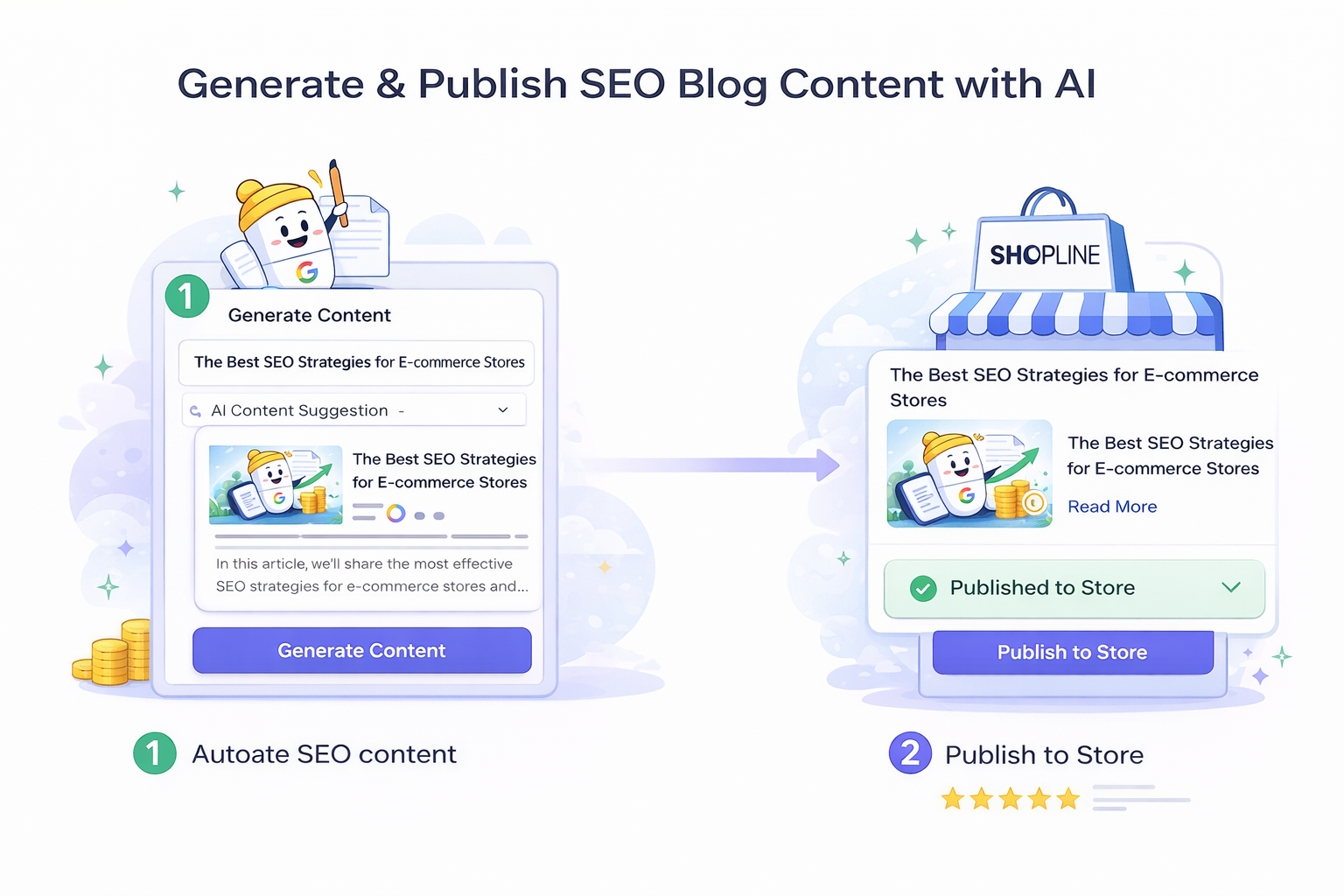
Technical integration was my biggest concern. I feared needing to understand code or deal with APIs. But SEONIB’s connection with SHOPLINE was astonishingly simple. It basically involved authorizing the connection to my SHOPLINE store in the SEONIB backend, and then, much like setting up a scheduled email, I could choose the publishing frequency and corresponding blog category.
The real value lay in establishing an “automated workflow.” Once I set the rules (e.g., daily at 10 AM, automatically generate and publish an article based on the “mattress buying guide” keyword library), it ran silently in the background. I could even see articles appearing on my store’s blog on time while I was on a business trip. This feeling of “content assets” accumulating automatically greatly alleviated my traffic anxiety. I no longer had to agonize over “what to post today” and could instead focus my energy on optimizing product detail pages and customer service.
The Traffic Growth Curve: Patience is More Important Than Passion
Growth isn’t a straight line. The first week, there was almost no movement, and indexing was very slow. I even doubted if I was wasting my time again. But by mid-second week, I started seeing sporadic clicks in Google Search Console from long-tail keywords, such as “low back pain mattress topper recommendation.”
By the third and fourth weeks, miracles happened. These early articles, answering specific questions, began to empower each other, forming small content clusters. Search engines seemed to recognize my website’s authority and content breadth in the “home sleep” theme, and began giving better rankings to higher-frequency, more commercially valuable keywords. The traffic curve began to steepen dramatically.
In the final retrospective, this 200% growth primarily came from two parts: 70% from the continuous, stable trickle of dozens of long-tail keywords; and the remaining 30% from improved rankings for a few core category terms (e.g., moving from page 20 to page 5). This was clearly the result of increased content depth and overall website trust.
Some Counter-Intuitive Insights
- Don’t Chase “Viral Hits”: For e-commerce independent sites, a stable traffic base composed of hundreds of long-tail keywords is far more valuable than a “viral article” that suddenly becomes popular but doesn’t convert. This traffic has clear intent and a short conversion path.
- Content is Not a Cost, It’s an Asset: Once paid advertising stops, traffic drops to zero. But once these SEO articles rank, they can bring in free traffic for months or even years to come. They are your store’s “digital real estate.”
- Trust Transfer: When a user arrives at your store through an article that solves their actual problem, their initial trust in your brand is far higher than that of a user who clicked through from an ad banner. This trust directly translates into add-to-cart rates and inquiry quality.
Now, SEONIB continues to run automatically in my backend. My role has shifted from a content creator to a strategy maker and performance optimizer. The tool solves the “whether” and “how fast” problems, while my business judgment determines “how accurate” and “how good” the content is. For SHOPLINE sellers with limited resources, this combination might be one of the most efficient ways to leverage organic traffic today.
FAQ
Q1: I have no SEO background, can I use this type of tool effectively? A: This is precisely where the value of such tools lies. They lower the operational threshold for SEO. You don’t need to understand technical details, but you do need basic business and user insight to determine which topics are relevant to your products and can attract potential customers. The tool handles execution; you handle decision-making.
Q2: Will automatically generated content be penalized by Google? A: The key lies in content quality, not whether it’s AI-generated. The strategy I use is: the generated content must revolve around real user search intents (through PAA questions), provide clear structure and complete information, and undergo my manual refinement and product association. Google penalizes low-quality, plagiarized, keyword-stuffed garbage content, not all AI-assisted content.
Q3: How long will it take to see results? A: Please be prepared for at least 2-4 weeks. Search engines need time to discover, crawl, index, and evaluate your new content. Slow initial growth is normal; it’s a process of accumulating “trust.” Never give up after just one or two weeks without results.
Q4: Besides the blog, where else can this content be used? A: Of course. A well-structured blog post’s core Q&A can be adapted into the FAQ section of product detail pages, broken down into social media material (like Instagram posts or TikTok scripts), and even used as content for email marketing. One investment, multiple outputs.
Q5: Do I need to spend a lot of time on it every day? A: During the initial setup phase (determining keywords, categories, publishing frequency), it might require a concentrated effort of a few hours. Once the automated workflow is running, I only need to spend 10-15 minutes daily checking the generated article titles and introductions, and ensuring internal links are added correctly. Most of the time, it’s “zero maintenance.”