
I hired an AI to write my blog, and it turned out to be more hardworking than me
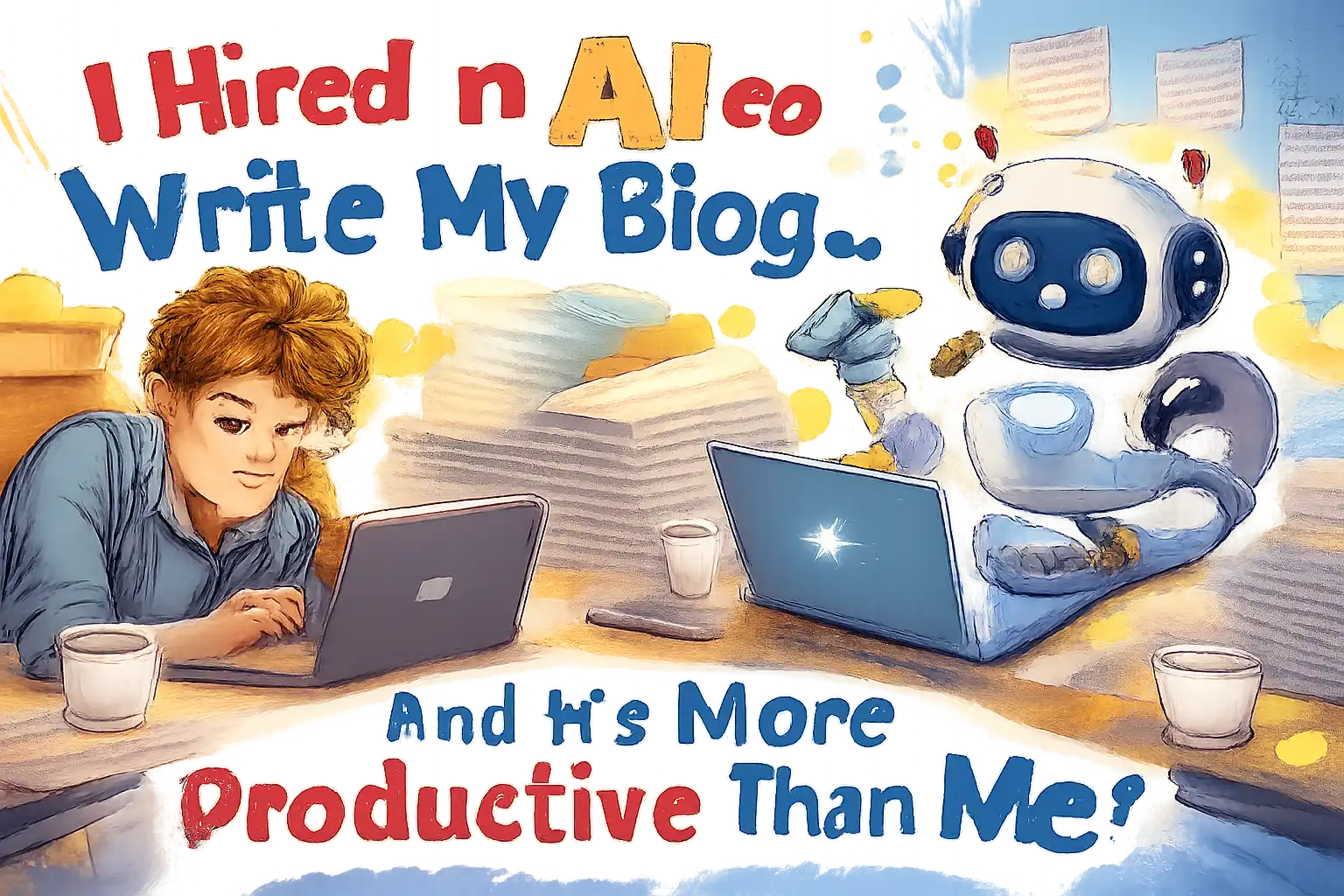
I admit that one of the goals I set at the beginning of the year was “publish three blog posts per week.” By February that goal had already turned into “publishing one post per month is fine”—and then in March I almost didn’t manage to push out even that one.
It’s not that I don’t want to write. I truly can’t keep up.
Every day I start by spending half an hour scrolling through various industry forums and social media, trying to figure out “what should I write today.” Then I open ChatGPT, input a prompt, and wait for it to spit out a draft that looks okay at first glance but needs major revisions upon closer inspection. After that I manually insert images, adjust formatting, fill in SEO meta descriptions, and check internal links—running through this whole process, a decent article from idea to publication easily takes four to five hours. And you have to know that I also have a SaaS product to iterate, customers to reply to, and bugs to fix.
This isn’t creation; it’s a production line—an absurdly inefficient one at that.
What makes it even more hopeless is that after you finally publish the article, you still have to manually distribute it across platforms. One copy on Medium, another on LinkedIn, another to the email list. If, like me, you maintain three or four channels, each publication becomes a small logistical nightmare. In that moment you get a surreal feeling: you’re an entrepreneur, but your most important daily task is copy‑and‑paste.
The truth about the content pipeline: most people’s bottleneck isn’t quality, it’s stamina
Many people think the biggest challenge in content marketing is “can’t produce high‑quality material.” But based on my real experience over the past year, what actually kills a content plan is never quality—it’s consistency.
You can spend three days writing a groundbreaking long‑form piece. But what about day four? Day five? When your energy is split among product development, customer support, and team management, that “one post every three days” schedule collapses into “one post every two weeks,” and then into “whatever mood I’m in.”
AI writing tools solve part of the problem—they do help you generate a draft quickly. But they don’t solve the cumbersome publishing workflow: generate → copy → paste → format → add images → SEO tweak → distribute across platforms. Each step in that workflow drains your willpower, and willpower is the scarcest resource in a startup.
I’ve tried various approaches. I set up simple automations with Zapier, but every time I switched platforms I had to re‑engineer the API connections. I outsourced to freelancers, but quality control became a new time‑sink. Ultimately I realized the core issue isn’t “whether someone writes,” but “whether the entire pipeline is automated.”
Generating content with AI isn’t hard. The hard part is making the whole process—from generation to publication—so that you never have to sit at a computer to perform any step.
From “I do it” to “it runs by itself”
The turning point came at a completely random moment. I was researching a competitor’s content strategy and happened to click on a tool for blog automation pipelines. Honestly, I didn’t have high expectations—there are so many “AI‑writes‑articles” tools on the market that I have at least three unused accounts gathering in a drawer.
What kept me there was the way it handled the publishing workflow. Most AI writing tools only write; they hand you the text and that’s it. This one, however, hooks in from the other end of content production: from trend discovery to multi‑platform publishing, with no human intervention required.
Three weeks ago I set up a blank test site to do a real‑world comparison. On one side I kept my manual + ChatGPT process; on the other side I handed everything over to the automated pipeline.
The first week’s results made it hard for me to stay still. Manually, I spent about six hours producing three articles and publishing them to a single platform. With automation, after setting a daily publishing frequency, it generated seven articles in seven days and simultaneously pushed them to my WordPress site and Medium. It even added images and filled in SEO meta descriptions on its own.
That feeling is hard to describe—part panic that your job is being taken, part relief that a weight has been lifted.
The “delicious” law of scheduled publishing
Honestly, the feature that made me completely abandon the manual workflow was the scheduled publishing function.
It sounds like a tiny thing, right? Just set a time and let the system send it out. In my previous workflow, “scheduled publishing” was never truly scheduled. I had to write the article, save it as a draft, set the schedule, and pray the server wouldn’t glitch at that moment—actually, it did glitch a few times, causing a post that should have gone out at 10 am on Friday to be delayed until Saturday afternoon.
In this automated pipeline, scheduled publishing is truly “set once, run forever.” I set it to publish every Monday, Wednesday, and Friday at 2 pm, and it pushed the posts out exactly at those times. It ran for three consecutive weeks without a single miss.
It’s not a groundbreaking technical breakthrough, but when you move from “thinking about publishing every day” to “the system does it for you,” the reduction in mental load is very real. You start to realize that the saved “operational time” isn’t the biggest gain—the real gain is that you no longer have to keep that task in your head.
Multilingual content is more valuable than you think
Another surprising aspect was multilingual generation.
I run a global SaaS with users in English, Japanese, and Spanish markets. Previously, producing multilingual content meant either paying for translators or using DeepL article by article and then manually tweaking—both approaches were costly, so I stuck to English only.
One of the native capabilities of this automated pipeline is that the same article can be output in multiple language versions directly. In the first test I generated English and Japanese versions simultaneously and compared the Japanese quality—it wasn’t perfect Japanese prose, but for SEO content it was far better than I expected. Those “good enough” pieces still captured search traffic in the Japanese market.
Honestly, I’m still not sure how stable it is for niche languages. But one thing is certain: even if multilingual versions only bring a 30 % traffic lift, that 30 % costs virtually nothing. For a resource‑constrained SaaS, such marginal returns are hard to ignore.
An unsettling but undeniable conclusion
Writing this article, I realized that the first draft was also produced by the automated pipeline—of course I made extensive edits and added my own experiences and observations. Still, it saved me the most painful part of going from “zero” to “draft.”
That makes me wonder: if your content marketing can be automated, what is its intrinsic value?
My current answer is: the value of an automated pipeline isn’t to replace your thinking, but to free your thinking from tedious execution. You still need to set the content strategy, define brand tone, and inject real experience and viewpoints into key topics. But you no longer have to waste energy on “copy‑and‑paste to which platform” tasks that add no value.
By the way, after the test site ran for three weeks, its organic search traffic already surpassed that of my main site—even though the main site has been live for two years. I’m not trying to over‑interpret the data, but it does make me a bit uncomfortable.
FAQ
Is this automation tool suitable for all types of blog content?
It works well for news, tutorials, and SEO long‑tail content, but it may not be ideal for brand pieces that require deep analysis or unique viewpoints. My usual approach is to let the pipeline handle basic SEO content while reserving in‑depth, opinion‑driven articles for human writers.
Do I need to know programming to set up the automation pipeline?
Not at all. When I set up the test site, it took me less than half an hour from registration to publishing the first piece of content. All you need to do is choose the platforms you want to publish to (e.g., WordPress or Shopify), grant access, and then set the publishing frequency and source topics.
How effective is multilingual content in practice?
Results vary by language. English and Japanese performed better than expected, while some niche languages still need manual fine‑tuning. The key point is that even if only a subset of languages generate traffic, that extra traffic comes at virtually zero cost, which is always a win.
Share Article